- ES Español (Latinoamérica)

- EN English

7.91. Ports (Mandatory)
- Semester: 10th Sem. Credits: 4
- Hour of this course: Theory: 3 hours; Practice: 2 hours;
- Syllabus:
- htmlonly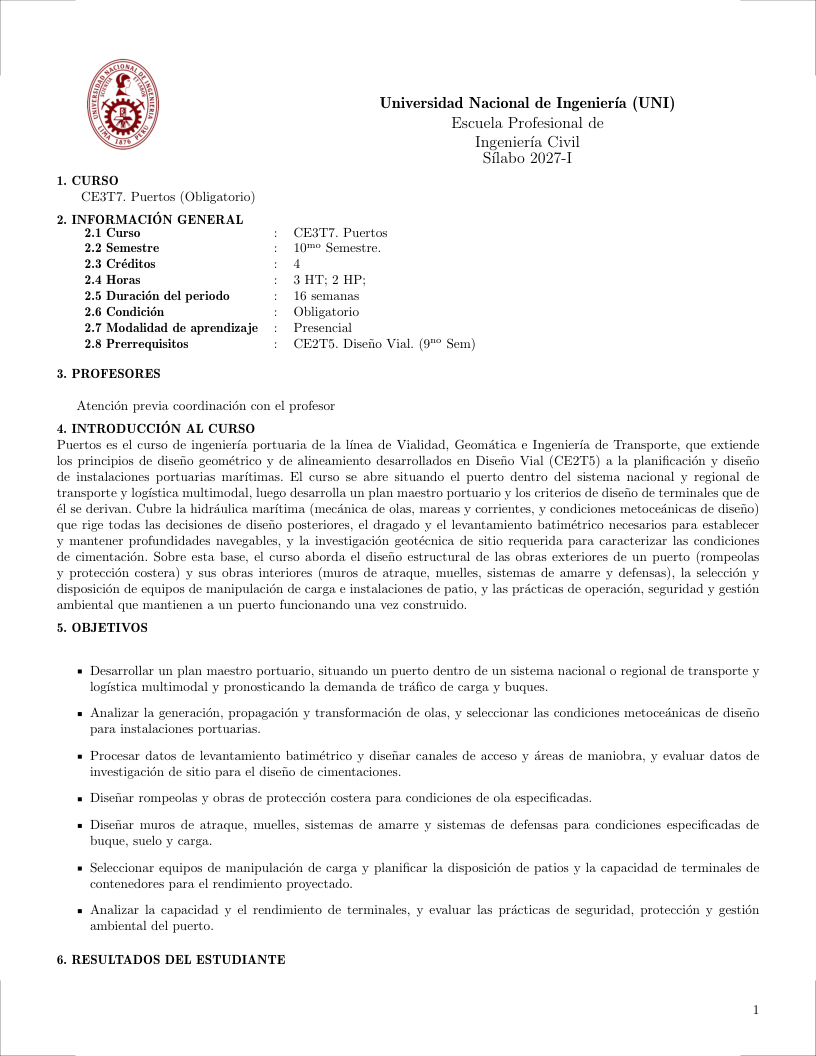
 Español (Latinoamérica)
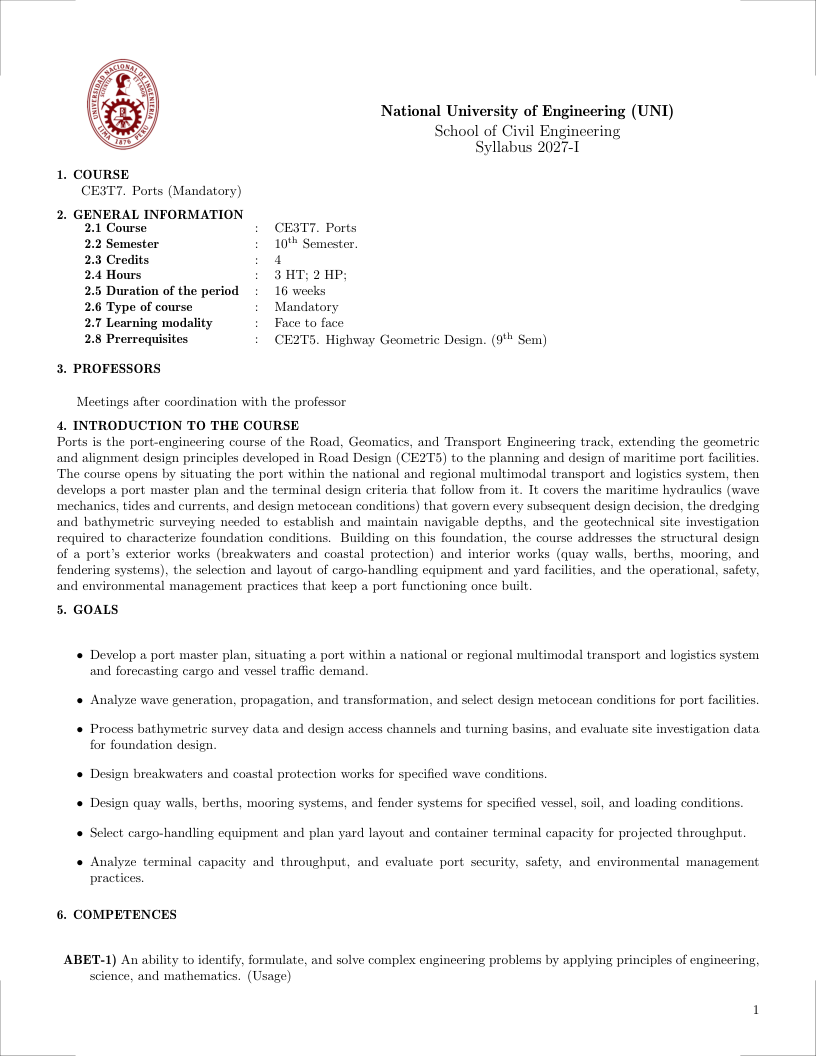 English
- Prerrequisites:
- CE2T5 Highway Geometric Design (9th Sem)
7.91.1. Justification ↑ Back to top
Ports is the port-engineering course of the Road, Geomatics, and Transport Engineering track, extending the geometric and alignment design principles developed in Road Design (CE2T5) to the planning and design of maritime port facilities. The course opens by situating the port within the national and regional multimodal transport and logistics system, then develops a port master plan and the terminal design criteria that follow from it. It covers the maritime hydraulics (wave mechanics, tides and currents, and design metocean conditions) that govern every subsequent design decision, the dredging and bathymetric surveying needed to establish and maintain navigable depths, and the geotechnical site investigation required to characterize foundation conditions. Building on this foundation, the course addresses the structural design of a port's exterior works (breakwaters and coastal protection) and interior works (quay walls, berths, mooring, and fendering systems), the selection and layout of cargo-handling equipment and yard facilities, and the operational, safety, and environmental management practices that keep a port functioning once built.
7.91.2. Generales Goals ↑ Back to top
- Develop a port master plan, situating a port within a national or regional multimodal transport and logistics system and forecasting cargo and vessel traffic demand.
- Analyze wave generation, propagation, and transformation, and select design metocean conditions for port facilities.
- Process bathymetric survey data and design access channels and turning basins, and evaluate site investigation data for foundation design.
- Design breakwaters and coastal protection works for specified wave conditions.
- Design quay walls, berths, mooring systems, and fender systems for specified vessel, soil, and loading conditions.
- Select cargo-handling equipment and plan yard layout and container terminal capacity for projected throughput.
- Analyze terminal capacity and throughput, and evaluate port security, safety, and environmental management practices.
7.91.3. Contribution to Outcomes ↑ Back to top
- ABET-1) An ability to identify, formulate, and solve complex engineering problems by applying principles of engineering, science, and mathematics. (Usage)
- ABET-2) An ability to apply engineering design to produce solutions that meet specified needs with consideration of public health, safety, and welfare, as well as global, cultural, social, environmental, and economic factors. (Usage)
- ABET-6) An ability to develop and conduct appropriate experimentation, analyze and interpret data, and use engineering judgment to draw conclusions. (Usage)
7.91.4. Content ↑ Back to top
7.91.4.1. Port Planning (14 hours) [Skills ABET-1,ABET-2] ↑ Back to top
Bibliography: (Tsinker, 2004; Agerschou et al., 2004)
Topics
- Port master planning process
- Site selection criteria for port development
- Port system planning within national and regional logistics networks
- Cargo and vessel traffic demand forecasting
Learning Outcomes
- Develop a port master plan [Usage]
- Evaluate candidate sites for port development [Assessment]
- Describe how a port fits within a national or regional logistics network [Familiarity]
- Forecast cargo and vessel traffic demand [Usage]
7.91.4.2. Maritime Hydraulics for Ports (4 hours) [Skills ABET-1] ↑ Back to top
Bibliography: (U.S. Army Corps of Engineers, 2002)
Topics
- Wave generation, propagation, and transformation analysis
- Tide and current characterization for port design
- Harbor agitation and resonance (seiche) analysis
- Design metocean conditions and return-period selection
Learning Outcomes
- Analyze wave generation, propagation, and transformation at a port site [Usage]
- Characterize tides and currents relevant to port design [Familiarity]
- Assess harbor agitation and resonance risk for a proposed layout [Assessment]
- Select design metocean conditions for a given return period [Usage]
7.91.4.3. Dredging and Bathymetry (2 hours) [Skills ABET-6] ↑ Back to top
Bibliography: (Agerschou et al., 2004; U.S. Army Corps of Engineers, 1983)
Topics
- Access channel and turning basin design
- Dredging equipment and methods selection
- Disposal and beneficial reuse of dredged material
- Bathymetric survey principles and data processing
Learning Outcomes
- Design an access channel and turning basin for a design vessel [Usage]
- Select appropriate dredging equipment and methods for given site conditions [Assessment]
- Evaluate disposal and beneficial reuse options for dredged material [Familiarity]
- Process bathymetric survey data to support channel design [Usage]
7.91.4.4. Breakwater and Coastal Structures (12 hours) [Skills ABET-2] ↑ Back to top
Bibliography: (U.S. Army Corps of Engineers, 2002)
Topics
- Breakwater design fundamentals
- Revetments and shore protection works
- Armor layer stability and unit sizing
- Rubble-mound versus vertical breakwater selection
Learning Outcomes
- Design a breakwater cross-section for specified wave conditions [Usage]
- Describe revetment and shore protection alternatives [Familiarity]
- Size armor layer units for hydraulic stability [Usage]
- Select between rubble-mound and vertical breakwater types for a given site [Assessment]
7.91.4.5. Berth and Quay Design (16 hours) [Skills ABET-2,ABET-6] ↑ Back to top
Bibliography: (Thoresen, 2018)
Topics
- Quay wall design (gravity, sheet pile, and piled structures)
- Berth dimensioning for design vessel classes
- Mooring systems and bollard layout
- Fender system selection and energy absorption design
Learning Outcomes
- Design a quay wall for specified soil and loading conditions [Assessment]
- Dimension a berth for a design vessel class [Usage]
- Lay out a mooring system and bollard arrangement [Usage]
- Specify a fender system based on berthing energy absorption requirements [Assessment]
7.91.4.6. Cargo Handling and Yard Design (4 hours) [Skills ABET-2] ↑ Back to top
Bibliography: (Thoresen, 2018)
Topics
- Cargo handling equipment (ship-to-shore cranes, yard cranes, conveyors)
- Yard layout and storage capacity planning
- Container terminal design and throughput sizing
- Bulk and break-bulk cargo facility design
Learning Outcomes
- Select cargo handling equipment appropriate to a given cargo type [Familiarity]
- Plan yard layout and storage capacity for projected throughput [Usage]
- Size a container terminal for projected throughput [Usage]
- Describe design requirements for bulk and break-bulk cargo facilities [Familiarity]
7.91.4.7. Port Operations, Safety, and Environmental Management (4 hours) [Skills ABET-6] ↑ Back to top
Bibliography: (Tsinker, 2004)
Topics
- Terminal capacity and throughput analysis
- Intermodal integration with inland logistics chains
- Port facility security under the ISPS Code
- Port environmental management and sustainability
Learning Outcomes
- Analyze terminal capacity and throughput [Assessment]
- Describe intermodal integration with inland logistics chains [Familiarity]
- Explain port facility security requirements under the ISPS Code [Familiarity]
- Assess port environmental management and sustainability practices [Assessment]
7.91.5. Bibliography ↑ Back to top
Tsinker, G. P. (2004). Port Engineering: Planning, Construction, Maintenance, and Security. Wiley.
Agerschou, H. et al. (2004). Planning and Design of Ports and Marine Terminals. Thomas Telford, 2nd edition.
U.S. Army Corps of Engineers (2002). Coastal engineering manual. Technical Report EM 1110-2-1100, U.S. Army Corps of Engineers.
U.S. Army Corps of Engineers (1983). Hydraulic design of deep-draft navigation projects. Technical Report EM 1110-2-1613, U.S. Army Corps of Engineers.
Thoresen, C. A. (2018). Port Designer's Handbook. ICE Publishing, 4th edition.