- ES Español (Latinoamérica)

- EN English

7.59. Professional Competencies Workshop - Transportation (Mandatory)
- Semester: 8th Sem. Credits: 4
- Hour of this course: Theory: 3 hours; Practice: 2 hours;
- Syllabus:
- htmlonly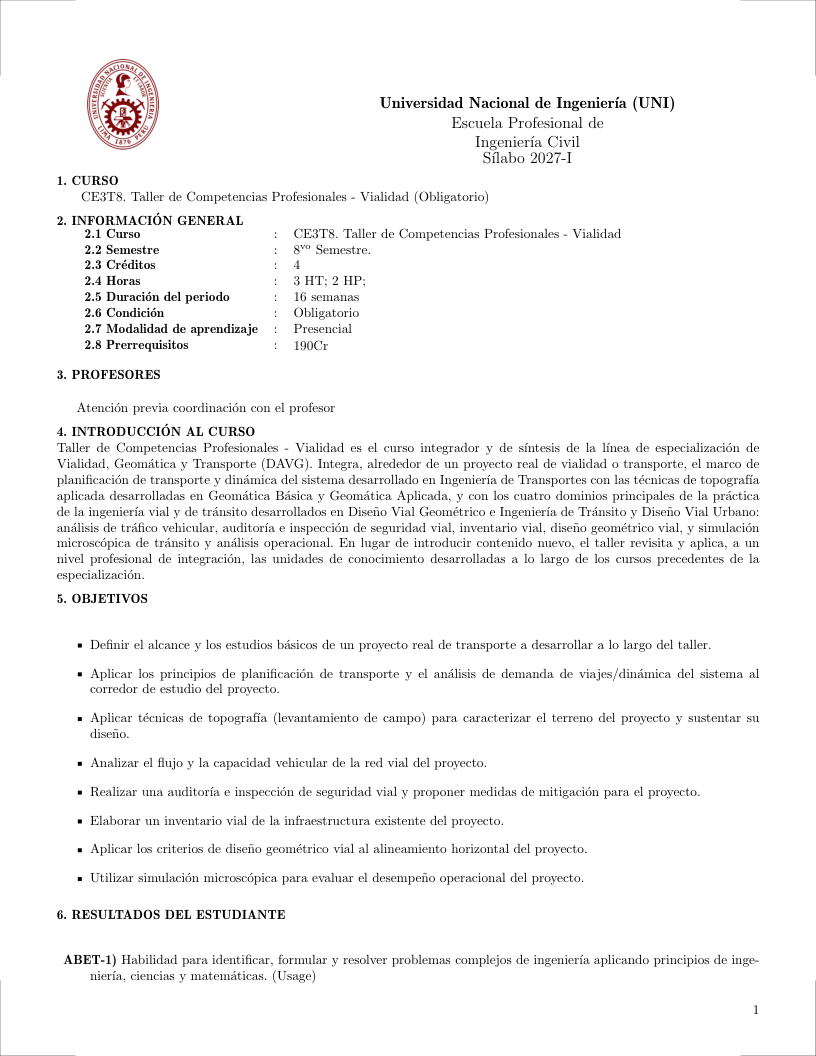
 Español (Latinoamérica)
 English
- Prerrequisites:
- 190Cr
7.59.1. Justification ↑ Back to top
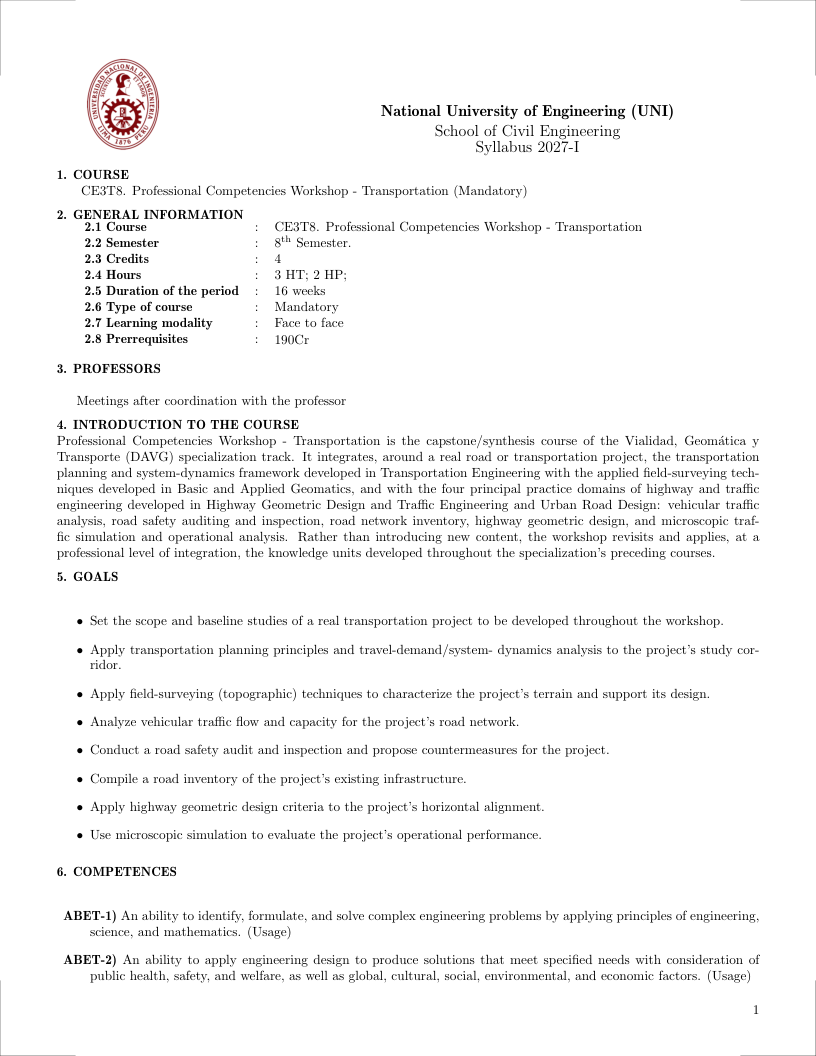
Professional Competencies Workshop - Transportation is the capstone/synthesis course of the Vialidad, Geomática y Transporte (DAVG) specialization track. It integrates, around a real road or transportation project, the transportation planning and system-dynamics framework developed in Transportation Engineering with the applied field-surveying techniques developed in Basic and Applied Geomatics, and with the four principal practice domains of highway and traffic engineering developed in Highway Geometric Design and Traffic Engineering and Urban Road Design: vehicular traffic analysis, road safety auditing and inspection, road network inventory, highway geometric design, and microscopic traffic simulation and operational analysis. Rather than introducing new content, the workshop revisits and applies, at a professional level of integration, the knowledge units developed throughout the specialization's preceding courses.
7.59.2. Generales Goals ↑ Back to top
- Set the scope and baseline studies of a real transportation project to be developed throughout the workshop.
- Apply transportation planning principles and travel-demand/system- dynamics analysis to the project's study corridor.
- Apply field-surveying (topographic) techniques to characterize the project's terrain and support its design.
- Analyze vehicular traffic flow and capacity for the project's road network.
- Conduct a road safety audit and inspection and propose countermeasures for the project.
- Compile a road inventory of the project's existing infrastructure.
- Apply highway geometric design criteria to the project's horizontal alignment.
- Use microscopic simulation to evaluate the project's operational performance.
7.59.3. Contribution to Outcomes ↑ Back to top
- ABET-1) An ability to identify, formulate, and solve complex engineering problems by applying principles of engineering, science, and mathematics. (Usage)
- ABET-2) An ability to apply engineering design to produce solutions that meet specified needs with consideration of public health, safety, and welfare, as well as global, cultural, social, environmental, and economic factors. (Usage)
- ABET-6) An ability to develop and conduct appropriate experimentation, analyze and interpret data, and use engineering judgment to draw conclusions. (Usage)
7.59.4. Content ↑ Back to top
7.59.4.1. Transportation Planning and Economics (15 hours) [Skills ABET-1] ↑ Back to top
Bibliography: (de Dios Ortúzar and Willumsen, 2011)
Topics
- Transportation planning process and institutional framework
- Travel demand modeling and forecasting methods
- Four-step travel demand model
- Data collection methods for transportation planning
- Economic evaluation and benefit-cost analysis
- Activity-based modeling and advanced forecasting techniques
- Multimodal transportation planning and integration
- Sustainable transportation and environmental considerations
- Public participation and stakeholder engagement
- Performance measures and system monitoring
Learning Outcomes
- Explain the transportation planning process and institutional relationships [Familiarity]
- Apply travel demand forecasting methods to predict future travel patterns [Assessment]
- Implement the four-step travel demand model for regional analysis [Usage]
- Design data collection programs for transportation studies [Assessment]
- Conduct benefit-cost analysis for transportation projects [Usage]
- Utilize activity-based models for advanced travel demand analysis [Assessment]
- Develop integrated multimodal transportation plans [Usage]
- Incorporate sustainability principles into transportation planning [Assessment]
- Facilitate public participation processes in transportation planning [Familiarity]
- Establish performance measures and monitoring systems for transportation networks [Assessment]
7.59.4.2. Workshop Project Scope and Baseline Studies (5 hours) [Skills ABET-1] ↑ Back to top
Bibliography: (Mannering and Washburn, 2013)
Topics
- Scope and location of the real road/transportation project to be developed in the workshop, and the general baseline studies (topographic, traffic, and socioeconomic context) that establish its starting conditions.
Learning Outcomes
- Describe the scope, location, and baseline conditions of a real transportation project [Familiarity].
7.59.4.3. Topographic Mapping and Digital Terrain Models (5 hours) [Skills ABET-1,ABET-6] ↑ Back to top
Bibliography: (Ghilani and Wolf, 2015a; Kavanagh, 2019)
Topics
- Contour representation and interpretation of terrain relief
- Digital Terrain Model (DTM) generation from field or GNSS survey data
- Topographic map production and cartographic conventions
Learning Outcomes
- Generate a contour map from field survey data [Usage]
- Build a digital terrain model (DTM) from a point-based topographic survey [Assessment]
7.59.4.4. Traffic Flow Theory and Capacity Analysis (5 hours) [Skills ABET-1] ↑ Back to top
Bibliography: (Roess et al., 2019; Transportation Research Board, 2022)
Topics
- Traffic flow characteristics and fundamental relationships
- Highway capacity analysis using HCM methodology
- Level of service concepts and analysis procedures
- Traffic control devices and MUTCD standards
- Signal timing and phasing design
- Intersection capacity and delay analysis
Learning Outcomes
- Explain traffic flow theory and fundamental traffic stream parameters [Familiarity]
- Perform highway capacity analysis for various facility types [Assessment]
- Determine level of service for transportation facilities [Usage]
- Apply MUTCD standards for traffic control device design and placement [Assessment]
- Design signal timing plans for isolated intersections [Usage]
- Analyze intersection capacity and calculate control delay [Assessment]
7.59.4.5. Road Safety Engineering (10 hours) [Skills ABET-6] ↑ Back to top
Bibliography: (AASHTO, 2010)
Topics
- Crash data analysis and identification of high-risk locations
- Road safety audits and systematic safety reviews
- Vision Zero and the safe systems approach to street design
- Pedestrian and bicycle safety countermeasures
Learning Outcomes
- Analyze crash data to identify high-risk locations and contributing factors [Assessment]
- Conduct a road safety audit for a roadway or intersection [Usage]
- Explain the Vision Zero safe systems approach to street design [Familiarity]
- Recommend pedestrian and bicycle safety countermeasures for a given location [Usage]
7.59.4.6. Traffic Control Devices (10 hours) [Skills ABET-2] ↑ Back to top
Bibliography: (Federal Highway Administration, 2023; Roess et al., 2019)
Topics
- Classification and design of regulatory, warning, and guide signs
- Sign placement, sizing, and retroreflectivity standards
- Pavement marking types, materials, and placement standards
- Traffic signal warrant analysis and justification studies
- Signal phasing, sequencing, and vehicle/pedestrian detection design
- Signal equipment, controllers, and maintenance considerations
Learning Outcomes
- Classify traffic signs according to national/MUTCD-equivalent standards and select the appropriate sign for a given condition [Familiarity]
- Specify sign placement, size, and retroreflectivity per design standards [Usage]
- Design a pavement marking plan for a given roadway section [Assessment]
- Conduct a signal warrant analysis to justify installing a traffic signal [Assessment]
- Design signal phasing and detection layouts for an intersection [Usage]
- Evaluate signal equipment and controller requirements for an installation [Familiarity]
7.59.4.7. Horizontal Alignment Design (10 hours) [Skills ABET-2] ↑ Back to top
Bibliography: (AASHTO, 2018a; Garber and Hoel, 2019)
Topics
- Simple circular curve geometry and layout
- Spiral transition curves and their application
- Superelevation design, rates, and runoff/transition lengths
- Side friction factors and minimum radius determination
- Horizontal sight distance and sight obstructions on curves
- Compound and reverse curve design considerations
Learning Outcomes
- Design simple circular horizontal curves for a given design speed [Usage]
- Apply spiral transition curves where required by design speed and curvature [Assessment]
- Design superelevation rates and transition/runoff lengths for a horizontal curve [Assessment]
- Determine minimum curve radius from side friction and superelevation limits [Usage]
- Verify horizontal sight distance and identify sight obstructions along a curve [Assessment]
- Evaluate compound and reverse curve layouts against design guidance [Familiarity]
7.59.4.8. Traffic Operations and Management (10 hours) [Skills ABET-1,ABET-6] ↑ Back to top
Bibliography: (Roess et al., 2019; Barceló, 2010)
Topics
- Arterial analysis and signal coordination
- Freeway operations and bottleneck analysis
- Traffic simulation and microsimulation modeling
- Incident management and traffic management centers
- Roundabout design and capacity analysis
Learning Outcomes
- Develop coordinated signal systems for arterial corridors [Usage]
- Evaluate freeway performance and identify operational bottlenecks [Assessment]
- Utilize traffic simulation models for complex operational analysis [Usage]
- Implement incident management strategies and traffic management operations [Assessment]
- Design roundabouts and analyze their operational performance [Usage]
7.59.5. Bibliography ↑ Back to top
de Dios Ortúzar, J. and Willumsen, L. G. (2011). Modelling Transport. Wiley, 4th edition.
Mannering, F. L. and Washburn, S. S. (2013). Principles of Highway Engineering and Traffic Analysis. Wiley, 5th edition.
Ghilani, C. D. and Wolf, P. R. (2015a). Elementary Surveying: An Introduction to Geomatics. Pearson, 14th edition.
Kavanagh, B. F. (2019). Surveying: Principles and Applications. Pearson, 10th edition.
Roess, R. P., Prassas, E. S., and McShane, W. R. (2019). Traffic Engineering. Pearson, 5th edition.
Transportation Research Board (2022). Highway capacity manual. Technical report, Transportation Research Board.
AASHTO (2010). Highway Safety Manual. American Association of State Highway and Transportation Officials, 1st edition.
Federal Highway Administration (2023). Manual on Uniform Traffic Control Devices for Streets and Highways. U.S. Department of Transportation, 11th edition.
AASHTO (2018a). A policy on geometric design of highways and streets. Technical report, American Association of State Highway and Transportation Officials.
Garber, N. J. and Hoel, L. A. (2019). Traffic and Highway Engineering. Cengage Learning, 6th edition.
Barceló, J. (2010). Fundamentals of Traffic Simulation. Springer.