- ES Español (Latinoamérica)

- EN English

3.1. CE100 Introduction to Civil Engineering (Mandatory)
- Semester: 1st Sem. Credits: 4
- Hour of this course: Theory: 4 hours;
- Syllabus:
 Español (Latinoamérica)
 English
- Prerrequisites: None
- ES Español (Latinoamérica)
- EN English
3.1.1. Justification Back to top
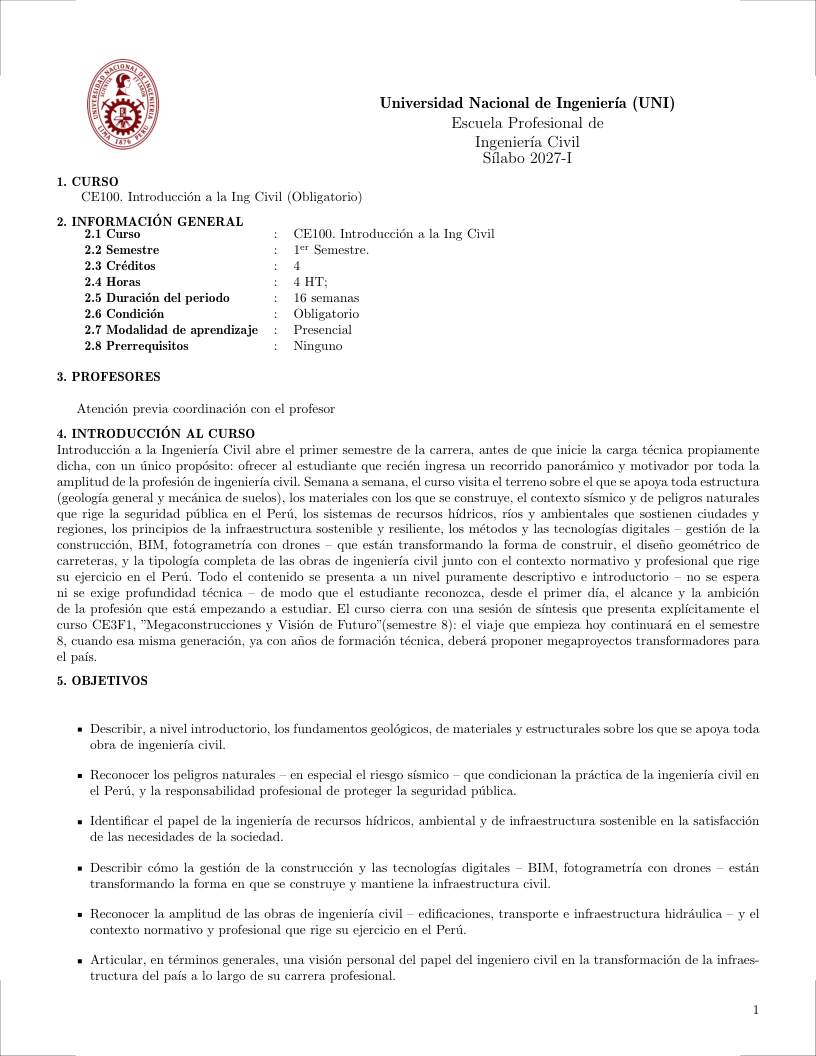
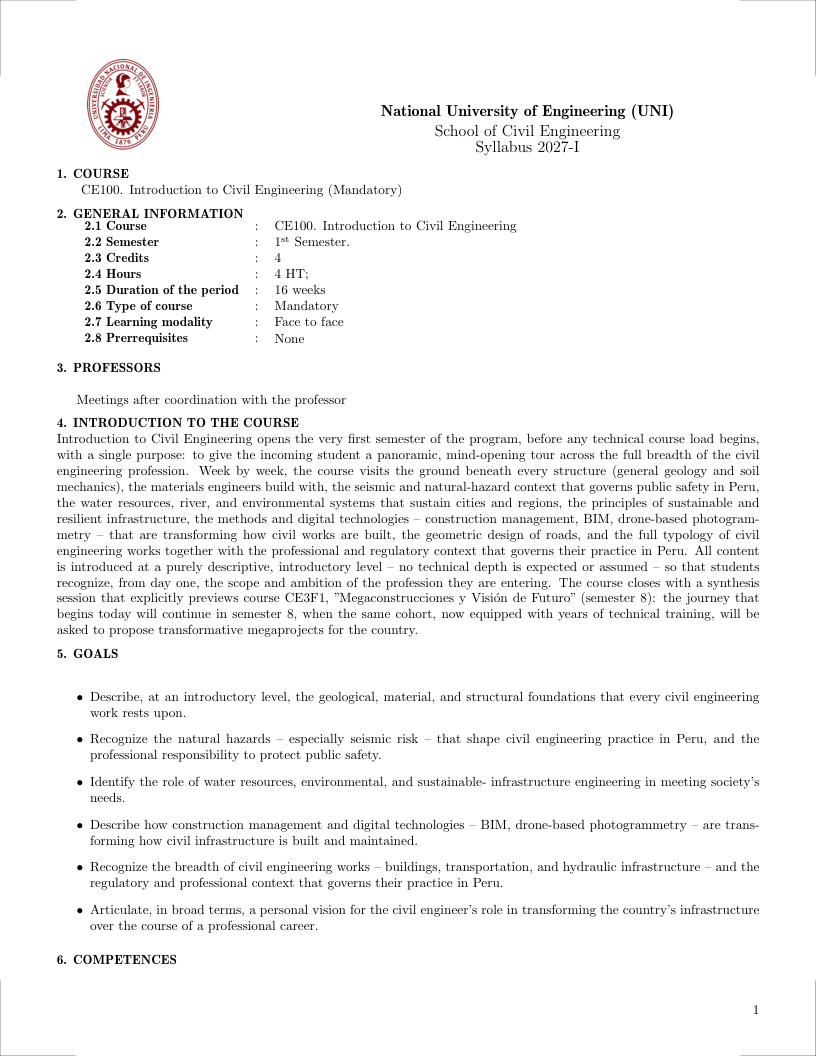
Introduction to Civil Engineering opens the very first semester of the program, before any technical course load begins, with a single purpose: to give the incoming student a panoramic, mind-opening tour across the full breadth of the civil engineering profession. Week by week, the course visits the ground beneath every structure (general geology and soil mechanics), the materials engineers build with, the seismic and natural-hazard context that governs public safety in Peru, the water resources, river, and environmental systems that sustain cities and regions, the principles of sustainable and resilient infrastructure, the methods and digital technologies – construction management, BIM, drone-based photogrammetry – that are transforming how civil works are built, the geometric design of roads, and the full typology of civil engineering works together with the professional and regulatory context that governs their practice in Peru. All content is introduced at a purely descriptive, introductory level – no technical depth is expected or assumed – so that students recognize, from day one, the scope and ambition of the profession they are entering. The course closes with a synthesis session that explicitly previews course CE3F1, "Megaconstrucciones y Visión de Futuro" (semester 8): the journey that begins today will continue in semester 8, when the same cohort, now equipped with years of technical training, will be asked to propose transformative megaprojects for the country.
- ES Español (Latinoamérica)
- EN English
3.1.2. Generales Goals Back to top
- Describe, at an introductory level, the geological, material, and structural foundations that every civil engineering work rests upon.
- Recognize the natural hazards – especially seismic risk – that shape civil engineering practice in Peru, and the professional responsibility to protect public safety.
- Identify the role of water resources, environmental, and sustainable- infrastructure engineering in meeting society's needs.
- Describe how construction management and digital technologies – BIM, drone-based photogrammetry – are transforming how civil infrastructure is built and maintained.
- Recognize the breadth of civil engineering works – buildings, transportation, and hydraulic infrastructure – and the regulatory and professional context that governs their practice in Peru.
- Articulate, in broad terms, a personal vision for the civil engineer's role in transforming the country's infrastructure over the course of a professional career.
- ES Español (Latinoamérica)
- EN English
3.1.3. Contribution to Outcomes Back to top
- ABET-4) An ability to recognize ethical and professional responsibilities in engineering situations and make informed judgments, which must consider the impact of engineering solutions in global, economic, environmental, and societal contexts. (Familiarity)
- ABET-7) An ability to acquire and apply new knowledge as needed, using appropriate learning strategies. (Familiarity)
- ES Español (Latinoamérica)
- EN English
3.1.4. Content Back to top
- ES Español (Latinoamérica)
- EN English
3.1.4.1. Mineralogy (3 hours) [Skills ABET-4,ABET-7] Back to top
Bibliography: (Tarbuck et al., 2014)
Topics
- Crystal structure and habit of minerals
- Main groups of rock-forming minerals: silicates, carbonates, oxides, and sulfates
- Mohs hardness scale and scratch tests
- Cleavage, fracture, and other diagnostic physical properties
- Luster, color, and streak as identification criteria
- Basic chemical composition and reaction with dilute hydrochloric acid
Learning Outcomes
- Identify the most common rock-forming minerals using physical properties [Familiarity]
- Apply the Mohs scale to determine the relative hardness of mineral samples [Usage]
- Distinguish similar minerals through cleavage, fracture, and luster [Assessment]
- Relate the mineral composition of a rock to its expected engineering behavior [Familiarity]
- Perform simple field tests (scratch, acid, luster) for mineral identification [Usage]
- ES Español (Latinoamérica)
- EN English
3.1.4.2. Phase Relationships and Seepage (3 hours) [Skills ABET-4,ABET-7] Back to top
Bibliography: (Das, 2019)
Topics
- Phase relationships and index properties of soils
- Soil classification systems including USCS and AASHTO
- Particle size distribution and Atterberg limits
- Compaction theory and field control methods
- Permeability and Darcy's law
- Seepage analysis and flow nets
- Effective stress principle and pore water pressure
- Capillarity and soil suction
- Frost action and thermal properties of soils
Learning Outcomes
- Calculate phase relationships and derive index properties from laboratory data [Usage]
- Classify soils according to USCS and AASHTO classification systems [Assessment]
- Interpret particle size distribution curves and plasticity charts [Assessment]
- Apply compaction theory to field construction control [Usage]
- Determine soil permeability using laboratory and field methods [Assessment]
- Construct flow nets and calculate seepage quantities [Usage]
- Explain the effective stress principle and its engineering significance [Familiarity]
- Analyze capillary rise and soil suction effects in partially saturated soils [Assessment]
- Evaluate frost susceptibility and design frost protection measures [Familiarity]
- ES Español (Latinoamérica)
- EN English
3.1.4.3. Construction Materials Science (3 hours) [Skills ABET-4,ABET-7] Back to top
Bibliography: (Neville, 2011)
Topics
- Physical and mechanical properties of construction materials including density, porosity, strength, and elasticity
- Microstructure and phase composition of construction materials
- Durability mechanisms including weathering, chemical attack, and environmental degradation
- Thermal and moisture properties of construction materials
- Crystalline and amorphous structures in construction materials
- Material selection criteria based on performance requirements
- Degradation mechanisms and service life prediction
Learning Outcomes
- Describe the fundamental physical and mechanical properties of major construction materials [Familiarity]
- Analyze the relationship between microstructure and macroscopic properties of materials [Assessment]
- Evaluate the durability performance of materials under specific environmental conditions [Usage]
- Explain the effects of thermal and moisture variations on material behavior [Familiarity]
- Select appropriate construction materials based on design specifications and performance criteria [Assessment]
- Predict service life and degradation patterns of materials in various environments [Usage]
- ES Español (Latinoamérica)
- EN English
3.1.4.4. Seismology and Natural Hazards (3 hours) [Skills ABET-4,ABET-7] Back to top
Bibliography: (Bolt, 2005; Kramer, 1996)
Topics
- Plate tectonics and earthquake generation mechanisms through fault rupture
- Seismic waves: types (P, S, surface) and their propagation
- Magnitude (seismic moment) and intensity (Modified Mercalli) scales
- Historical seismicity and subduction tectonic context of Peru
- Typology of natural disasters: seismic, volcanic, tsunami, and mass movement
- Disaster risk management: prevention, mitigation, preparedness, and response (SINAGERD framework)
- Seismological instrumentation: seismographs, accelerographs, and national monitoring networks
Learning Outcomes
- Explain plate tectonics and earthquake generation mechanisms through fault rupture [Familiarity]
- Differentiate types of seismic waves and their effects on buildings [Usage]
- Interpret and distinguish between earthquake magnitude and intensity scales [Usage]
- Describe the historical seismicity and subduction context of Peru [Familiarity]
- Classify the main types of natural disasters affecting Peruvian territory [Familiarity]
- Analyze the disaster risk management framework for earthquake prevention and response [Assessment]
- ES Español (Latinoamérica)
- EN English
3.1.4.5. Hydrologic Cycle and Water Balance (3 hours) [Skills ABET-4,ABET-7] Back to top
Bibliography: (Chow et al., 1988)
Topics
- Hydrologic cycle and water balance concepts
- Precipitation measurement and analysis
- Evaporation and evapotranspiration estimation
- Infiltration theory and rainfall-runoff processes
Learning Outcomes
- Explain the hydrologic cycle and quantify water balance components [Familiarity]
- Analyze precipitation data and develop depth-area-duration relationships [Assessment]
- Estimate evaporation and evapotranspiration using empirical methods [Usage]
- Apply infiltration models to estimate runoff from rainfall events [Assessment]
- ES Español (Latinoamérica)
- EN English
3.1.4.6. Sediment Transport in Alluvial Channels (3 hours) [Skills ABET-4,ABET-7] Back to top
Bibliography: (Julien, 2010; García, 2008)
Topics
- Watershed erosion and sediment yield
- Physical properties of sediment: size, shape, density, and fall velocity
- Flow in sand and gravel channels and associated bedforms
- Flow resistance in alluvial channels
- Incipient motion condition and design of erodible channels
- Fundamentals and techniques for measuring sediment transport
- Bed load sediment transport
- Suspended load sediment transport
- Sediment entry into intakes and diversion structures
- Total sediment load transport formulas
Learning Outcomes
- Explain watershed erosion processes and their relation to sediment yield [Familiarity]
- Classify sediments by their physical properties and estimate their fall velocity [Usage]
- Determine the incipient motion condition for a given alluvial channel [Assessment]
- Calculate flow resistance in an alluvial channel accounting for bedforms [Usage]
- Estimate bed load and suspended load transport rates using standard formulas [Assessment]
- Apply total sediment load formulas to an alluvial channel design problem [Usage]
- Evaluate sediment entry into an intake and propose exclusion measures [Assessment]
- ES Español (Latinoamérica)
- EN English
3.1.4.7. Water and Wastewater Treatment Process Design (3 hours) [Skills ABET-4,ABET-7] Back to top
Bibliography: (Eddy et al., 2013)
Topics
- Water quality parameters and regulatory standards for drinking water and wastewater effluent
- Physical treatment processes: screening, sedimentation, flotation, and filtration
- Chemical treatment processes: coagulation, flocculation, disinfection, and pH adjustment
- Biological treatment principles: suspended growth (activated sludge) and attached growth (trickling filters) systems
- Process selection and design criteria based on source water or wastewater characteristics
- Advanced treatment processes: membrane filtration, advanced oxidation, and nutrient removal (N&P)
- Sludge and biosolids handling, treatment, and disposal methods
- Plant layout, hydraulic profile, and pumping system design
- Industrial wastewater pretreatment and specific contaminant removal strategies
- Process control, monitoring, and troubleshooting in treatment plants
Learning Outcomes
- Identify key water quality parameters and their significance for human health and the environment [Familiarity]
- Select appropriate physical and chemical unit processes for a given water or wastewater treatment objective [Assessment]
- Design fundamental components of water treatment plants, such as rapid mix basins, flocculators, and sedimentation tanks [Usage]
- Explain the biological mechanisms and operational parameters of activated sludge systems [Familiarity]
- Size primary and secondary treatment units based on flow rates and pollutant loading [Assessment]
- Design advanced treatment trains for water reuse or stringent nutrient discharge limits [Usage]
- Evaluate sludge management alternatives and select appropriate thickening/dewatering methods [Assessment]
- Develop hydraulic profiles and pump specifications for treatment plant layouts [Usage]
- Propose pretreatment strategies for specific industrial wastewater streams [Assessment]
- Implement basic process control strategies to optimize treatment plant performance [Usage]
- ES Español (Latinoamérica)
- EN English
3.1.4.8. Foundational Sustainability Principles and Triple Bottom Line (3 hours) [Skills ABET-4,ABET-7] Back to top
Bibliography: (Kibert, 2016)
Topics
- Triple bottom line (TBL) framework and sustainability metrics
- Life-cycle thinking and stage-gate analysis for infrastructure projects
- Regenerative design and net-positive impact goals
Learning Outcomes
- Define the three pillars of the triple bottom line and give an infrastructure-related example for each [Familiarity]
- Apply life-cycle thinking to compare the long-term impacts of two alternative paving materials [Assessment]
- Develop a project goal for achieving a net-positive environmental impact [Assessment]
- ES Español (Latinoamérica)
- EN English
3.1.4.9. Construction Methods, Equipment, and Productivity (3 hours) [Skills ABET-4,ABET-7] Back to top
Bibliography: (Peurifoy et al., 2018)
Topics
- Earthwork operations: excavation, hauling, compaction, and mass diagrams
- Concrete construction: formwork, placing, finishing, and curing
- Steel erection, connection, and safety procedures
- Construction equipment types, capabilities, and selection criteria
- Productivity measurement, cycle time analysis, and crew balancing
- Heavy civil construction methods for tunnels, dams, and bridges
- Equipment economics: ownership vs. rental, depreciation, and operating cost
- Trenchless technologies and deep excavation support systems
- Automation and robotics in construction operations
Learning Outcomes
- Select appropriate construction equipment for common earthwork and material handling tasks [Usage]
- Design basic formwork and shoring for a concrete slab or wall [Assessment]
- Explain the sequence and safety considerations for steel erection [Familiarity]
- Calculate productivity rates and cycle times for equipment operations [Usage]
- Balance a construction crew to optimize productivity for a given task [Assessment]
- Compare construction methods for a heavy civil project like a cut-and-cover tunnel [Assessment]
- Analyze the economic life and hourly cost of a piece of construction equipment [Usage]
- Describe the applications and limitations of trenchless construction technologies [Familiarity]
- Evaluate the potential for automation to improve safety and productivity on a construction site [Assessment]
- ES Español (Latinoamérica)
- EN English
3.1.4.10. Building Information Modeling (BIM) for Digital Delivery and Asset Management (3 hours) [Skills ABET-4,ABET-7] Back to top
Bibliography: (Eastman et al., 2018)
Topics
- BIM concepts: dimensions (3D, 4D, 5D, 6D, 7D), LOD, and LOIN
- BIM authoring tools and parametric modeling techniques
- Model coordination, clash detection, and interference checking
- Collaboration platforms, Common Data Environments (CDE), and BIM execution plans
- BIM-based analysis: quantity takeoff, energy simulation, and structural analysis
- Digital twins and the connection between BIM and operational data
- Interoperability standards: IFC, COBie, and openBIM
- Asset information models (AIM) and BIM for facilities management (FM)
- Regulatory submission and automated code compliance checking
Learning Outcomes
- Define the different dimensions of BIM (3D-7D) and their associated information [Familiarity]
- Create a basic 3D parametric model of a structural framing system using BIM software [Usage]
- Perform a clash detection analysis between architectural and structural models [Assessment]
- Outline the key components of a BIM Execution Plan (BEP) [Familiarity]
- Extract a material quantity takeoff schedule from a BIM model [Usage]
- Explain the relationship between a BIM model and a digital twin for an asset [Familiarity]
- Export a BIM model using the IFC format to ensure interoperability [Usage]
- Develop an Asset Information Model (AIM) deliverable for handover to a facility manager [Assessment]
- Evaluate the potential of automated rule-checking for building code compliance [Assessment]
- ES Español (Latinoamérica)
- EN English
3.1.4.11. Water Supply System in Building Sanitary Installations (3 hours) [Skills ABET-4,ABET-7] Back to top
Bibliography: (de Capacitación para la Industria de la Construcción (SENCICO), 2006)
Topics
- Importance and scope of sanitary installations in a building
- Cold water system design: demand allowance, pressures, and pipe sizing
- Hot water system design and other building water uses
- Cisterns, elevated tanks, and water pumping systems
Learning Outcomes
- Explain the importance and scope of sanitary installations in a building [Familiarity]
- Design a building's cold and hot water system, determining demand allowance, pressures, and pipe sizing [Usage]
- Size cisterns, elevated tanks, and water pumping systems for a building [Assessment]
- ES Español (Latinoamérica)
- EN English
3.1.4.12. Design Controls and Criteria (3 hours) [Skills ABET-4,ABET-7] Back to top
Bibliography: (Ministerio de Transportes y Comunicaciones del Perú, 2018; AASHTO, 2018a)
Topics
- Design vehicle types and turning template characteristics
- Driver performance characteristics: perception-reaction time and eye/object height
- Functional classification of highways and streets and its relation to design criteria
- Design speed selection and its relationship to operating speed
- Design domain concept and flexible design criteria ranges
- Design exception process for substandard criteria
Learning Outcomes
- Select an appropriate design vehicle and apply its turning template to a layout [Familiarity]
- Apply driver performance parameters (perception-reaction time, eye/object height) in design computations [Usage]
- Determine the functional classification of a facility and the design criteria it implies [Assessment]
- Select a design speed consistent with context, function, and operating speed expectations [Assessment]
- Explain the design domain concept and its use in flexible design [Familiarity]
- Document a design exception for a criterion that cannot be met [Usage]
- ES Español (Latinoamérica)
- EN English
3.1.4.13. UAV and Close-Range Photogrammetry (3 hours) [Skills ABET-4,ABET-7] Back to top
Bibliography: (Colomina and Molina, 2014; McGlone et al., 2013)
Topics
- UAV mission planning: flight paths, overlap, and ground sample distance
- UAV sensors and payloads for photogrammetric acquisition
- Close-range photogrammetry applications (e.g. facade/structure documentation)
- Regulatory considerations for UAV survey operations
- End-to-end UAV photogrammetric processing workflows
Learning Outcomes
- Plan a UAV photogrammetric mission with appropriate overlap and ground sample distance [Usage]
- Select UAV sensors and payloads appropriate to a photogrammetric task [Familiarity]
- Apply close-range photogrammetric techniques to document a structure [Assessment]
- Comply with applicable UAV survey operation regulations [Familiarity]
- Execute an end-to-end UAV photogrammetric processing workflow [Usage]
- ES Español (Latinoamérica)
- EN English
3.1.4.14. Professional and Regulatory Context (3 hours) [Skills ABET-4] Back to top
Bibliography: (Servicio Nacional de Capacitación para la Industria de la Construcción (SENCICO) / Ministerio de Vivienda, 2018a)
Topics
- Typology of civil engineering works: buildings, transportation and hydraulic infrastructure, and special/industrial structures (chimneys, tanks, silos)
- Peruvian regulatory framework (Reglamento Nacional de Edificaciones) and applicable international standards (ACI, ASCE) for special/industrial structures
- Professional responsibility and public-safety risk considerations specific to special/industrial structures under seismic hazard
- Design process and stakeholders involved in a special/industrial structures project: owner, design engineer, and regulatory authority
Learning Outcomes
- Classify civil engineering works by typology and identify the regulatory framework applicable to special/industrial structures [Familiarity]
- Explain the professional responsibility and public-safety risk considerations specific to the design of special/industrial structures [Familiarity]
- Describe the design process and the stakeholders involved in a special/industrial structures project [Usage]
- ES Español (Latinoamérica)
- EN English
3.1.4.15. The Journey Ahead: From Day One to Megaprojects (6 hours) [Skills ABET-4,ABET-7] Back to top
Bibliography: ()
Topics
- Synthesis of the panoramic tour: how the areas introduced in this course – geology and soils, structural and seismic safety, water, river, and environmental engineering, sustainable infrastructure, construction and digital technologies, and transportation and geomatics – interconnect within a single civil engineering project.
- The civil engineer's professional responsibility to society and to the country's development.
- Preview of course CE3F1, "Megaconstrucciones y Visión de Futuro" (semester 8), immediately prior to the capstone sequence (CE402, CE403): the journey that begins today will continue in semester 8, when students will be asked to propose transformative megaprojects for Peru.
- Individual reflection: each student identifies the civil engineering sub-discipline that most inspires them and drafts a one-page statement of purpose for their studies.
Learning Outcomes
- Synthesize the breadth of civil engineering sub-disciplines introduced in the course into a coherent picture of a civil engineering project [Familiarity].
- Recognize the civil engineer's professional and social responsibility in shaping the country's infrastructure [Familiarity].
- Relate the introductory panorama of this course to the future vision-building course CE3F1, "Megaconstrucciones y Visión de Futuro," taken in semester 8 [Familiarity].
- ES Español (Latinoamérica)
- EN English
3.1.5. Bibliography Back to top
Tarbuck, E. J., Lutgens, F. K., and Tasa, D. (2014). Earth: An Introduction to Physical Geology. Pearson, 11th edition.
Das, B. M. (2019). Principles of Geotechnical Engineering. Cengage Learning, 9th edition.
Neville, A. M. (2011). Properties of Concrete. Pearson, 5th edition.
Bolt, B. A. (2005). Earthquakes. W.H. Freeman, 5th edition.
Kramer, S. L. (1996). Geotechnical Earthquake Engineering. Prentice Hall.
Chow, V. T., Maidment, D. R., and Mays, L. W. (1988). Applied Hydrology. McGraw-Hill.
Julien, P. Y. (2010). Erosion and Sedimentation. Cambridge University Press, 2nd edition.
García, M. H. (2008). Sedimentation Engineering: Processes, Measurements, Modeling, and Practice. ASCE Manuals and Reports on Engineering Practice No. 110.
Eddy, M. ., Tchobanoglous, G., Stensel, H. D., Tsuchihashi, R., and Burton, F. (2013). Wastewater Engineering: Treatment and Resource Recovery. McGraw-Hill, 5th edition.
Kibert, C. J. (2016). Sustainable Construction: Green Building Design and Delivery. Wiley, 5th edition.
Peurifoy, R. L., Schexnayder, C. J., Shapira, A., and Jha, K. N. (2018). Construction Planning, Equipment, and Methods. McGraw-Hill, 9th edition.
Eastman, C., Teicholz, P., Sacks, R., and Liston, K. (2018). BIM Handbook: A Guide to Building Information Modeling for Owners, Designers, Engineers, Contractors, and Facility Managers. Wiley, 3rd edition.
de Capacitación para la Industria de la Construcción (SENCICO), S. N. (2006). Norma is.010: Instalaciones sanitarias para edificaciones. Technical report, Reglamento Nacional de Edificaciones del Perú.
Ministerio de Transportes y Comunicaciones del Perú (2018). Manual de carreteras: Diseño geométrico (dg-2018). Technical report, Ministerio de Transportes y Comunicaciones.
AASHTO (2018a). A policy on geometric design of highways and streets. Technical report, American Association of State Highway and Transportation Officials.
Colomina, I. and Molina, P. (2014). Unmanned aerial systems for photogrammetry and remote sensing: A review. ISPRS Journal of Photogrammetry and Remote Sensing, 92:79–97.
McGlone, J. C., Mikhail, E. M., and Bethel, J. (2013). Manual of photogrammetry. American Society for Photogrammetry and Remote Sensing (ASPRS), 6th edition.
Servicio Nacional de Capacitación para la Industria de la Construcción (SENCICO) / Ministerio de Vivienda, C. y. S. d. P. (2018a). Norma técnica e.030: Diseño sismorresistente. Technical report, Reglamento Nacional de Edificaciones del Perú.