- ES Español (Latinoamérica)

- EN English

3.71. CE3F1 Megaconstructions (Mandatory)
- Semester: 9th Sem. Credits: 6
- Hour of this course: Theory: 6 hours;
- Syllabus:
 Español (Latinoamérica)
 English
- Prerrequisites:
- 150Cr
- ES Español (Latinoamérica)
- EN English
3.71.1. Justification Back to top
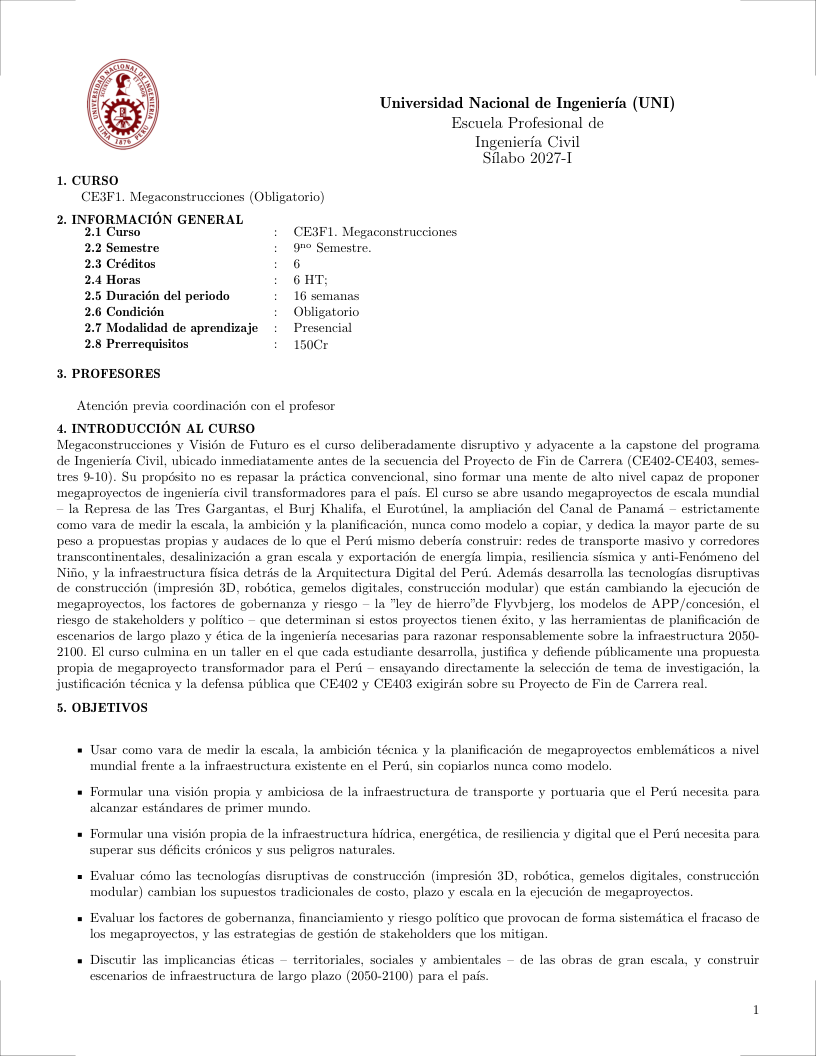
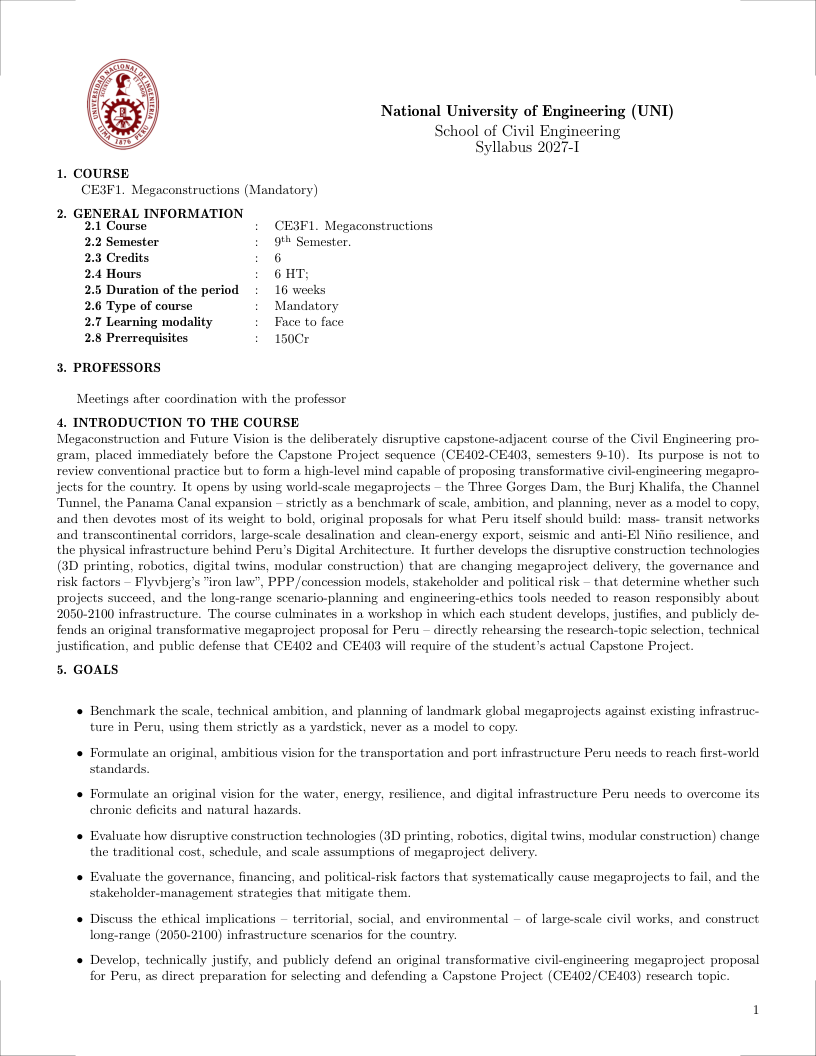
Megaconstruction and Future Vision is the deliberately disruptive capstone-adjacent course of the Civil Engineering program, placed immediately before the Capstone Project sequence (CE402-CE403, semesters 9-10). Its purpose is not to review conventional practice but to form a high-level mind capable of proposing transformative civil-engineering megaprojects for the country. It opens by using world-scale megaprojects – the Three Gorges Dam, the Burj Khalifa, the Channel Tunnel, the Panama Canal expansion – strictly as a benchmark of scale, ambition, and planning, never as a model to copy, and then devotes most of its weight to bold, original proposals for what Peru itself should build: mass- transit networks and transcontinental corridors, large-scale desalination and clean-energy export, seismic and anti-El Niño resilience, and the physical infrastructure behind Peru's Digital Architecture. It further develops the disruptive construction technologies (3D printing, robotics, digital twins, modular construction) that are changing megaproject delivery, the governance and risk factors – Flyvbjerg's "iron law", PPP/concession models, stakeholder and political risk – that determine whether such projects succeed, and the long-range scenario-planning and engineering-ethics tools needed to reason responsibly about 2050-2100 infrastructure. The course culminates in a workshop in which each student develops, justifies, and publicly defends an original transformative megaproject proposal for Peru – directly rehearsing the research-topic selection, technical justification, and public defense that CE402 and CE403 will require of the student's actual Capstone Project.
- ES Español (Latinoamérica)
- EN English
3.71.2. Generales Goals Back to top
- Benchmark the scale, technical ambition, and planning of landmark global megaprojects against existing infrastructure in Peru, using them strictly as a yardstick, never as a model to copy.
- Formulate an original, ambitious vision for the transportation and port infrastructure Peru needs to reach first-world standards.
- Formulate an original vision for the water, energy, resilience, and digital infrastructure Peru needs to overcome its chronic deficits and natural hazards.
- Evaluate how disruptive construction technologies (3D printing, robotics, digital twins, modular construction) change the traditional cost, schedule, and scale assumptions of megaproject delivery.
- Evaluate the governance, financing, and political-risk factors that systematically cause megaprojects to fail, and the stakeholder-management strategies that mitigate them.
- Discuss the ethical implications – territorial, social, and environmental – of large-scale civil works, and construct long-range (2050-2100) infrastructure scenarios for the country.
- Develop, technically justify, and publicly defend an original transformative civil-engineering megaproject proposal for Peru, as direct preparation for selecting and defending a Capstone Project (CE402/CE403) research topic.
- ES Español (Latinoamérica)
- EN English
3.71.3. Contribution to Outcomes Back to top
- ABET-2) An ability to apply engineering design to produce solutions that meet specified needs with consideration of public health, safety, and welfare, as well as global, cultural, social, environmental, and economic factors. (Usage)
- ABET-3) An ability to communicate effectively with a range of audiences. (Usage)
- ABET-4) An ability to recognize ethical and professional responsibilities in engineering situations and make informed judgments, which must consider the impact of engineering solutions in global, economic, environmental, and societal contexts. (Usage)
- ES Español (Latinoamérica)
- EN English
3.71.4. Content Back to top
- ES Español (Latinoamérica)
- EN English
3.71.4.1. Anatomy of Global Megaprojects (4 hours) [Skills ABET-2] Back to top
Bibliography: (Flyvbjerg et al., 2003)
Topics
- The Three Gorges Dam (China): the world's largest hydraulic structure
- Burj Khalifa and the global race for mega-tall skyscrapers
- The Channel Tunnel: transnational undersea engineering
- The Panama Canal expansion
- Hyperloop and very-high-speed ground transportation
- Floating cities and habitable marine infrastructure
Learning Outcomes
- Describe the scale and technical challenge of at least three landmark megaprojects worldwide [Familiarity]
- Compare the scale (investment, timeline, scope) of an international megaproject with equivalent existing infrastructure in Peru [Usage]
- Use an international megaproject as a benchmark to justify the ambition of a national proposal [Assessment]
- ES Español (Latinoamérica)
- EN English
3.71.4.2. The Peru That Should Exist: Transportation and Ports (8 hours) [Skills ABET-2] Back to top
Bibliography: (de Dios Ortúzar and Willumsen, 2011; Flyvbjerg et al., 2003)
Topics
- A world-scale Lima-Callao Metro network: from 2 lines to a 10+ line network (benchmark: Berlin, Madrid, Seoul, Shanghai)
- Metro systems for Arequipa, Cusco, Trujillo, and Piura
- The Corío Port and the new logistics geography of the South Pacific, after Chancay
- The Amazonas-Puno transversal corridor, integrating jungle, highlands, and altiplano
- Chancay-Corío bi-oceanic corridor to Brazil: magnetic-levitation (Maglev) cargo trains and automated pneumatic tube ducts, with canopy-encapsulated macro-viaducts over the Amazon for zero environmental impact, record-span cable-stayed bridges over canyons, and deep foundations in unstable tropical clay soils
- Peru as a South American air hub: international airports in Cusco, Arequipa, and Iquitos
Learning Outcomes
- Diagnose the mass-transit deficit of Lima and other Peruvian cities against comparably sized international references [Familiarity]
- Propose a mass-transit network for a Peruvian city that currently has no metro system [Usage]
- Justify, with scale and demand data, a transformative road or rail corridor proposal for the country [Assessment]
- Evaluate the territorial and economic impact of connecting the Pacific megaports to Brazil by rail [Assessment]
- ES Español (Latinoamérica)
- EN English
3.71.4.3. Smart Highways and Intelligent Ground Transportation (6 hours) [Skills ABET-2] Back to top
Bibliography: (Sussman, 2005)
Topics
- The "Smart Pan-American": an elevated, high-speed, uninterrupted Tumbes-Tacna highway (2,500 km) exclusively for mass cargo and autonomous vehicles
- Graphene self-healing pavement and smart materials
- In-lane electromagnetic induction charging for electric trucks on the move
- Fiber optic embedded as a digital backbone in every new road corridor built
- Road infrastructure designed for autonomous vehicles and driverless cargo logistics
Learning Outcomes
- Explain what makes a highway "smart": sensors, digital backbone, energy, and advanced materials [Familiarity]
- Conceptually design a smart-highway segment integrating self-healing pavement, inductive charging lanes, and fiber optic [Usage]
- Evaluate the technical and investment feasibility of converting an existing road corridor into a smart highway [Assessment]
- ES Español (Latinoamérica)
- EN English
3.71.4.4. Megatunnels and Long-Range Tunneling (6 hours) [Skills ABET-2] Back to top
Bibliography: (Maidl et al., 2013)
Topics
- The Trans-Andean Megatunnel: a 40+ km low-altitude rail and hydrocarbon tunnel from the Atlantic basin to the Central Coast (Chancay/Callao)
- A network of trans-Andean tunnels with integrated highways, coast-highlands-jungle
- State-of-the-art autonomous tunnel boring machines (TBMs) for deep excavation under extreme pressures
- AI-managed massive ventilation systems for very long tunnels
- Design of structural linings able to withstand the weight of a seismically active mountain range
Learning Outcomes
- Describe the geotechnical and construction challenges of a tunnel longer than 40 km under an active mountain range [Familiarity]
- Compare tunnel boring machine (TBM) technologies for different geological conditions in the Peruvian Andes [Usage]
- Technically justify the alignment and lining of a proposed trans-Andean megatunnel [Assessment]
- ES Español (Latinoamérica)
- EN English
3.71.4.5. Underground Highways (6 hours) [Skills ABET-2] Back to top
Bibliography: (Broere, 2016)
Topics
- Underground cargo macro-ring of Metropolitan Lima: three-level cargo highways connecting Ancón (Chancay), Callao, and Lurín beneath the bedrock
- Advanced geotechnics for excavating urban conglomerates at depths never before attempted
- CO2 absorption and filtering systems inside tunnels via algae bio-reactors
- Integration of logistics robotics for automatic cargo distribution to the surface
Learning Outcomes
- Explain why a dense city may require underground, rather than surface, road infrastructure [Familiarity]
- Conceptually design a multi-level underground cargo highway segment [Usage]
- Evaluate the geotechnical and environmental risks of an underground logistics ring beneath a city [Assessment]
- ES Español (Latinoamérica)
- EN English
3.71.4.6. High-Speed Rail (6 hours) [Skills ABET-2] Back to top
Bibliography: (Givoni, 2006)
Topics
- Northern high-speed corridor: Lima-Trujillo-Chiclayo
- Southern high-speed corridor: Lima-Ica-Arequipa
- High-speed track engineering: curvature, superelevation, and dimensional tolerances
- International high-speed rail benchmarks (Spanish AVE, Japanese Shinkansen, Chinese high-speed rail) as a measuring stick
- Economic and demand viability of high-speed corridors across Peru's geography
Learning Outcomes
- Describe the track-engineering requirements that distinguish high-speed rail from conventional rail [Familiarity]
- Compare the proposed northern and southern corridors in terms of demand, topography, and feasibility [Usage]
- Justify the economic viability of a specific high-speed corridor for Peru [Assessment]
- ES Español (Latinoamérica)
- EN English
3.71.4.7. Water and Energy for a First-World Peru (6 hours) [Skills ABET-2] Back to top
Bibliography: (Voutchkov, 2012; International Renewable Energy Agency (IRENA), 2019)
Topics
- Large-scale coastal desalination (Israel/Chile models) for Lima, Piura, and Ica
- Peru's coastal desert as a world solar power
- 100% universal sanitation and drinking water for isolated Amazonian communities
- Peru as a clean-energy exporter and electrical interconnection with Ecuador, Brazil, and Chile
- The automated "Southern Mega-Chavimochic": transfer of southern Amazon-basin water surplus via automated dams above 4,000 masl and hundreds of kilometers of nanopolymer-lined hydraulic tunnels to the southern coast (Arequipa, Moquegua, Tacna)
- Gates and valves controlled by predictive AI algorithms analyzing global climate data, cascading micro-hydro plants along the transfer route, and solar-powered backup desalination at scale
Learning Outcomes
- Explain why Peru's chronic coastal water deficit is a solvable engineering problem, not only a climate one [Familiarity]
- Conceptually size a desalination plant for a Peruvian coastal city [Usage]
- Conceptually design an interregional water-transfer system, including automated control and cascading hydroelectric generation [Usage]
- Propose an infrastructure strategy to close the sanitation gap in isolated communities [Assessment]
- ES Español (Latinoamérica)
- EN English
3.71.4.8. Resilience and Territory at a First-World Scale (6 hours) [Skills ABET-2] Back to top
Bibliography: (Kelman, 2020; Priestley et al., 2007)
Topics
- Seismic code and massive reinforcement of critical infrastructure (hospitals, schools) ahead of the coastal "Big One"
- Watershed management and national anti-El Niño infrastructure, not patchwork works
- Massive seismic-resistant social housing and planned satellite cities
Learning Outcomes
- Describe the seismic risk of the Peruvian coast and its relationship to existing critical infrastructure [Familiarity]
- Propose a preventive hydraulic infrastructure strategy against El Niño at watershed scale [Usage]
- Evaluate the feasibility of a massive seismic-resistant social housing program [Assessment]
- ES Español (Latinoamérica)
- EN English
3.71.4.9. Peru's Digital Architecture as an Invisible Infrastructure Megaproject (6 hours) [Skills ABET-2] Back to top
Bibliography: (Secretaría de Gobierno y Transformación Digital, Presidencia del Consejo de Ministros, 2021; Batty, 2013)
Topics
- The 9 principles of Peru's Digital Architecture: accelerating, cross-cutting, scalable, modular, distributed, sovereign, sustainable, secure, and citizen-centered
- Completing the National Fiber-Optic Backbone Network, including fiber optic embedded in every smart-highway corridor built as a design standard
- 5G/6G connectivity as national infrastructure
- Smart cities: traffic, waste, and energy management
Learning Outcomes
- List and explain the 9 foundational principles of Peru's Digital Architecture [Familiarity]
- Apply the 9 principles of Digital Architecture to the conceptual design of a national digital infrastructure system [Usage]
- Evaluate whether a digital infrastructure proposal meets the sovereignty and security principles [Assessment]
- ES Español (Latinoamérica)
- EN English
3.71.4.10. Disruptive Large-Scale Construction Technologies (6 hours) [Skills ABET-2] Back to top
Bibliography: (Buswell et al., 2018)
Topics
- 3D concrete printing at construction scale
- Robotics and automation in large-scale works
- Digital twins at megaproject scale
Learning Outcomes
- Describe how 3D concrete printing changes traditional construction-schedule assumptions [Familiarity]
- Evaluate the role of a digital twin in managing an infrastructure megaproject [Assessment]
- ES Español (Latinoamérica)
- EN English
3.71.4.11. Modular Construction and Accelerated Prefabrication (4 hours) [Skills ABET-2] Back to top
Bibliography: (Gibb, 1999)
Topics
- The case of the hospital built in 26 hours during the pandemic (China) as a benchmark for possible speed
- "Lego-style" construction: fully offsite-prefabricated pieces, assembled on site
- Application to a massive national school infrastructure program in Peru
- Industrial factory quality control versus traditional on-site construction variability
- Advantages and limits of modular construction versus conventional construction
Learning Outcomes
- Explain how offsite prefabrication compresses construction timelines by orders of magnitude [Familiarity]
- Apply the "lego-style" modular construction model to the conceptual design of a massive school infrastructure program [Usage]
- Evaluate the limits and risks of modular construction versus conventional construction for a specific case [Assessment]
- ES Español (Latinoamérica)
- EN English
3.71.4.12. Governance, Financing, and Risk in Megaprojects (6 hours) [Skills ABET-4] Back to top
Bibliography: (Flyvbjerg et al., 2003; Yescombe, 2013)
Topics
- Flyvbjerg's "iron law" of megaprojects: systematic cost and schedule overruns
- Public-Private Partnership (PPP) and concession models
- Stakeholder management in large-scale projects
- Political and social risk in infrastructure megaprojects
Learning Outcomes
- Explain the "iron law" of megaprojects and why it occurs systematically [Familiarity]
- Identify the main stakeholders of a proposed megaproject and their conflicting interests [Usage]
- Evaluate the political-social risk of a national infrastructure megaproject [Assessment]
- ES Español (Latinoamérica)
- EN English
3.71.4.13. Visionary Thinking, Ethics, and Speculative Design (6 hours) [Skills ABET-2,ABET-4] Back to top
Bibliography: (Schwartz, 1991; Martin and Schinzinger, 2010)
Topics
- 2050-2100 scenario planning for national infrastructure
- Adaptive infrastructure for extreme climate scenarios
- Ethics of the territorial, social, and environmental impact of large-scale works
- Transformative leadership in civil engineering
Learning Outcomes
- Describe what scenario planning is and why it matters for long-range infrastructure [Familiarity]
- Construct a 2050 scenario for Peru that includes at least three original megaprojects [Usage]
- Discuss the ethical implications of displacing communities or ecosystems for a proposed megaproject [Assessment]
- ES Español (Latinoamérica)
- EN English
3.71.4.14. Country Megaproject Proposal Workshop (8 hours) [Skills ABET-2,ABET-3] Back to top
Bibliography: (Flyvbjerg and Gardner, 2023)
Topics
- Development of an original transformative megaproject proposal for Peru
- Technical and scale justification of the proposal
- Public defense of the proposal before peers and a jury
Learning Outcomes
- Propose a transformative civil infrastructure megaproject for Peru, with technical and scale justification [Assessment]
- Publicly defend the megaproject proposal against technical observations and criticism [Assessment]
- ES Español (Latinoamérica)
- EN English
3.71.5. Bibliography Back to top
Flyvbjerg, B., Bruzelius, N., and Rothengatter, W. (2003). Megaprojects and Risk: An Anatomy of Ambition. Cambridge University Press.
de Dios Ortúzar, J. and Willumsen, L. G. (2011). Modelling Transport. Wiley, 4th edition.
Sussman, J. M. (2005). Perspectives on Intelligent Transportation Systems (ITS). Springer.
Maidl, B., Thewes, M., and Maidl, U. (2013). Handbook of Tunnel Engineering. Ernst & Sohn.
Broere, W. (2016). Urban underground space: Solving the problems of today's cities. Tunnelling and Underground Space Technology, 55:245–248.
Givoni, M. (2006). Development and impact of the modern high-speed train: A review. Transport Reviews, 26(5):593–611.
Voutchkov, N. (2012). Desalination Engineering: Planning and Design. McGraw-Hill.
International Renewable Energy Agency (IRENA) (2019). Future of solar photovoltaic: Deployment, investment, technology, grid integration and socio-economic aspects. Technical report, International Renewable Energy Agency.
Kelman, I. (2020). Disaster by Choice: How Our Actions Turn Natural Hazards into Catastrophes. Oxford University Press.
Priestley, M. J. N., Calvi, G. M., and Kowalsky, M. J. (2007). Displacement-Based Seismic Design of Structures. IUSS Press.
Secretaría de Gobierno y Transformación Digital, Presidencia del Consejo de Ministros (2021). Arquitectura digital del perú. Technical report, Presidencia del Consejo de Ministros, Perú.
Batty, M. (2013). The New Science of Cities. MIT Press.
Buswell, R. A., de Silva, W. L. L., Jones, S. A., and Dirrenberger, J. (2018). 3d printing using concrete extrusion: A roadmap for research. Cement and Concrete Research, 112:37–49.
Gibb, A. G. F. (1999). Off-site Fabrication: Prefabrication, Pre-assembly and Modularisation. Whittles Publishing.
Yescombe, E. R. (2013). Public-Private Partnerships: Principles of Policy and Finance. Elsevier, 2nd edition.
Schwartz, P. (1991). The Art of the Long View: Planning for the Future in an Uncertain World. Doubleday.
Martin, M. W. and Schinzinger, R. (2010). Introduction to Engineering Ethics. McGraw-Hill, 2nd edition.
Flyvbjerg, B. and Gardner, D. (2023). How Big Things Get Done: The Surprising Factors That Determine the Fate of Every Project, from Home Renovations to Space Exploration and Everything In Between. Currency.