- ES Español (Latinoamérica)

- EN English

3.57. CE3H4 Water Resources (Mandatory)
- Semester: 8th Sem. Credits: 4
- Hour of this course: Theory: 2 hours; Practice: 4 hours;
- Syllabus:
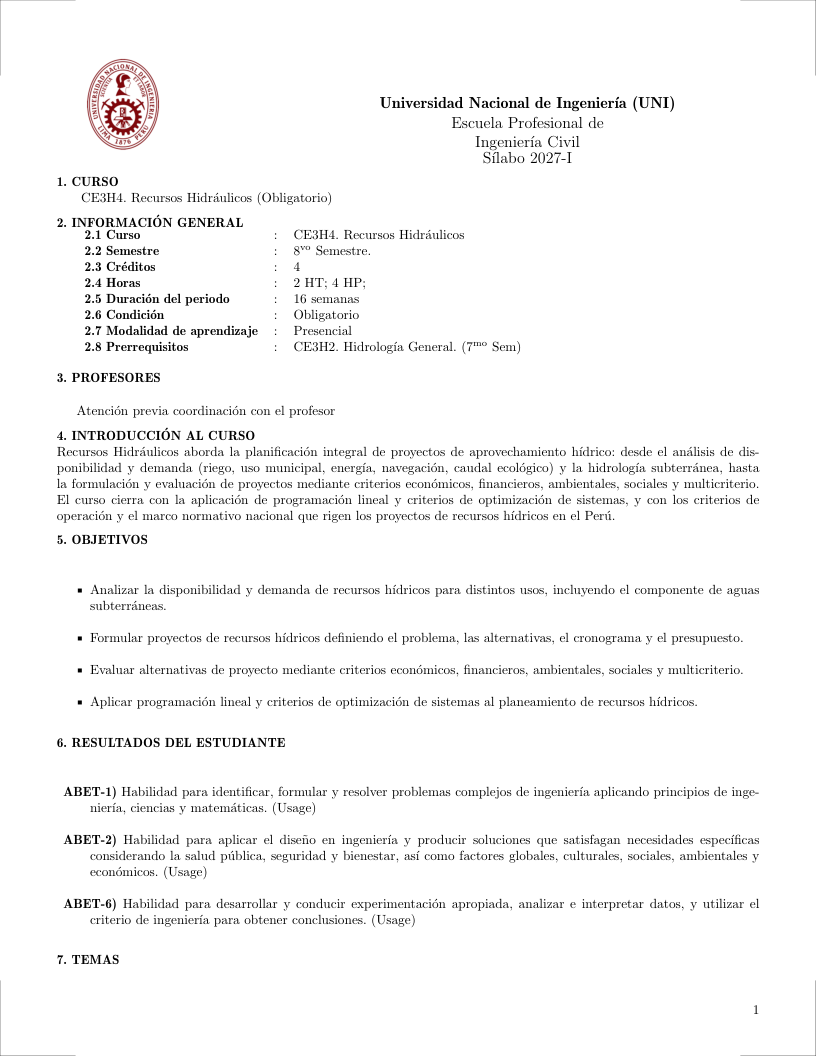
 Español (Latinoamérica)
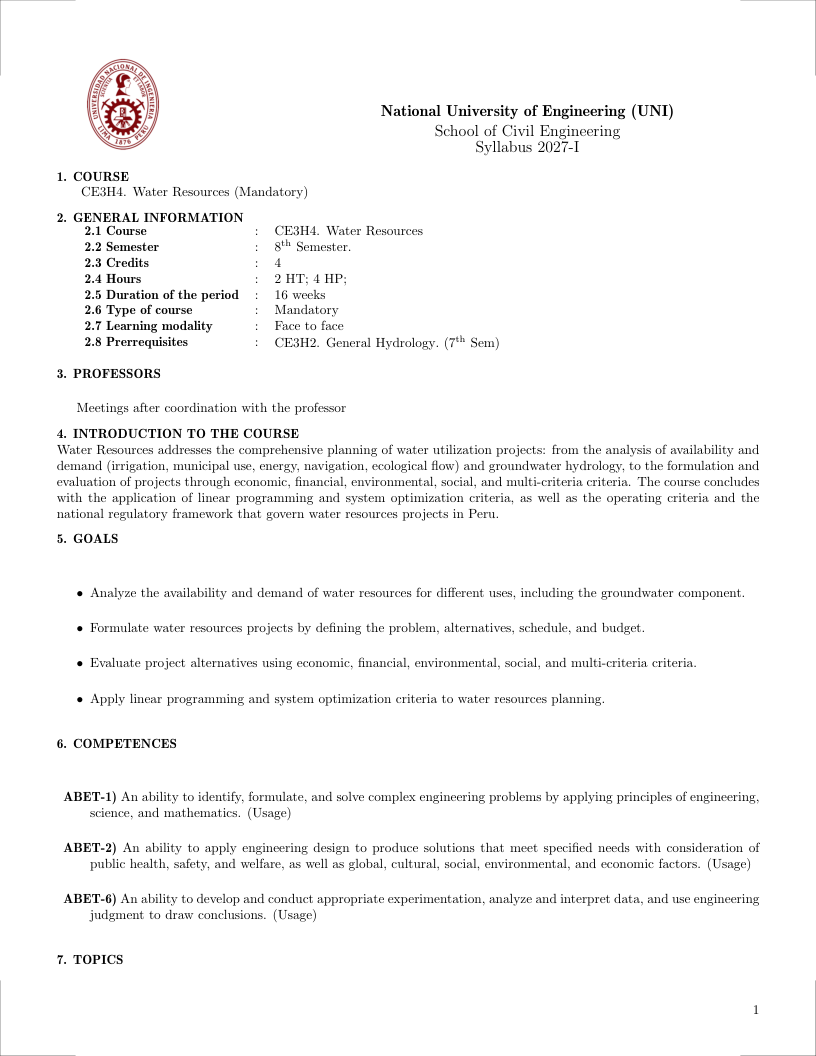 English
- Prerrequisites:
- CE3H2 General Hydrology (7th Sem)
- ES Español (Latinoamérica)
- EN English
3.57.1. Justification Back to top
Water Resources addresses the comprehensive planning of water utilization projects: from the analysis of availability and demand (irrigation, municipal use, energy, navigation, ecological flow) and groundwater hydrology, to the formulation and evaluation of projects through economic, financial, environmental, social, and multi-criteria criteria. The course concludes with the application of linear programming and system optimization criteria, as well as the operating criteria and the national regulatory framework that govern water resources projects in Peru.
- ES Español (Latinoamérica)
- EN English
3.57.2. Generales Goals Back to top
- Analyze the availability and demand of water resources for different uses, including the groundwater component.
- Formulate water resources projects by defining the problem, alternatives, schedule, and budget.
- Evaluate project alternatives using economic, financial, environmental, social, and multi-criteria criteria.
- Apply linear programming and system optimization criteria to water resources planning.
- ES Español (Latinoamérica)
- EN English
3.57.3. Contribution to Outcomes Back to top
- ABET-1) An ability to identify, formulate, and solve complex engineering problems by applying principles of engineering, science, and mathematics. (Usage)
- ABET-2) An ability to apply engineering design to produce solutions that meet specified needs with consideration of public health, safety, and welfare, as well as global, cultural, social, environmental, and economic factors. (Usage)
- ABET-6) An ability to develop and conduct appropriate experimentation, analyze and interpret data, and use engineering judgment to draw conclusions. (Usage)
- ES Español (Latinoamérica)
- EN English
3.57.4. Content Back to top
- ES Español (Latinoamérica)
- EN English
3.57.4.1. Introduction and Methodology of Water Resources Analysis (6 hours) [Skills ABET-1] Back to top
Bibliography: (Loucks and van Beek, 2017)
Topics
- Definitions and methodology for water resources project analysis. History of water resources development.
- Current status of water resources in Peru and the National Water Resources Plan.
- Management of basic information and water resources simulation tools.
Learning Outcomes
- Describe the general methodological framework for the analysis of water resources projects [Familiarity].
- Collect and organize the basic information required for a water resources study [Usage].
- ES Español (Latinoamérica)
- EN English
3.57.4.2. Hydrologic Cycle and Water Balance (11 hours) [Skills ABET-1] Back to top
Bibliography: (Chow et al., 1988; Loucks and van Beek, 2017)
Topics
- Hydrologic cycle and water balance concepts
- Precipitation measurement and analysis
- Evaporation and evapotranspiration estimation
- Infiltration theory and rainfall-runoff processes
Learning Outcomes
- Explain the hydrologic cycle and quantify water balance components [Familiarity]
- Analyze precipitation data and develop depth-area-duration relationships [Assessment]
- Estimate evaporation and evapotranspiration using empirical methods [Usage]
- Apply infiltration models to estimate runoff from rainfall events [Assessment]
- ES Español (Latinoamérica)
- EN English
3.57.4.3. Surface Hydrology and Watershed Modeling (9 hours) [Skills ABET-1] Back to top
Bibliography: (Chow et al., 1988; Loucks and van Beek, 2017)
Topics
- Hydrograph analysis and unit hydrograph method
- Watershed modeling and hydrologic simulation
- Streamflow measurement and gauging techniques
Learning Outcomes
- Derive unit hydrographs and synthesize runoff hydrographs [Usage]
- Develop watershed models using software tools for hydrologic simulation [Usage]
- Conduct streamflow measurements and interpret flow duration curves [Assessment]
- ES Español (Latinoamérica)
- EN English
3.57.4.4. Flood Frequency Analysis and Climate Change (8 hours) [Skills ABET-1] Back to top
Bibliography: (Chow et al., 1988; Loucks and van Beek, 2017)
Topics
- Flood frequency analysis and design storms
- Hydrologic routing methods for channels and reservoirs
- Climate change impacts on hydrologic systems, including the El Niño phenomenon (ENSO) as its dominant manifestation on the Peruvian coast
Learning Outcomes
- Perform flood frequency analysis using statistical methods [Assessment]
- Route flood hydrographs through channels and reservoirs [Usage]
- Evaluate the impacts of climate change and the El Niño phenomenon on watershed hydrology and design implications [Assessment]
- ES Español (Latinoamérica)
- EN English
3.57.4.5. Groundwater Hydrology (8 hours) [Skills ABET-1] Back to top
Bibliography: (Fetter, 2001)
Topics
- Aquifer types: confined, unconfined, and semi-confined
- Darcy's law applied to groundwater flow and hydraulic conductivity
- Well hydraulics: Theis and Thiem equations for transient and steady-state flow
- Pumping tests and estimation of hydrogeologic parameters (transmissivity, storativity)
- Numerical modeling of groundwater flow and aquifer water balance
- Groundwater-surface water interaction and conjunctive use of resources
- Groundwater quality and basic contaminant transport
- Design and construction of water supply wells
- Sustainable aquifer management and prevention of overexploitation
Learning Outcomes
- Classify aquifer types and describe their hydraulic boundary conditions [Familiarity]
- Apply Darcy's law to calculate groundwater flow rates and velocities [Usage]
- Solve the Theis and Thiem equations to determine drawdown in pumping wells [Assessment]
- Estimate hydrogeologic parameters from pumping test data [Usage]
- Model the water balance of an aquifer and evaluate exploitation scenarios [Assessment]
- Design a water supply well accounting for aquifer characteristics [Usage]
- Evaluate the sustainability of aquifer exploitation and propose management measures [Assessment]
- ES Español (Latinoamérica)
- EN English
3.57.4.6. Scope and Requirements Planning (12 hours) [Skills ABET-2] Back to top
Bibliography: (Institute, 2021b)
Topics
- Requirements elicitation techniques across predictive and adaptive approaches
- Scope definition: project scope statement vs. product backlog depending on approach
- Requirements traceability: linking requirements to outcomes across all approaches
- Scope decomposition: WBS for predictive, backlog structuring for adaptive
Learning Outcomes
- Define project and product scope using techniques appropriate to the selected development approach [Usage]
- Compare scope planning approaches in predictive and adaptive development contexts [Assessment]
- Design a requirements traceability approach ensuring all deliverables are linked to stated stakeholder needs [Assessment]
- ES Español (Latinoamérica)
- EN English
3.57.4.7. Schedule Planning (2 hours) [Skills ABET-2] Back to top
Bibliography: (Institute, 2021b)
Topics
- Activity estimation techniques: analogous, parametric, three-point, and story points
- Schedule development: critical path for predictive, sprint and release planning for adaptive
- Building schedule flexibility: buffers, contingency, and iteration capacity
- Schedule baseline in predictive vs. release roadmap in adaptive: comparison and use
Learning Outcomes
- Develop a project schedule appropriate to the selected development approach [Usage]
- Compare scheduling practices in predictive and adaptive project environments [Assessment]
- Evaluate a project schedule for realism, buffer adequacy, and alignment with scope and resource constraints [Assessment]
- ES Español (Latinoamérica)
- EN English
3.57.4.8. Cost and Budget Planning (1 hours) [Skills ABET-2] Back to top
Bibliography: (Institute, 2021b; Blank and Tarquin, 2017)
Topics
- Cost estimation techniques: analogous, parametric, bottom-up, and three-point
- Budget structure: cost baseline, contingency reserves, and management reserves
- Cost planning in adaptive environments: fixed-capacity budgeting and cost per iteration
- Establishing and maintaining the cost performance baseline and managing reserve drawdown
Learning Outcomes
- Estimate project costs and develop a budget using appropriate techniques [Usage]
- Adapt cost planning practices for adaptive and hybrid project environments [Assessment]
- Evaluate the adequacy of a project budget including contingency and management reserves [Assessment]
- ES Español (Latinoamérica)
- EN English
3.57.4.9. Economic, Financial and Social Evaluation of Water Resources Projects (12 hours) [Skills ABET-1] Back to top
Bibliography: (Blank and Tarquin, 2017)
Topics
- Economic evaluation indicators: Net Present Value (NPV), Internal Rate of Return (IRR), and Benefit-Cost ratio
- Selecting among project alternatives by comparing economic indicators
- Sensitivity analysis to variations in costs, benefits, and discount rate
- Funding sources and financial structuring of water projects
- User payment capacity and tariff schemes
- Cost allocation among beneficiaries in multipurpose projects
- Social evaluation of projects: exchange theory and shadow prices
- Distributional impacts and equity in project social evaluation
Learning Outcomes
- Calculate NPV, IRR, and Benefit-Cost ratio for a water resources project [Usage]
- Select among project alternatives based on compared economic indicators [Assessment]
- Perform a sensitivity analysis of project profitability to changes in key variables [Usage]
- Evaluate funding sources and tariff schemes based on user payment capacity [Assessment]
- Allocate costs among beneficiaries in a multipurpose project [Usage]
- Apply social evaluation principles to estimate a project's net benefit to society [Assessment]
- ES Español (Latinoamérica)
- EN English
3.57.4.10. Environmental Impact Assessment and Sustainability Metrics (3 hours) [Skills ABET-2] Back to top
Bibliography: (Glasson and Therivel, 2019)
Topics
- EIA process: screening, scoping, impact analysis, mitigation, and public participation
- Impact prediction methods for air, water, soil, noise, and ecological systems
- Mitigation hierarchy and design of environmental management plans
- Peruvian legal and institutional framework of the National Environmental Impact Assessment System (SEIA, Law No. 27446 and its regulations): categorization of instruments (DIA, EIA-sd, EIA-d) and competent authorities
- International environmental and social standards: the World Bank's Environmental and Social Framework and the International Finance Corporation's (IFC) Performance Standards
- Sustainability concepts and the triple bottom line (environment, economy, society)
- Cumulative impact assessment and strategic environmental assessment (SEA)
- Social impact assessment and stakeholder engagement methods
- Citizen participation within the SEIA framework: public hearings, informational workshops, and consultation mechanisms throughout the EIA process
- Socio-environmental conflict management: stakeholder mapping, conflict analysis, and dialogue and resolution strategies
- Land acquisition and involuntary resettlement (Legislative Decree No. 1192): valuation, negotiation, and compensation procedures
- Prior consultation of Indigenous peoples (Law No. 29785): applicability, process stages, and its relationship to the EIA
- Sustainability metrics and indicator frameworks (e.g., SDGs, Envision)
- Decision-support tools and multi-criteria analysis for sustainable design
- Identification of environmental hazards and risk sources associated with a civil engineering project
- Environmental risk assessment methodology: probability x consequence matrices and risk prioritization
- Development of environmental risk management and contingency plans integrated into the EIA process
Learning Outcomes
- Outline the key stages of a standardized Environmental Impact Assessment (EIA) process [Familiarity]
- Predict primary environmental impacts of a proposed infrastructure project on local air and water quality [Usage]
- Develop mitigation measures for identified significant environmental impacts [Assessment]
- Explain Peru's SEIA framework (Law No. 27446) and the instrument categorization that determines a project's approval process [Familiarity]
- Compare Peru's SEIA requirements against the World Bank's Environmental and Social Framework and the IFC Performance Standards for a multilaterally financed project [Familiarity]
- Apply the triple bottom line framework to evaluate a simple engineering project [Assessment]
- Conduct a scoping exercise to define the boundaries and key issues for a cumulative impact assessment [Assessment]
- Design a stakeholder engagement plan for a controversial development project [Usage]
- Plan a citizen participation process (public hearings and workshops) for a project subject to the SEIA [Usage]
- Analyze a real socio-environmental conflict and propose a dialogue and resolution strategy [Assessment]
- Describe the land acquisition and involuntary resettlement procedure under Legislative Decree No. 1192 [Familiarity]
- Identify when a project requires a prior consultation process under Law No. 29785 and its stages [Familiarity]
- Select appropriate sustainability metrics to track the performance of a green infrastructure project [Assessment]
- Use a simple multi-criteria decision analysis (MCDA) tool to compare alternative project designs [Usage]
- Identify the environmental hazards and risk sources of a civil engineering project [Familiarity]
- Apply a risk matrix (probability x consequence) to prioritize the environmental risks of a project [Usage]
- Formulate an environmental risk management and contingency plan integrated into a project's EIA [Assessment]
- ES Español (Latinoamérica)
- EN English
3.57.4.11. Weighted Sum and Scoring Methods (3 hours) [Skills ABET-6] Back to top
Bibliography: (Triantaphyllou, 2000)
Topics
- Weighted sum model (SAW): normalization of criteria, weight assignment, and aggregation
- Weight elicitation methods: direct assignment, rank order centroid, and swing weights
- Weighted product model and its advantage for ratio-scale criteria
- VIKOR method: compromise ranking based on closeness to the ideal and maximum group utility
Learning Outcomes
- Apply the weighted sum model to rank alternatives and conduct sensitivity analysis on weights [Usage]
- Elicit criteria weights using swing weights or rank order centroid and justify the chosen method [Usage]
- Compare weighted sum and VIKOR rankings and explain differences due to aggregation approach [Assessment]
- ES Español (Latinoamérica)
- EN English
3.57.4.12. LP Formulation and Modeling (6 hours) [Skills ABET-6] Back to top
Bibliography: (Hillier and Lieberman, 2021)
Topics
- Decision variables, objective function (minimization and maximization), and constraint types
- Standard and canonical forms of an LP: converting inequalities to equalities, non-negativity restrictions
- Common LP modeling patterns: resource allocation, blending, production planning, and diet problems
- Modeling with soft constraints: penalty methods and goal relaxation in LP formulations
Learning Outcomes
- Formulate a linear programming model from a verbal problem description, identifying variables, objective, and constraints [Usage]
- Convert an LP between its inequality, equality (standard), and canonical forms [Usage]
- Evaluate the adequacy of an LP model and identify modeling errors or inappropriate linearization assumptions [Assessment]
- ES Español (Latinoamérica)
- EN English
3.57.4.13. Operation Criteria and Regulatory Framework (3 hours) [Skills ABET-2] Back to top
Bibliography: (del Agua (ANA), 2016)
Topics
- Operation criteria for water utilization systems.
- National regulatory framework for water resources (Water Resources Law and its regulations).
Learning Outcomes
- Apply operation criteria to a water utilization system [Usage].
- Identify the national regulatory framework applicable to a water resources project [Familiarity].
- ES Español (Latinoamérica)
- EN English
3.57.5. Bibliography Back to top
Loucks, D. P. and van Beek, E. (2017). Water Resources Systems Planning and Management: An Introduction to Methods, Models, and Applications. Springer, 2nd edition.
Chow, V. T., Maidment, D. R., and Mays, L. W. (1988). Applied Hydrology. McGraw-Hill.
Fetter, C. W. (2001). Applied Hydrogeology. Prentice Hall, 4th edition.
Institute, P. M. (2021b). A Guide to the Project Management Body of Knowledge (PMBOK Guide). Project Management Institute, 7th edition.
Blank, L. and Tarquin, A. (2017). Engineering Economy. McGraw-Hill, 8th edition.
Glasson, J. and Therivel, R. (2019). Introduction to Environmental Impact Assessment. Routledge, 5th edition.
Triantaphyllou, E. (2000). Multi-Criteria Decision Making Methods: A Comparative Study. Springer.
Hillier, F. S. and Lieberman, G. J. (2021). Introduction to Operations Research. McGraw-Hill, 11th edition.
del Agua (ANA), A. N. (2016). Ley de recursos hídricos, ley n.° 29338, y su reglamento. Technical report, Ministerio de Agricultura y Riego del Perú.