- ES Español (Latinoamérica)

- EN English

3.63. AI162 AI Policy and Governance (Elective)
- Credits: 3
- Hour of this course: Theory: 2 hours; Laboratory: 2 hours;
- Syllabus:
 Español (Latinoamérica)
 English
- Prerrequisites: None
- ES Español (Latinoamérica)
- EN English
3.63.1. Justification Back to top
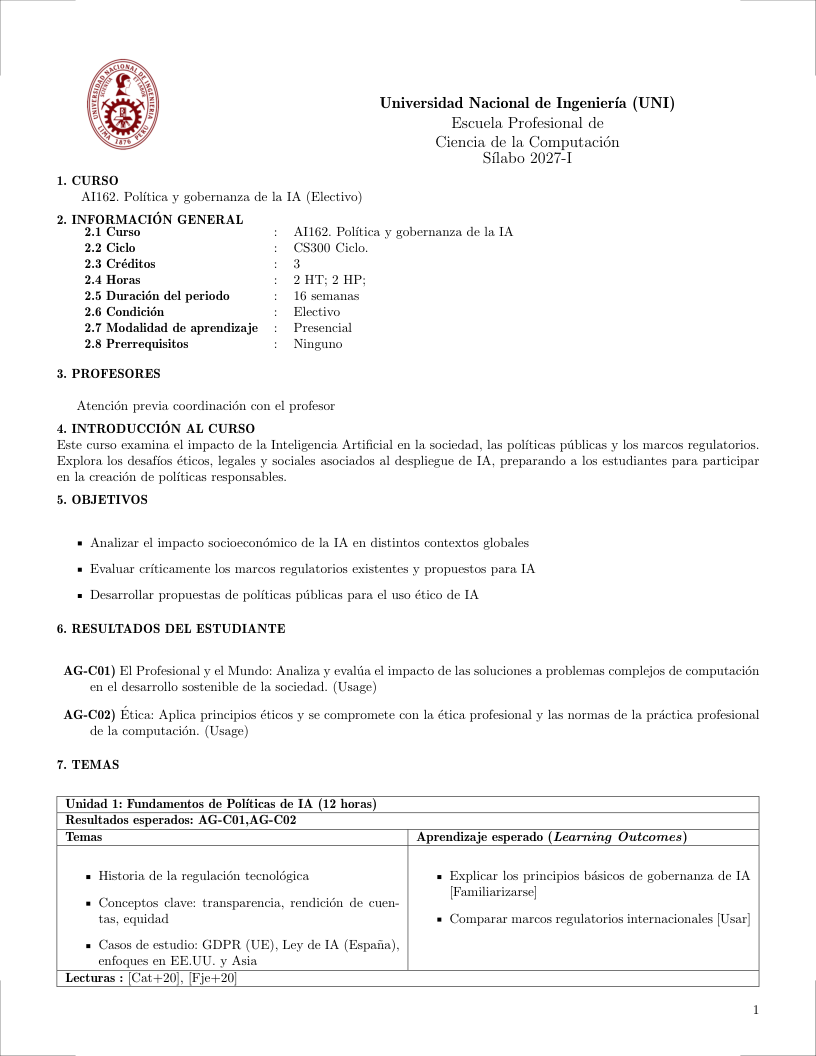
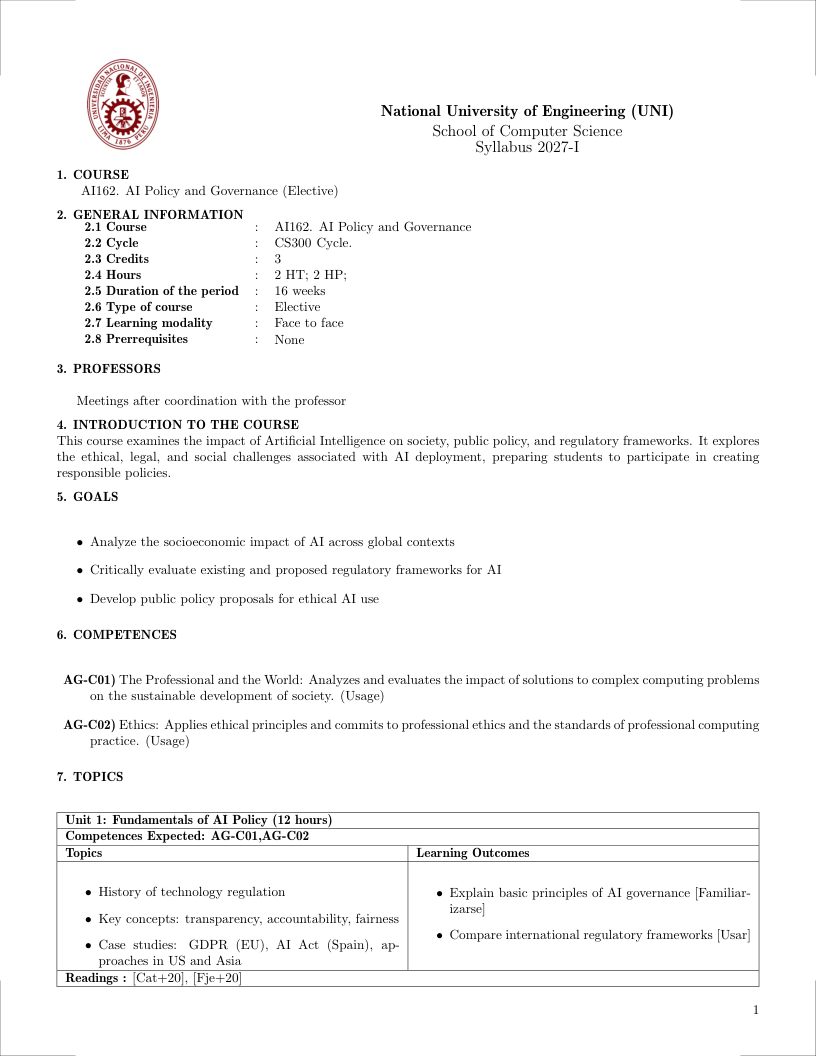
This course examines the impact of Artificial Intelligence on society, public policy, and regulatory frameworks. It explores the ethical, legal, and social challenges associated with AI deployment, preparing students to participate in creating responsible policies.
- ES Español (Latinoamérica)
- EN English
3.63.2. Generales Goals Back to top
- Analyze the socioeconomic impact of AI across global contexts
- Critically evaluate existing and proposed regulatory frameworks for AI
- Develop public policy proposals for ethical AI use
- ES Español (Latinoamérica)
- EN English
3.63.3. Contribution to Outcomes Back to top
- AG-C01) The Professional and the World: Analyzes and evaluates the impact of solutions to complex computing problems on the sustainable development of society. (Usage)
- AG-C02) Ethics: Applies ethical principles and commits to professional ethics and the standards of professional computing practice. (Usage)
- ES Español (Latinoamérica)
- EN English
3.63.4. Content Back to top
- ES Español (Latinoamérica)
- EN English
3.63.4.1. Fundamentals of AI Policy (12 hours) [Skills AG-C01,AG-C02] Back to top
Bibliography: (Cath et al., 2020; Fjeld et al., 2020)
Topics
- History of technology regulation
- Key concepts: transparency, accountability, fairness
- Case studies: GDPR (EU), AI Act (Spain), approaches in US and Asia
Learning Outcomes
- Explain basic principles of AI governance [Familiarity]
- Compare international regulatory frameworks [Usage]
- ES Español (Latinoamérica)
- EN English
3.63.4.2. Social and Economic Impact (12 hours) [Skills AG-C01,AG-C02] Back to top
Bibliography: (Zuboff, 2019; Eubanks, 2018)
Topics
- Algorithmic bias and systemic discrimination
- Automation and the future of work
- Digital divides and access to AI technologies
Learning Outcomes
- Assess how AI amplifies social inequalities [Assessment]
- Propose solutions to mitigate negative impacts [Usage]
- ES Español (Latinoamérica)
- EN English
3.63.4.3. Public Policy Design (18 hours) [Skills AG-C01,AG-C02] Back to top
Bibliography: (Crawford, 2021; Jobin et al., 2019)
Topics
- Risk assessment methodologies for AI systems
- Multi-stakeholder participation: governments, corporations, civil society
- Tools for algorithmic auditing
Learning Outcomes
- Design a policy framework for a real-world case [Assessment]
- Justify proposals with technical and ethical evidence [Usage]
- ES Español (Latinoamérica)
- EN English
3.63.4.4. Ethics and Human Rights (18 hours) [Skills AG-C01,AG-C02] Back to top
Bibliography: (Binns, 2018; UNESCO, 2021)
Topics
- Digital rights and data protection
- Military AI and ethical dilemmas
- UNESCO recommendations on AI ethics
Learning Outcomes
- Analyze conflicts between innovation and human rights [Familiarity]
- Draft an ethics code for AI projects [Assessment]
- ES Español (Latinoamérica)
- EN English
3.63.5. Bibliography Back to top
Cath, C. et al. (2020). Governing Artificial Intelligence: Ethical, Legal, and Technical Opportunities and Challenges. Oxford University Press.
Fjeld, J. et al. (2020). Principled artificial intelligence: Mapping consensus in ethical and rights-based approaches. Technical report, Harvard Berkman Klein Center.
Zuboff, S. (2019). The Age of Surveillance Capitalism. PublicAffairs.
Eubanks, V. (2018). Automating Inequality: How High-Tech Tools Profile, Police, and Punish the Poor. St. Martin's Press.
Crawford, K. (2021). Atlas of AI: Power, Politics, and the Planetary Costs of Artificial Intelligence. Yale University Press.
Jobin, A. et al. (2019). The global landscape of AI Ethics guidelines. Nature Machine Intelligence, 1:389–399.
Binns, R. (2018). Algorithmic Accountability and Public Reason. Springer.
UNESCO (2021). Recommendation on the ethics of artificial intelligence. Technical report.