- ES Español (Latinoamérica)

- EN English

3.13. CS201 Optics and electromagnetism (Mandatory)
- Cycle: 3rd Sem.
- Credits: 5
- Hour of this course: Theory: 4 hours; Practice: 2 hours;
- Syllabus:
 Español (Latinoamérica)
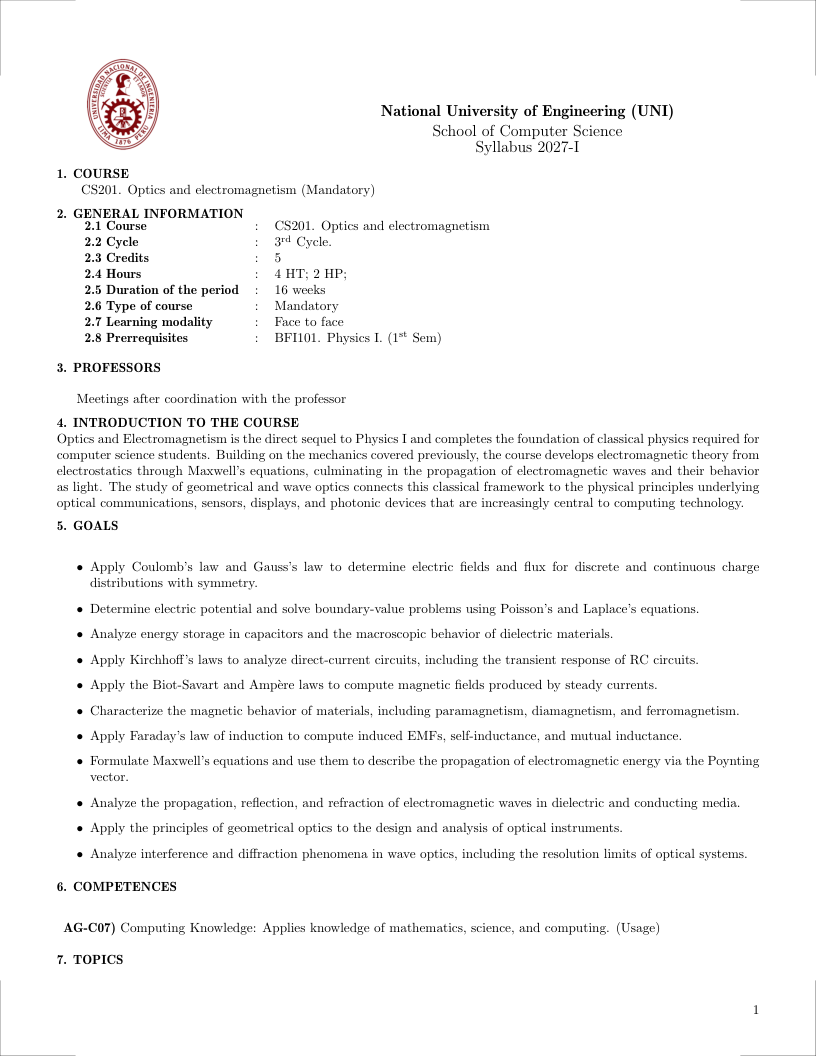 English
- Prerrequisites:
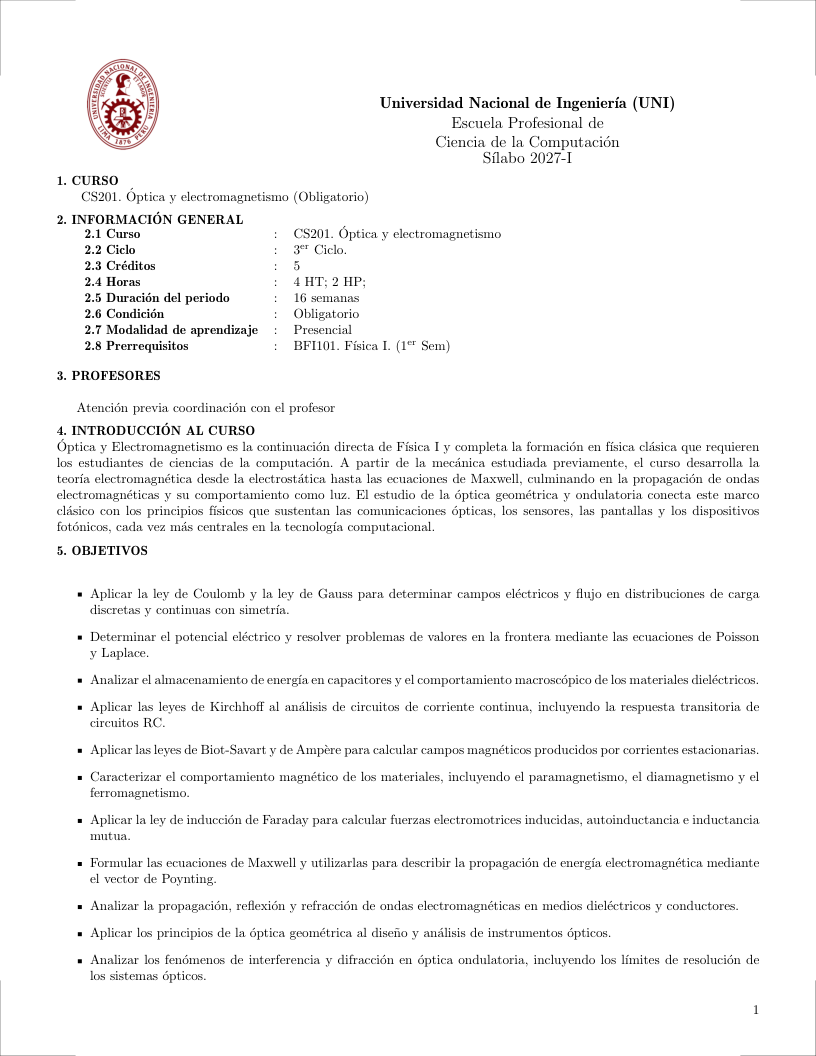
- ES Español (Latinoamérica)
- EN English
3.13.1. Justification Back to top
Optics and Electromagnetism is the direct sequel to Physics I and completes the foundation of classical physics required for computer science students. Building on the mechanics covered previously, the course develops electromagnetic theory from electrostatics through Maxwell's equations, culminating in the propagation of electromagnetic waves and their behavior as light. The study of geometrical and wave optics connects this classical framework to the physical principles underlying optical communications, sensors, displays, and photonic devices that are increasingly central to computing technology.
- ES Español (Latinoamérica)
- EN English
3.13.2. Generales Goals Back to top
- Apply Coulomb's law and Gauss's law to determine electric fields and flux for discrete and continuous charge distributions with symmetry.
- Determine electric potential and solve boundary-value problems using Poisson's and Laplace's equations.
- Analyze energy storage in capacitors and the macroscopic behavior of dielectric materials.
- Apply Kirchhoff's laws to analyze direct-current circuits, including the transient response of RC circuits.
- Apply the Biot-Savart and Ampère laws to compute magnetic fields produced by steady currents.
- Characterize the magnetic behavior of materials, including paramagnetism, diamagnetism, and ferromagnetism.
- Apply Faraday's law of induction to compute induced EMFs, self-inductance, and mutual inductance.
- Formulate Maxwell's equations and use them to describe the propagation of electromagnetic energy via the Poynting vector.
- Analyze the propagation, reflection, and refraction of electromagnetic waves in dielectric and conducting media.
- Apply the principles of geometrical optics to the design and analysis of optical instruments.
- Analyze interference and diffraction phenomena in wave optics, including the resolution limits of optical systems.
- ES Español (Latinoamérica)
- EN English
3.13.3. Contribution to Outcomes Back to top
- AG-C07) Computing Knowledge: Applies knowledge of mathematics, science, and computing. (Usage)
- ES Español (Latinoamérica)
- EN English
3.13.4. Content Back to top
- ES Español (Latinoamérica)
- EN English
3.13.4.1. Electrostatics: Electric Field and Gauss's Law (6 hours) [Skills AG-C07] Back to top
Bibliography: (Griffiths, 2017; Young and Freedman, 2015)
Topics
- Coulomb's law for point charges and the principle of linear superposition
- The electric field vector \(\vec{E}\) for discrete and continuous charge distributions
- Gauss's Law in integral form and its relation to enclosed charge
- Differential form of Gauss's Law: \(\nabla \cdot \vec{E} = \rho/\epsilon_0\)
- Applications of Gauss's Law to spherical and cylindrical symmetry
Learning Outcomes
- Calculate the electrostatic force and field for charge distributions using superposition and Gauss's Law [Usage]
- Evaluate the electric flux through surfaces and relate it to enclosed charge [Assessment]
- Determine volume charge density from a given expression of the electric field using Gauss's law in differential form [Usage]
- ES Español (Latinoamérica)
- EN English
3.13.4.2. Electric Potential and Poisson/Laplace Equations (6 hours) [Skills AG-C07] Back to top
Bibliography: (Griffiths, 2017)
Topics
- Definition of the scalar potential \(V\) and the relation \(\vec{E} = -\nabla V\)
- The conservative nature of the electrostatic field: \(\nabla \times \vec{E} = 0\)
- Calculating potential from continuous line, surface, and volume charge distributions
- Properties of equipotential surfaces and their relation to field lines
- Derivation of Poisson's equation \(\nabla^2 V = -\rho/\epsilon_0\)
- Laplace's equation \(\nabla^2 V = 0\) in charge-free regions
- The first and second uniqueness theorems for electrostatic solutions
- The method of images for planar and spherical grounded conductors
- Solution of Laplace's equation via separation of variables in Cartesian and Spherical coordinates
- Expansion of potential in terms of Monopole, Dipole, and Quadrupole moments
Learning Outcomes
- Compute the potential energy of a configuration of point charges [Usage]
- Derive the electric field vector from a given scalar potential function [Usage]
- Solve Laplace's equation for a rectangular pipe with given boundary conditions [Assessment]
- Apply the method of images to find the force between a point charge and an infinite conducting plane [Usage]
- Analyze the dominant term of the multipole expansion for a charge distribution at large distances [Assessment]
- ES Español (Latinoamérica)
- EN English
3.13.4.3. Electrostatic Energy and Dielectrics (6 hours) [Skills AG-C07] Back to top
Bibliography: (Griffiths, 2017; Serway and Jewett, 2018)
Topics
- Work required to assemble a distribution of charges
- Energy density in the electric field: \(u = \frac{1}{2}\epsilon_0 E^2\)
- Definition of capacitance \(C = Q/V\) and calculation for standard geometries
- Atomic polarization and the polarization vector \(\vec{P}\)
- Bound surface and volume charges in polarized media
- The electric displacement vector \(\vec{D}\) and Gauss's Law in matter
- Linear dielectrics, electric susceptibility \(\chi_e\), and relative permittivity \(\epsilon_r\)
- Interface boundary conditions for \(\vec{E}\) and \(\vec{D}\) vectors
- Energy in dielectric systems: \(W = \frac{1}{2}\int \vec{D} \cdot \vec{E} d\tau\)
- Microscopic description of dielectrics and the Clausius-Mossotti relation
Learning Outcomes
- Calculate the capacitance of a parallel-plate capacitor filled with a linear dielectric [Usage]
- Evaluate the bound charge distribution for a dielectric sphere with uniform polarization [Assessment]
- Solve for the electric field on both sides of a dielectric interface using boundary conditions [Usage]
- Analyze the force exerted on a dielectric slab being pulled into a capacitor [Assessment]
- ES Español (Latinoamérica)
- EN English
3.13.4.4. Electric Current, Circuits, and Kirchhoff's Laws (4 hours) [Skills AG-C07] Back to top
Bibliography: (Serway and Jewett, 2018; Young and Freedman, 2015)
Topics
- Definition of current, current density, and the continuity equation
- Ohm's law, resistivity, and temperature dependence of resistance
- Kirchhoff's Current Law (KCL) for circuit node analysis
- Kirchhoff's Voltage Law (KVL) for circuit loop analysis
- Series and parallel circuit simplification and equivalent resistance
- RC and RL circuit transients and engineering time constants
Learning Outcomes
- Apply KCL and KVL to solve multi-loop DC circuits relevant to digital hardware design [Usage]
- Calculate power dissipated and determine time constants for RC and RL circuits [Assessment]
- Analyze the transient response of RC and RL circuits and relate it to signal timing in digital systems [Usage]
- ES Español (Latinoamérica)
- EN English
3.13.4.5. Magnetostatics: Biot-Savart and Ampere's Laws (7 hours) [Skills AG-C07] Back to top
Bibliography: (Griffiths, 2017; Young and Freedman, 2015)
Topics
- Lorentz force law for point charges: \(\vec{F} = q(\vec{E} + \vec{v} \times \vec{B})\)
- Magnetic force on current-carrying wires and loops
- Biot-Savart Law for the magnetic field of a current element
- Ampère's Law in integral form for high-symmetry currents
- Differential form of Ampère's Law: \(\nabla \times \vec{B} = \mu_0 \vec{J}\)
- The solenoidal nature of \(\vec{B}\): \(\nabla \cdot \vec{B} = 0\)
- The magnetic vector potential \(\vec{A}\) and its relation \(\vec{B} = \nabla \times \vec{A}\)
- The Coulomb gauge \(\nabla \cdot \vec{A} = 0\) in magnetostatics
- Magnetic dipole moment \(\vec{m}\) of a current loop
- Multipole expansion of the vector potential and the dipole term
Learning Outcomes
- Calculate the magnetic field of an infinite straight wire using Ampère's Law [Usage]
- Compute the magnetic field on the axis of a circular current loop using the Biot-Savart Law [Usage]
- Verify that a given magnetic field satisfies the solenoidal condition \(\nabla \cdot \vec{B} = 0\) [Assessment]
- Determine the magnetic vector potential for a uniform magnetic field [Usage]
- Analyze the torque and force on a magnetic dipole in a non-uniform magnetic field [Assessment]
- ES Español (Latinoamérica)
- EN English
3.13.4.6. Magnetic Properties of Matter (7 hours) [Skills AG-C07] Back to top
Bibliography: (Griffiths, 2017)
Topics
- The magnetization vector \(\vec{M}\) as magnetic dipole moment per unit volume
- Bound surface currents \(\vec{K}_b\) and volume currents \(\vec{J}_b\)
- The magnetic field intensity \(\vec{H}\) and Ampère's Law in matter
- Physical principles of diamagnetism and paramagnetism
- Ferromagnetism, magnetic domains, and the hysteresis loop
- Interface boundary conditions for \(\vec{B}\) and \(\vec{H}\) vectors
- Linear magnetic media and magnetic permeability \(\mu\)
- The magnetic scalar potential in current-free regions
- Introduction to perfect diamagnetism and the Meissner effect
Learning Outcomes
- Find the bound current distribution for a long cylinder with uniform longitudinal magnetization [Usage]
- Classify materials as diamagnetic, paramagnetic, or ferromagnetic based on their susceptibility [Assessment]
- Solve for the \(\vec{B}\) and \(\vec{H}\) fields in a linear magnetic sphere placed in a uniform field [Usage]
- Analyze the energy loss per cycle in a ferromagnetic material from its hysteresis curve [Assessment]
- ES Español (Latinoamérica)
- EN English
3.13.4.7. Electrodynamics: Faraday's Law and Induction (6 hours) [Skills AG-C07] Back to top
Bibliography: (Griffiths, 2017; Serway and Jewett, 2018)
Topics
- Faraday's Law of induction and Lenz's Law for direction
- The flux rule for electromotive force (EMF) in moving circuits
- The non-conservative nature of the induced electric field: \(\nabla \times \vec{E} = -\partial \vec{B}/\partial t\)
- Mutual inductance \(M\) between two circuits
- Self-inductance \(L\) and the back-EMF in inductors
- Energy stored in the magnetic field: \(W = \frac{1}{2\mu_0}\int B^2 d\tau\)
- Formation of eddy currents and magnetic braking
- Formalism of the inductance matrix for multi-circuit systems
- The Neumann formula for calculating mutual inductance
Learning Outcomes
- Calculate the induced EMF in a rotating loop within a constant magnetic field [Usage]
- Apply Lenz's Law to determine the direction of the induced current in a given physical scenario [Assessment]
- Compute the total magnetic energy stored in a long solenoid [Usage]
- Evaluate the mutual inductance between a long wire and a neighboring rectangular loop [Assessment]
- ES Español (Latinoamérica)
- EN English
3.13.4.8. Maxwell's Equations and Gauge Transformations (8 hours) [Skills AG-C07] Back to top
Bibliography: (Griffiths, 2017; Serway and Jewett, 2018)
Topics
- Maxwell's displacement current and its role in completing Ampere's Law
- The complete set of four Maxwell's equations in integral and differential forms
- Poynting's theorem and energy conservation in electromagnetic fields
- The Poynting vector \(\vec{S} = \vec{E} \times \vec{H}\) as energy flux density
- Gauge invariance and the formulation of potentials in electrodynamics
Learning Outcomes
- State all four Maxwell equations and identify their physical content [Familiarity]
- Calculate the displacement current and the Poynting vector for an electromagnetic configuration [Usage]
- Analyze energy flow and power transport in electromagnetic systems including transmission lines [Assessment]
- ES Español (Latinoamérica)
- EN English
3.13.4.9. Electromagnetic Waves and Propagation in Media (8 hours) [Skills AG-C07] Back to top
Bibliography: (Griffiths, 2017; Hecht, 2017)
Topics
- Derivation of the electromagnetic wave equation in vacuum
- Monochromatic plane wave solutions and their properties
- Polarization states: linear, circular, and elliptical
- Energy density, intensity, and momentum of plane waves
- Reflection and refraction at normal incidence on an interface
- Fresnel equations and Brewster's angle for oblique incidence
- Wave propagation in conducting media and the skin depth \(\delta\)
- Frequency dependence of permittivity and the physics of dispersion
- Phase velocity versus group velocity in dispersive media
- TE and TM modes in rectangular waveguides
Learning Outcomes
- Derive the dispersion relation and the speed of light from Maxwell's equations [Usage]
- Determine the polarization state of a wave from its vector components [Assessment]
- Apply Fresnel's equations to find the reflection coefficient for TE and TM polarizations [Usage]
- Analyze how the skin depth varies with frequency for a given metallic conductor [Assessment]
- Calculate the Brewster angle for an interface between air and glass [Usage]
- ES Español (Latinoamérica)
- EN English
3.13.4.10. Geometrical Optics and Optical Instruments (9 hours) [Skills AG-C07] Back to top
Bibliography: (Hecht, 2017)
Topics
- Fermat's Principle and the derivation of reflection/refraction laws
- The Lens-Maker's formula and spherical mirror equations
- Thick lenses, cardinal points, and system matrices
- Abbe theory of image formation and resolution limits
- Compound microscopes, Keplerian/Galilean telescopes, and cameras
- Paraxial ray tracing using the ABCD matrix formalism
- The five Seidel aberrations: Spherical, Coma, Astigmatism, Curvature, Distortion
Learning Outcomes
- Design a telescope system with a specific angular magnification using two thin lenses [Usage]
- Evaluate the position and nature of an image formed by a combination of a mirror and a lens [Assessment]
- Calculate the equivalent ABCD matrix for a complex optical train of three components [Usage]
- ES Español (Latinoamérica)
- EN English
3.13.4.11. Wave Optics: Interference and Diffraction (9 hours) [Skills AG-C07] Back to top
Bibliography: (Hecht, 2017; Serway and Jewett, 2018)
Topics
- Principle of superposition and phasor representation of waves
- Young's double-slit experiment and interference fringe intensity
- The Michelson Interferometer: Measurement of small displacements
- Fraunhofer diffraction by single, double, and \(N\) slits
- Diffraction by circular apertures and the Airy disk
- The Rayleigh criterion for the limit of resolution
- Fresnel diffraction and Fresnel zone plates
- Multi-beam interference and the Fabry-Perot interferometer
Learning Outcomes
- Calculate the fringe spacing on a screen for a double-slit setup with 532 nm light [Usage]
- Determine the minimum resolvable separation of two stars using a 10-inch telescope [Assessment]
- Compute the finesse and free spectral range of a Fabry-Perot cavity [Usage]
- ES Español (Latinoamérica)
- EN English
3.13.5. Bibliography Back to top
Griffiths, D. J. (2017). Introduction to Electrodynamics. Cambridge University Press, 4th edition.
Young, H. D. and Freedman, R. A. (2015). Sears and Zemansky's University Physics with Modern Physics. Pearson Education, 14th edition.
Serway, R. A. and Jewett, J. W. (2018). Physics for Scientists and Engineers with Modern Physics. Cengage Learning, 10th edition.
Hecht, E. (2017). Optics. Pearson Education, 5th edition.