- ES Español (Latinoamérica)

- EN English

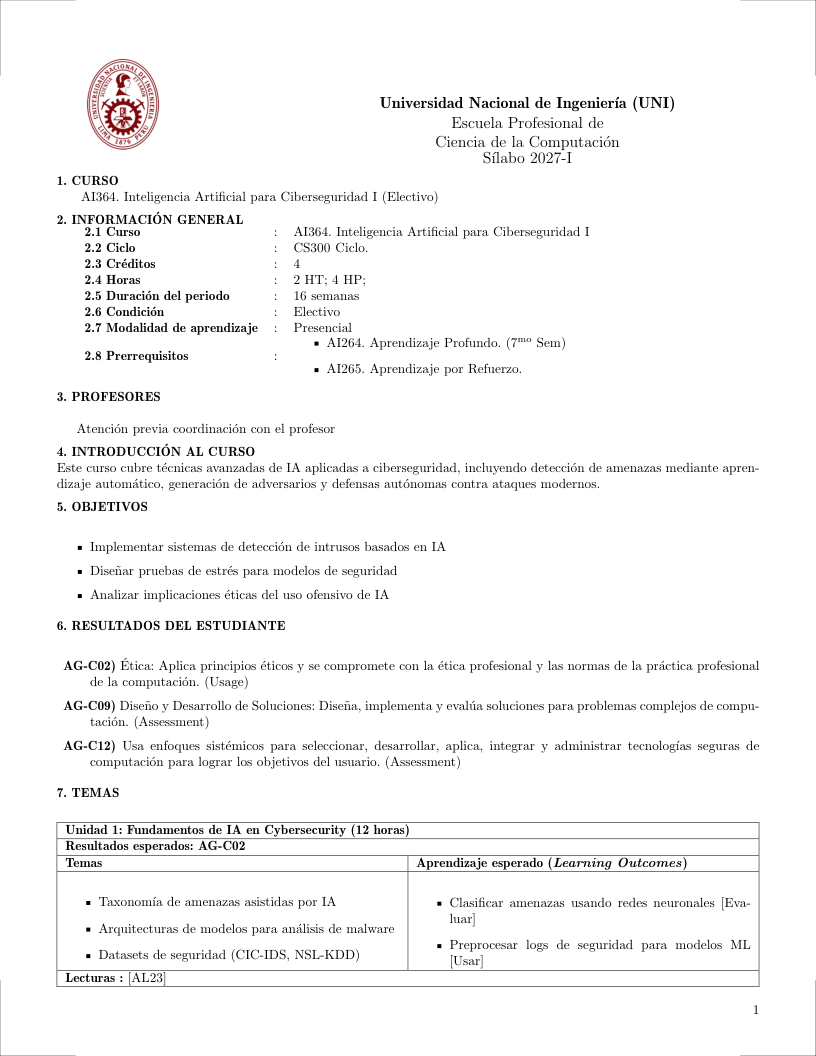
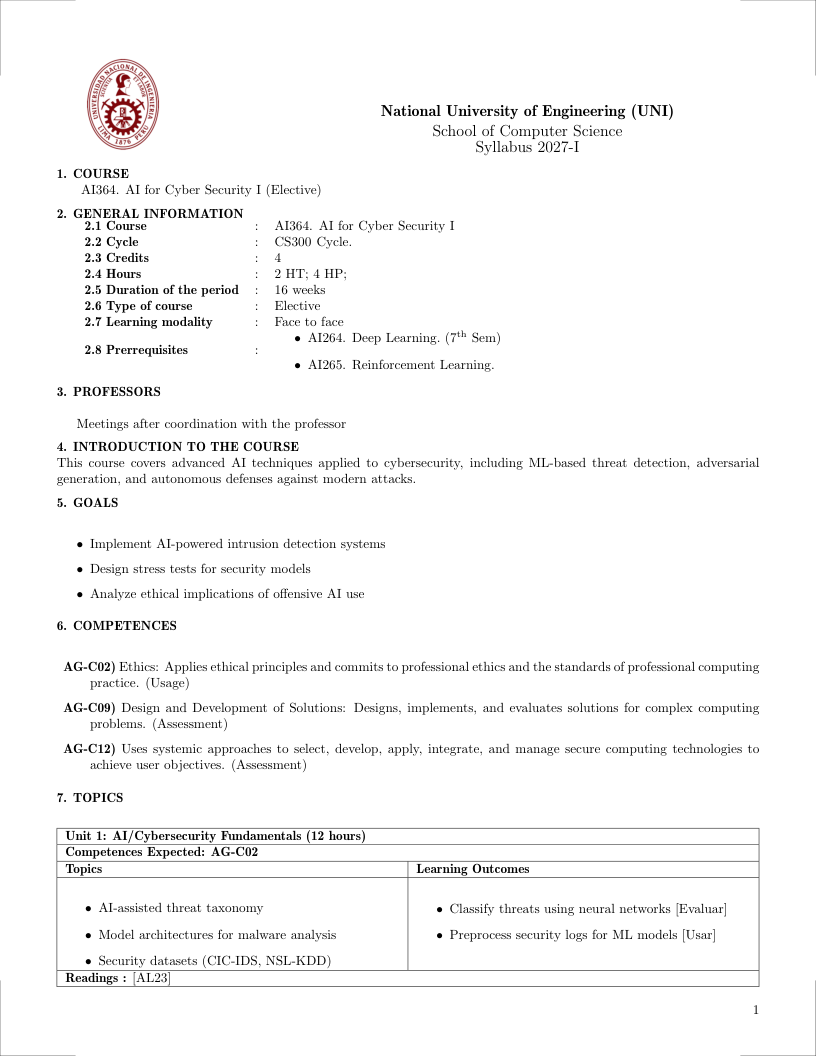
3.68. AI364 AI for Cyber Security I (Elective)
- Credits: 4
- Hour of this course: Theory: 2 hours; Laboratory: 4 hours;
- Syllabus:
 Español (Latinoamérica)
 English
- Prerrequisites:
- AI264 Deep Learning (7th Sem)
- AI265 Reinforcement Learning
- ES Español (Latinoamérica)
- EN English
3.68.1. Justification Back to top
This course covers advanced AI techniques applied to cybersecurity, including ML-based threat detection, adversarial generation, and autonomous defenses against modern attacks.
- ES Español (Latinoamérica)
- EN English
3.68.2. Generales Goals Back to top
- Implement AI-powered intrusion detection systems
- Design stress tests for security models
- Analyze ethical implications of offensive AI use
- ES Español (Latinoamérica)
- EN English
3.68.3. Contribution to Outcomes Back to top
- AG-C02) Ethics: Applies ethical principles and commits to professional ethics and the standards of professional computing practice. (Usage)
- AG-C09) Design and Development of Solutions: Designs, implements, and evaluates solutions for complex computing problems. (Assessment)
- AG-C12) Applies computer science theory and software development fundamentals to produce computer-based solutions. (Assessment)
- ES Español (Latinoamérica)
- EN English
3.68.4. Content Back to top
- ES Español (Latinoamérica)
- EN English
3.68.4.1. AI/Cybersecurity Fundamentals (12 hours) [Skills AG-C02] Back to top
Bibliography: (Apruzzese and Laskov, 2023)
Topics
- AI-assisted threat taxonomy
- Model architectures for malware analysis
- Security datasets (CIC-IDS, NSL-KDD)
Learning Outcomes
- Classify threats using neural networks [Assessment]
- Preprocess security logs for ML models [Usage]
- ES Español (Latinoamérica)
- EN English
3.68.4.2. Attacks & Defenses (24 hours) [Skills AG-C02] Back to top
Bibliography: (Goodfellow et al., 2014b; Anderson and Roth, 2020)
Topics
- Adversarial examples in security models
- Automated exploit generation (RL-based fuzzing)
- Self-adaptive detection systems
Learning Outcomes
- Implement adversarial attacks on ML models [Usage]
- Design metamorphic defenses [Assessment]
- ES Español (Latinoamérica)
- EN English
3.68.4.3. Cybersecurity Ethics (8 hours) [Skills AG-C02] Back to top
Bibliography: (Apruzzese and Laskov, 2023)
Topics
- Autonomous cyber weapons
- Liability for AI-generated vulnerabilities
- International regulations (AI Cyber Initiative)
Learning Outcomes
- Evaluate risks of autonomous systems [Familiarity]
- Design accountability protocols [Usage]
- ES Español (Latinoamérica)
- EN English
3.68.5. Bibliography Back to top
Apruzzese, G. and Laskov, P. (2023). AI for Cybersecurity. Springer.
Goodfellow, I., Shlens, J., and Szegedy, C. (2014b). Explaining and Harnessing Adversarial Examples. ICLR.
Anderson, H. and Roth, P. (2020). Metamorphic testing for adversarial defenses. ACM CCS.