- ES Español (Latinoamérica)

- EN English

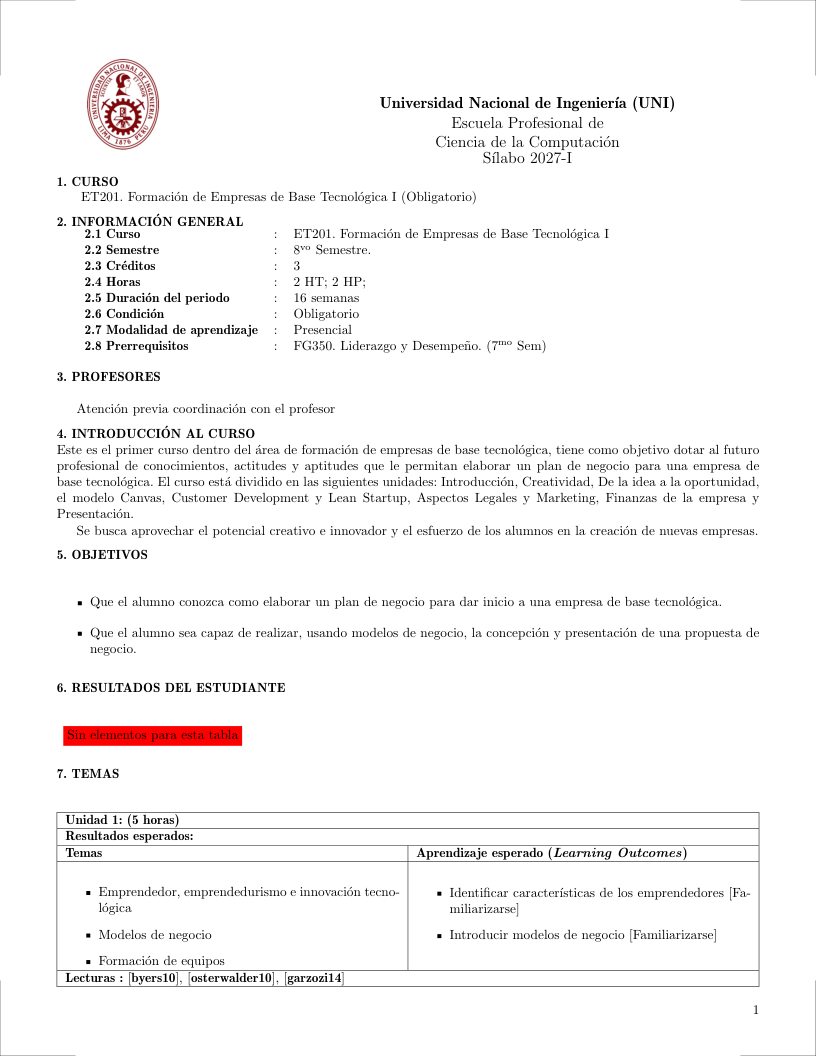
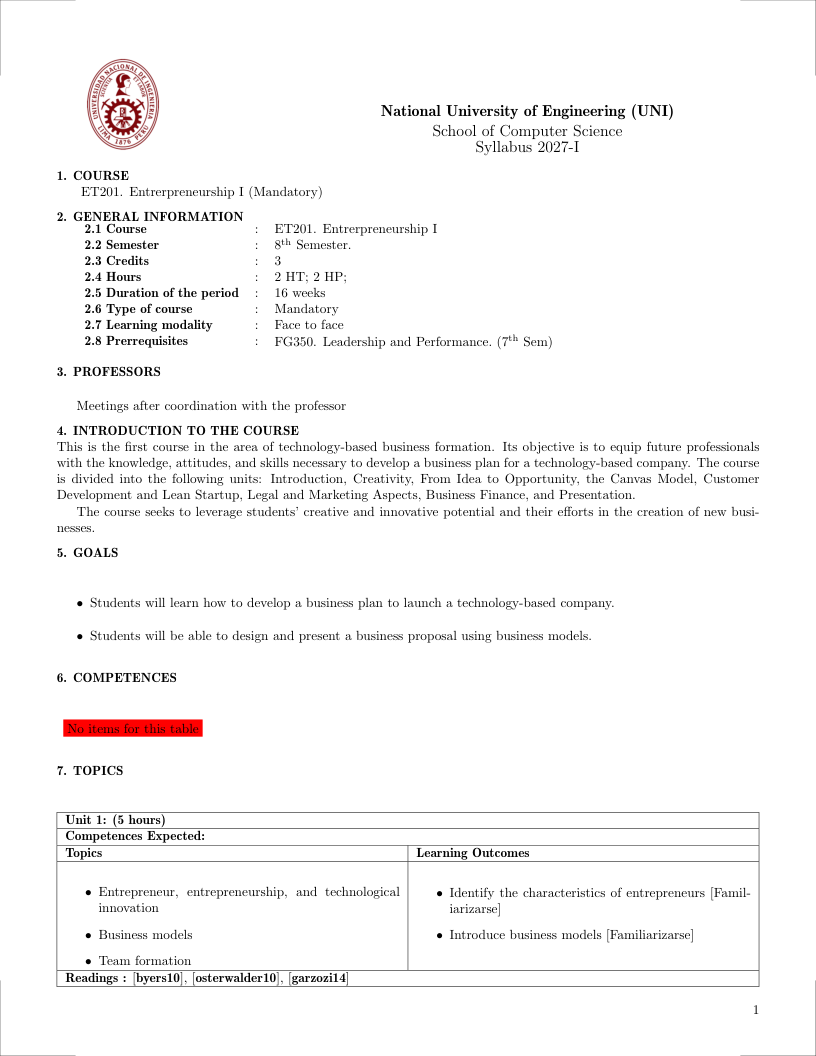
3.81. ET201 Entrerpreneurship I (Elective)
- Credits: 3
- Hour of this course: Theory: 2 hours; Practice: 2 hours;
- Syllabus:
 Español (Latinoamérica)
 English
- Prerrequisites:
- ES Español (Latinoamérica)
- EN English
3.81.1. Justification Back to top
This is the first course in the area of technology-based business formation. Its objective is to equip future professionals with the knowledge, attitudes, and skills necessary to develop a business plan for a technology-based company. The course is divided into the following units: Introduction, Creativity, From Idea to Opportunity, the Canvas Model, Customer Development and Lean Startup, Legal and Marketing Aspects, Business Finance, and Presentation.
The course seeks to leverage students' creative and innovative potential and their efforts in the creation of new businesses.
- ES Español (Latinoamérica)
- EN English
3.81.2. Generales Goals Back to top
- Students will learn how to develop a business plan to launch a technology-based company.
- Students will be able to design and present a business proposal using business models.
- ES Español (Latinoamérica)
- EN English
3.81.3. Contribution to Outcomes Back to top
- EMP-1) Apply entrepreneurship principles to identify business opportunities and develop a viable business model. (Assessment)
- AG-C02) Ethics: Applies ethical principles and commits to professional ethics and the standards of professional computing practice. (Usage)
- AG-C03) Individual and Team Work: Performs effectively as an individual and as a member or leader in diverse teams. (Usage)
- AG-C04) Communication: Communicates effectively in complex computing activities. (Usage)
- ES Español (Latinoamérica)
- EN English
3.81.4. Content Back to top
- ES Español (Latinoamérica)
- EN English
3.81.4.1. Introduction (5 hours) [Skills AG-C03,EMP-1] Back to top
Bibliography: (Byers et al., 2010; Osterwalder and Pigneur, 2010; Garzozi-Pincay et al., 2014)
Topics
- Entrepreneur, entrepreneurship, and technological innovation
- Business models
- Team formation
Learning Outcomes
- Identify the characteristics of entrepreneurs [Familiarity]
- Introduce business models [Familiarity]
- ES Español (Latinoamérica)
- EN English
3.81.4.2. Creativity (5 hours) [Skills EMP-1] Back to top
Bibliography: (Byers et al., 2010; Blank and Dorf, 2012; Garzozi-Pincay et al., 2014)
Topics
- Vision
- Mission
- Value proposition
- Creativity and invention
- Types and sources of innovation
- Strategy and technology
- Scale and scope
Learning Outcomes
- Correctly formulate a company's vision and mission [Usage]
- Characterize an innovative value proposition [Assessment]
- Identify different types and sources of innovation [Familiarity]
- ES Español (Latinoamérica)
- EN English
3.81.4.3. From Idea to Opportunity (5 hours) [Skills EMP-1] Back to top
Bibliography: (Byers et al., 2010; Osterwalder and Pigneur, 2010; Ries, 2011; Garzozi-Pincay et al., 2014)
Topics
- Business strategy
- Barriers
- Sustainable competitive advantage
- Alliances
- Organizational learning
- Product development and design
Learning Outcomes
- Understand business strategies [Familiarity]
- Characterize barriers and competitive advantages [Familiarity]
- ES Español (Latinoamérica)
- EN English
3.81.4.4. The Canvas Model (20 hours) [Skills EMP-1] Back to top
Bibliography: (Osterwalder and Pigneur, 2010; Blank and Dorf, 2012; Garzozi-Pincay et al., 2014)
Topics
- Creating a new business
- The business plan
- Canvas
- Elements of the Canvas
Learning Outcomes
- Understand the elements of the Canvas model [Usage]
- Develop a business plan based on the Canvas model [Usage]
- ES Español (Latinoamérica)
- EN English
3.81.4.5. Customer Development and Lean Startup (20 hours) [Skills EMP-1] Back to top
Bibliography: (Blank and Dorf, 2012; Ries, 2011; Garzozi-Pincay et al., 2014)
Topics
- Acceleration vs. incubation
- Customer Development
- Lean Startup
Learning Outcomes
- Understand and apply the Customer Development model [Usage]
- Understand and apply the Lean Startup model [Usage]
- ES Español (Latinoamérica)
- EN English
3.81.4.6. Legal and Marketing Aspects (5 hours) [Skills AG-C02,EMP-1] Back to top
Bibliography: (Byers et al., 2010; Ries, 2011; Congreso de la Republica del Perú, 1996; de la Republica del Peru, 1997; Garzozi-Pincay et al., 2014)
Topics
- Legal and tax aspects for company formation
- Intellectual property
- Patents
- Copyrights and trademarks
- Marketing objectives and market segments
- Market research and customer acquisition
Learning Outcomes
- Understand the legal aspects necessary for forming a technology company [Familiarity]
- Identify market segments and marketing objectives [Familiarity]
- ES Español (Latinoamérica)
- EN English
3.81.4.7. Business Finance (5 hours) [Skills EMP-1] Back to top
Bibliography: (Byers et al., 2010; Blank and Dorf, 2012; Garzozi-Pincay et al., 2014)
Topics
- Cost model
- Profit model
- Pricing
- Financial plan
- Financing methods
- Sources of capital
- Venture capital
Learning Outcomes
- Define a cost and profit model [Assessment]
- Understand various financing sources [Familiarity]
- ES Español (Latinoamérica)
- EN English
3.81.4.8. Presentation (5 hours) [Skills AG-C04,EMP-1] Back to top
Bibliography: (Byers et al., 2010; Blank and Dorf, 2012; Garzozi-Pincay et al., 2014)
Topics
- The Elevator Pitch
- Presentation
- Negotiation
Learning Outcomes
- Understand various methods for presenting business proposals [Familiarity]
- Deliver a business proposal presentation [Usage]
- ES Español (Latinoamérica)
- EN English
3.81.5. Bibliography Back to top
Byers, T., Dorf, R., and Nelson, A. (2010). Technology Ventures: From Idea to Enterprise. McGraw-Hill Science.
Osterwalder, A. and Pigneur, Y. (2010). Business Model Generation: A Handbook for Visionaries, Game Changers, and Challengers. Wiley.
Garzozi-Pincay, R., Messina-Scolaro, M., Moncada-Marino, C., Ochoa-Luna, J., Ilabel-Pérez, G., and Zambrano-Segura, R. (2014). Planes de Negocios para Emprendedores. Iniciativa Latinoamericana de Libros de Texto Abiertos (LATIn).
Blank, S. and Dorf, B. (2012). The Startup Owner's Manual: The Step-By-Step Guide for Building a Great Company. K and S Ranch.
Ries, E. (2011). The Lean Startup: How Today's Entrepreneurs Use Continuous Innovation to Create Radically Successful Businesses. Crown Business.
Congreso de la Republica del Perú (1996). Decreto Legislativo Nº823. Ley de la Propiedad Industrial. El Peruano.
de la Republica del Peru, C. (1997). Ley Nº26887. Ley General de Sociedades. El Peruano.