- ES Español (Latinoamérica)

- EN English

3.22. BRC120 National Reality, Constitution, and Human Rights (Mandatory)
- Cycle: 4th Sem.
- Credits: 2
- Hour of this course: Theory: 2 hours;
- Syllabus:
 Español (Latinoamérica)
 English
- Prerrequisites: None
- ES Español (Latinoamérica)
- EN English
3.22.1. Justification Back to top
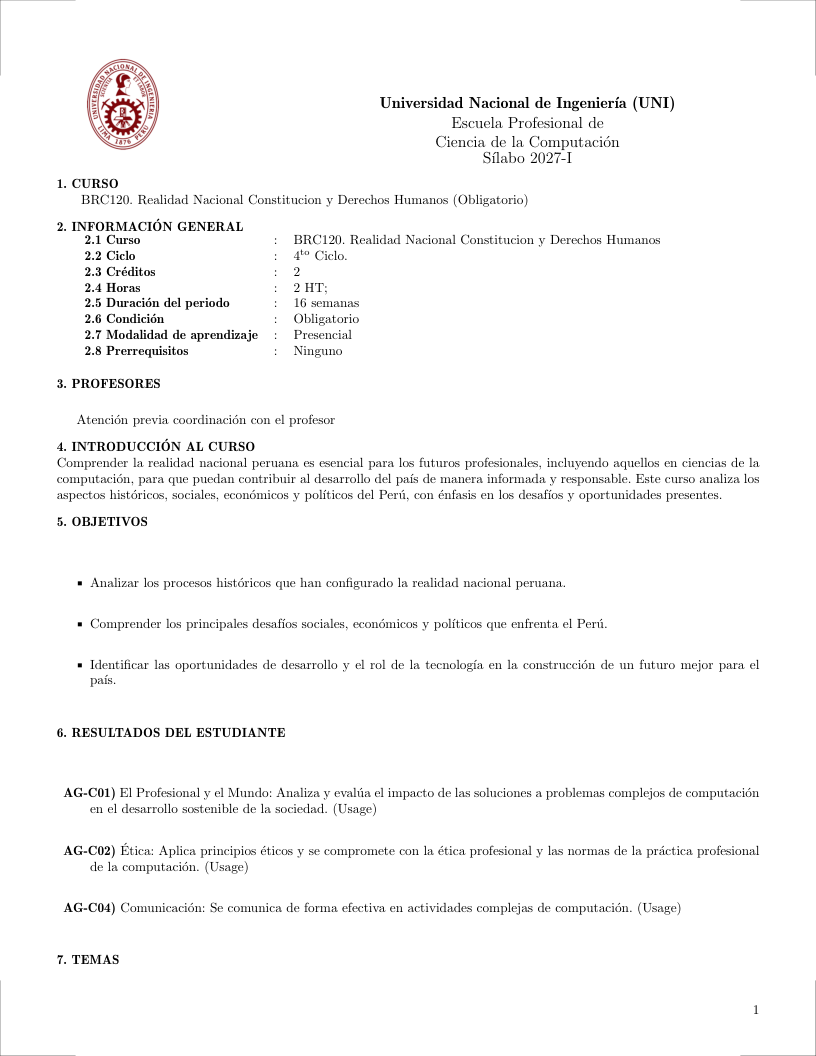
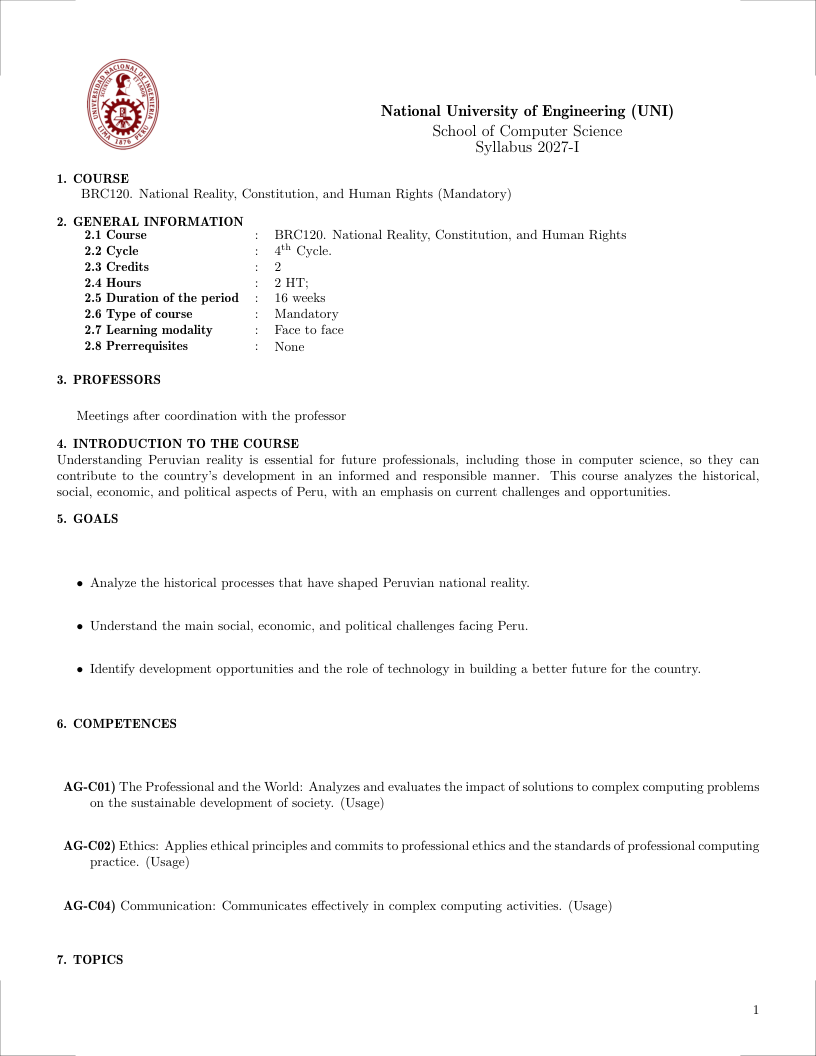
Understanding Peruvian reality is essential for future professionals, including those in computer science, so they can contribute to the country's development in an informed and responsible manner. This course analyzes the historical, social, economic, and political aspects of Peru, with an emphasis on current challenges and opportunities.
- ES Español (Latinoamérica)
- EN English
3.22.2. Generales Goals Back to top
- Analyze the historical processes that have shaped Peruvian national reality.
- Understand the main social, economic, and political challenges facing Peru.
- Identify development opportunities and the role of technology in building a better future for the country.
- ES Español (Latinoamérica)
- EN English
3.22.3. Contribution to Outcomes Back to top
- AG-C01) The Professional and the World: Analyzes and evaluates the impact of solutions to complex computing problems on the sustainable development of society. (Usage)
- AG-C02) Ethics: Applies ethical principles and commits to professional ethics and the standards of professional computing practice. (Usage)
- AG-C04) Communication: Communicates effectively in complex computing activities. (Usage)
- ES Español (Latinoamérica)
- EN English
3.22.4. Content Back to top
- ES Español (Latinoamérica)
- EN English
3.22.4.1. History of Peru (8 hours) [Skills AG-C02,AG-C04] Back to top
Bibliography: (Klarén, 2012; Cotler, 2005)
Topics
- Pre-Hispanic Peru.
- Colonial era.
- Republican Peru: 19th and 20th centuries.
Learning Outcomes
- Describe the main periods of Peruvian history. [Familiarity]
- Analyze the key events that have shaped national identity. [Usage]
- Explain the influence of the past on Peru's current reality. [Assessment]
- ES Español (Latinoamérica)
- EN English
3.22.4.2. Cultural and Social Diversity (8 hours) [Skills AG-C02,AG-C04] Back to top
Bibliography: (Portocarrero, 2001; Manrique, 1988)
Topics
- Cultural diversity of Peru.
- Ethnic and linguistic groups.
- Social inequality and exclusion.
Learning Outcomes
- Identify the different cultural groups that make up Peru. [Familiarity]
- Analyze the causes and consequences of social inequality. [Usage]
- Propose solutions to promote social inclusion. [Assessment]
- ES Español (Latinoamérica)
- EN English
3.22.4.3. Peruvian Economy (8 hours) [Skills AG-C02,AG-C04] Back to top
Bibliography: (Óscar Dancourt, 2013; Hunt, 2018)
Topics
- Economic structure of Peru.
- Economic sectors: mining, agriculture, industry, services.
- International trade.
- Economic challenges and sustainable development.
Learning Outcomes
- Describe the economic structure of Peru. [Familiarity]
- Analyze the importance of the different economic sectors. [Usage]
- Evaluate economic policies and their impact on sustainable development. [Assessment]
- ES Español (Latinoamérica)
- EN English
3.22.4.4. Peruvian Political System (8 hours) [Skills AG-C02,AG-C04] Back to top
Bibliography: (Tanaka, 2018; Quiroz, 2013)
Topics
- Organization of the Peruvian State.
- Democracy and governance.
- Corruption and transparency.
Learning Outcomes
- Describe the organization of the Peruvian State. [Familiarity]
- Analyze the challenges to democracy and governance in Peru. [Usage]
- Evaluate the importance of transparency and the fight against corruption. [Assessment]
- ES Español (Latinoamérica)
- EN English
3.22.4.5. Technology and Development in Peru (8 hours) [Skills AG-C02,AG-C04] Back to top
Bibliography: (de Economía y Finanzas Perú, 2019)
Topics
- The role of technology in Peru's development.
- Digital divide and digital inclusion.
- Technological innovation and entrepreneurship.
Learning Outcomes
- Analyze the importance of technology for Peru's economic and social development. [Familiarity]
- Propose solutions to reduce the digital divide. [Usage]
- Evaluate the potential of technological innovation and entrepreneurship in Peru. [Assessment]
- ES Español (Latinoamérica)
- EN English
3.22.4.6. Challenges and Opportunities for the Future (8 hours) [Skills AG-C01,AG-C02,AG-C04] Back to top
Bibliography: (CEPLAN, 2021)
Topics
- Sustainable development.
- Peru's vision for 2050.
- The role of professionals in building the future.
Learning Outcomes
- Analyze the challenges Peru faces in achieving sustainable development. [Familiarity]
- Understand the long-term vision for the country's development. [Usage]
- Reflect on the role of professionals in building a better future for Peru. [Assessment]
- Evaluate the impact of computing solutions on Peru's sustainable social development. [Assessment]
- ES Español (Latinoamérica)
- EN English
3.22.5. Bibliography Back to top
Klarén, P. F. (2012). Nación y sociedad en la historia del Perú. IEP.
Cotler, J. (2005). Clases, Estado y Nación en el Perú. IEP.
Portocarrero, G. (2001). Rostros criollos del Perú: cultura, sociedad, política. PUCP.
Manrique, N. (1988). Yawar Fiesta: una ceremonia de sangre. DESCO.
Óscar Dancourt (2013). La economía peruana: siglos XIX y XX. PUCP.
Hunt, S. (2018). El Perú en el siglo XXI. IEP.
Tanaka, M. (2018). Democracia y política en el Perú. IEP.
Quiroz, A. W. (2013). Historia de la corrupción en el Perú. IEP.
de Economía y Finanzas Perú, M. (2019). Plan Nacional de Competitividad y Productividad 2019-2030.
CEPLAN (2021). Bases del plan estratégico de desarrollo nacional: Perú al 2050.