- ES Español (Latinoamérica)

- EN English

3.62. AI261 Probability and Statistics for AI (Elective)
- Credits: 4
- Hour of this course: Theory: 2 hours; Laboratory: 4 hours;
- Syllabus:
 Español (Latinoamérica)
 English
- Prerrequisites:
- BMA102 Differential Calculus (1st Sem)
- BMA101 Linear Algebra (1st Sem)
- STA251 Probability Calculation (2nd Sem)
- ES Español (Latinoamérica)
- EN English
3.62.1. Justification Back to top
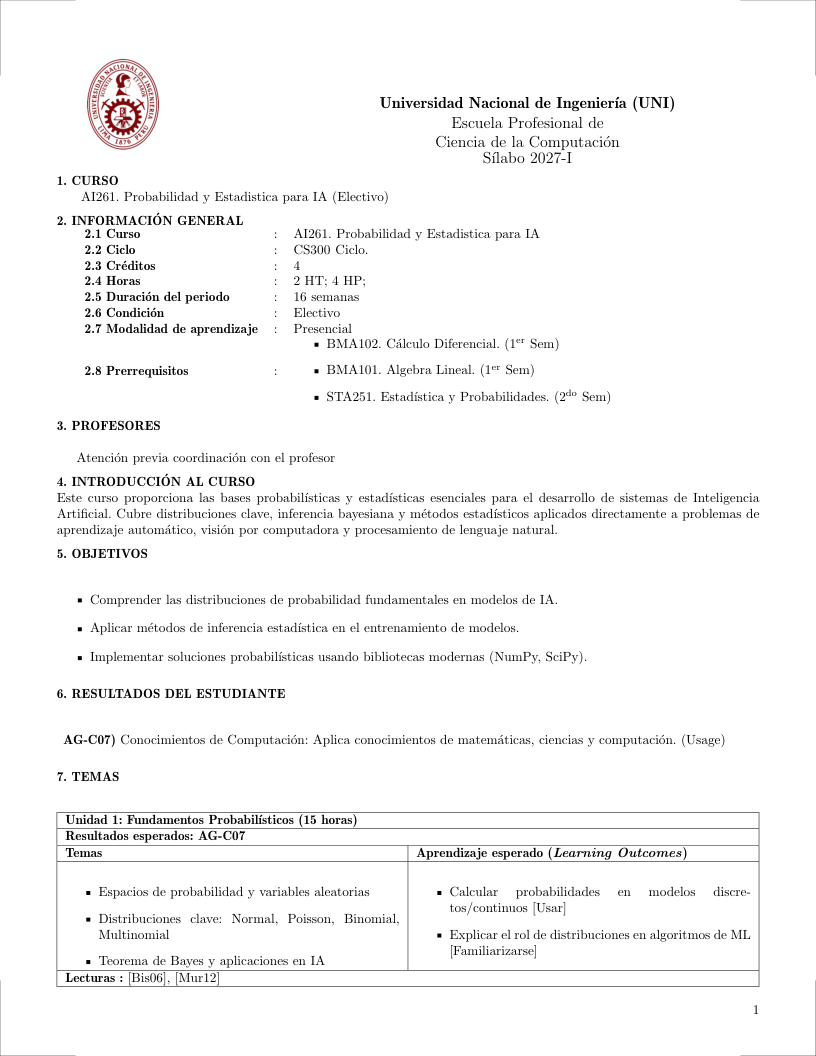
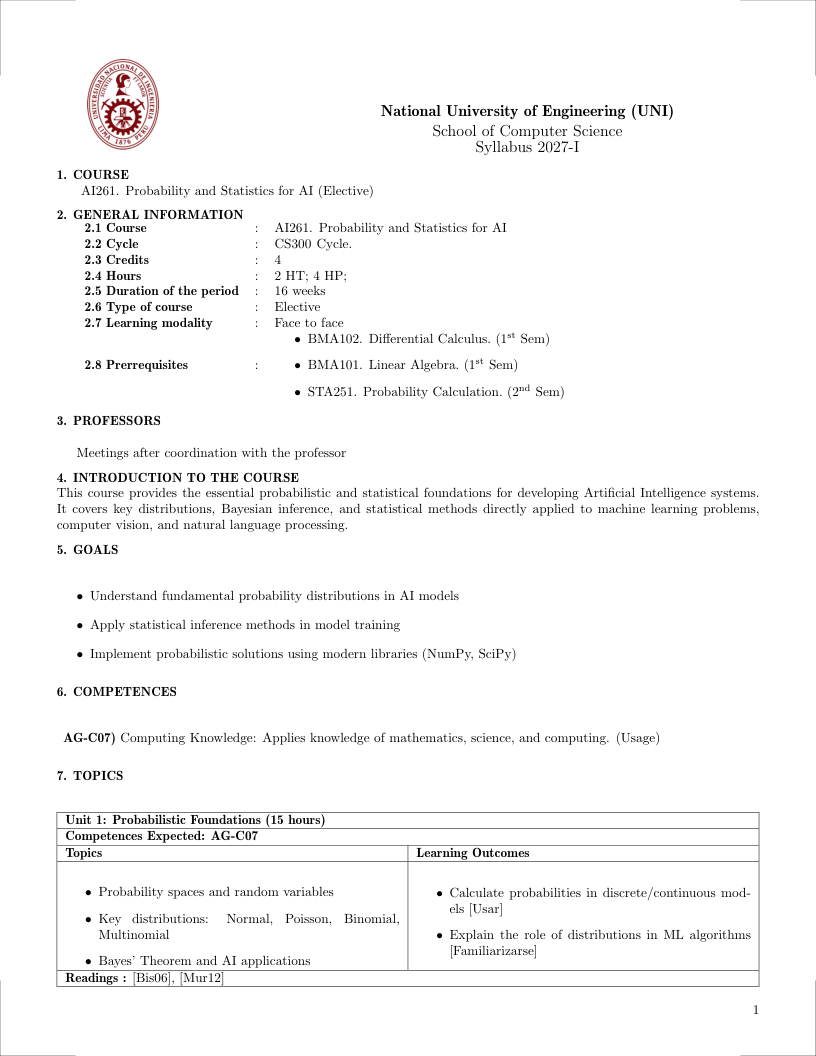
This course provides the essential probabilistic and statistical foundations for developing Artificial Intelligence systems. It covers key distributions, Bayesian inference, and statistical methods directly applied to machine learning problems, computer vision, and natural language processing.
- ES Español (Latinoamérica)
- EN English
3.62.2. Generales Goals Back to top
- Understand fundamental probability distributions in AI models
- Apply statistical inference methods in model training
- Implement probabilistic solutions using modern libraries (NumPy, SciPy)
- ES Español (Latinoamérica)
- EN English
3.62.3. Contribution to Outcomes Back to top
- AG-C07) Computing Knowledge: Applies knowledge of mathematics, science, and computing. (Usage)
- ES Español (Latinoamérica)
- EN English
3.62.4. Content Back to top
- ES Español (Latinoamérica)
- EN English
3.62.4.1. Probabilistic Foundations (15 hours) [Skills AG-C07] Back to top
Bibliography: (Bishop, 2006; Murphy, 2012)
Topics
- Probability spaces and random variables
- Key distributions: Normal, Poisson, Binomial, Multinomial
- Bayes' Theorem and AI applications
Learning Outcomes
- Calculate probabilities in discrete/continuous models [Usage]
- Explain the role of distributions in ML algorithms [Familiarity]
- ES Español (Latinoamérica)
- EN English
3.62.4.2. Statistics for AI (15 hours) [Skills AG-C07] Back to top
Bibliography: (DeGroot and Schervish, 2014; Wasserman, 2004)
Topics
- Parameter estimation (MLE, MAP)
- Confidence intervals and hypothesis testing
- Correlation analysis and linear regression
Learning Outcomes
- Implement MLE/MAP in Python [Usage]
- Evaluate statistical significance in model results [Assessment]
- ES Español (Latinoamérica)
- EN English
3.62.4.3. Markov Chains and Stochastic Processes (15 hours) [Skills AG-C07] Back to top
Bibliography: (Ross, 2019; Bishop, 2006)
Topics
- Hidden Markov Models (HMMs)
- Markov Chain Monte Carlo (MCMC)
- Applications in NLP and computer vision
Learning Outcomes
- Simulate basic stochastic processes [Usage]
- Relate theory to neural network architectures [Familiarity]
- ES Español (Latinoamérica)
- EN English
3.62.4.4. Computational Tools (15 hours) [Skills AG-C07] Back to top
Bibliography: (VanderPlas, 2016; McKinney, 2022)
Topics
- NumPy for probabilistic operations
- SciPy for statistical tests
- Visualization with Matplotlib/Seaborn
Learning Outcomes
- Program probabilistic simulations [Usage]
- Generate statistical visualizations [Assessment]
- ES Español (Latinoamérica)
- EN English
3.62.5. Bibliography Back to top
Bishop, C. M. (2006). Pattern Recognition and Machine Learning. Springer.
Murphy, K. P. (2012). Machine Learning: A Probabilistic Perspective. MIT Press.
DeGroot, M. H. and Schervish, M. J. (2014). Probability and Statistics. Pearson, 4th edition.
Wasserman, L. (2004). All of Statistics: A Concise Course in Statistical Inference. Springer. Aunque es de 2004, sigue siendo referencia estándar.
Ross, S. M. (2019). Introduction to Probability Models. Academic Press, 12th edition.
VanderPlas, J. (2016). Python Data Science Handbook. O'Reilly.
McKinney, W. (2022). Python for Data Analysis. O'Reilly, 3rd edition.