- ES Español (Latinoamérica)

- EN English

3.21. MA213 Differential Equations (Mandatory)
- Cycle: 4th Sem.
- Credits: 4
- Hour of this course: Theory: 2 hours; Practice: 4 hours;
- Syllabus:
 Español (Latinoamérica)
 English
- Prerrequisites:
- BMA103 Integral Calculus (2nd Sem)
- ES Español (Latinoamérica)
- EN English
3.21.1. Justification Back to top
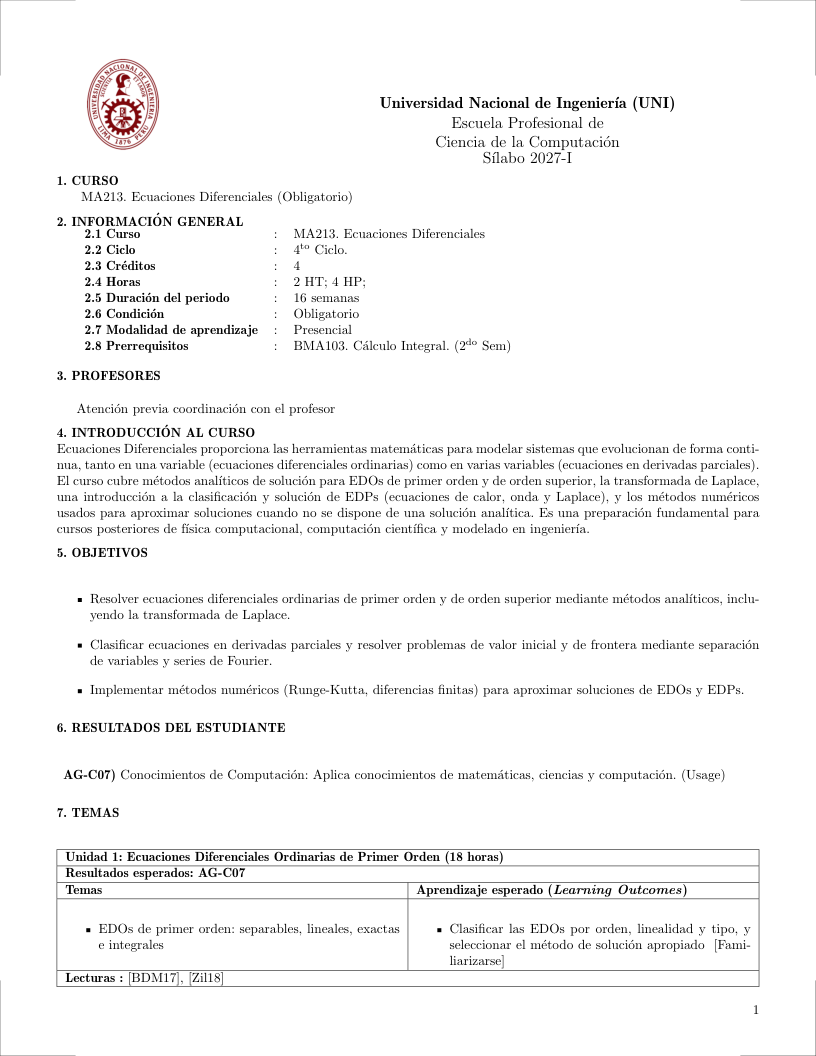
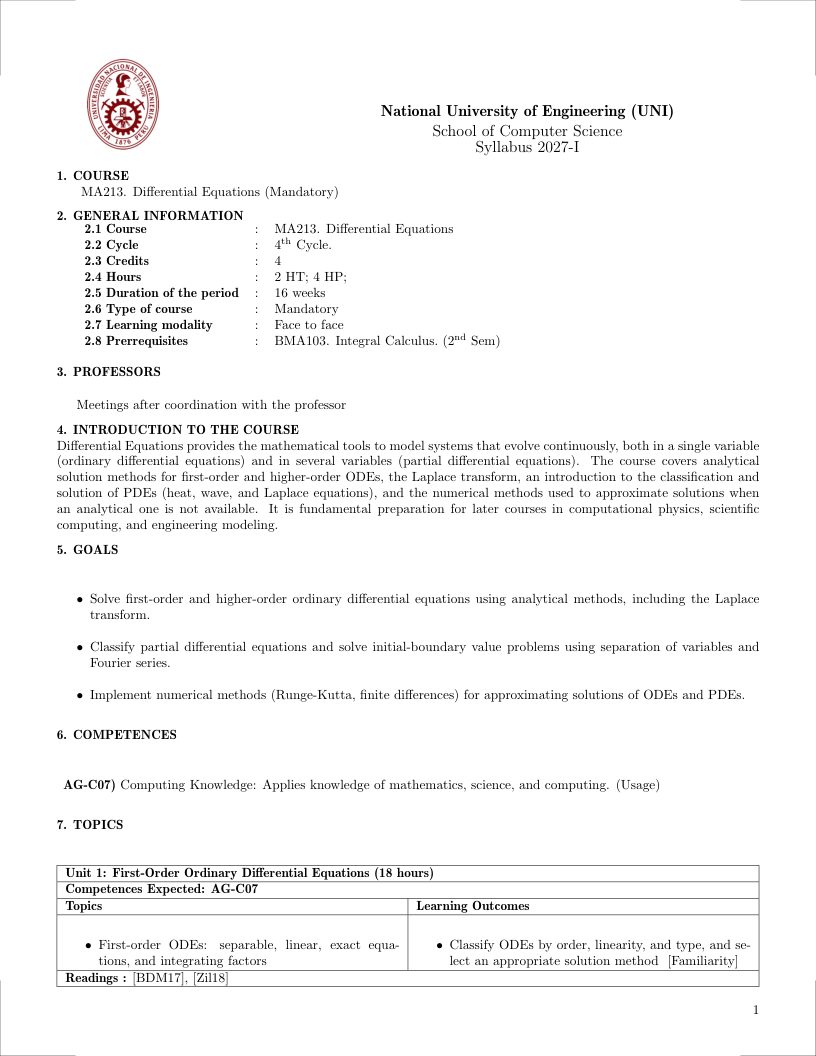
Differential Equations provides the mathematical tools to model systems that evolve continuously, both in a single variable (ordinary differential equations) and in several variables (partial differential equations). The course covers analytical solution methods for first-order and higher-order ODEs, the Laplace transform, an introduction to the classification and solution of PDEs (heat, wave, and Laplace equations), and the numerical methods used to approximate solutions when an analytical one is not available. It is fundamental preparation for later courses in computational physics, scientific computing, and engineering modeling.
- ES Español (Latinoamérica)
- EN English
3.21.2. Generales Goals Back to top
- Solve first-order and higher-order ordinary differential equations using analytical methods, including the Laplace transform.
- Classify partial differential equations and solve initial-boundary value problems using separation of variables and Fourier series.
- Implement numerical methods (Runge-Kutta, finite differences) for approximating solutions of ODEs and PDEs.
- ES Español (Latinoamérica)
- EN English
3.21.3. Contribution to Outcomes Back to top
- AG-C07) Computing Knowledge: Applies knowledge of mathematics, science, and computing. (Usage)
- ES Español (Latinoamérica)
- EN English
3.21.4. Content Back to top
- ES Español (Latinoamérica)
- EN English
3.21.4.1. First-Order Ordinary Differential Equations (18 hours) [Skills AG-C07] Back to top
Bibliography: (Boyce et al., 2017; Zill, 2018)
Topics
- First-order ODEs: separable, linear, exact equations, and integrating factors
Learning Outcomes
- Classify ODEs by order, linearity, and type, and select an appropriate solution method [Familiarity]
- ES Español (Latinoamérica)
- EN English
3.21.4.2. Higher-Order Differential Equations and Systems (30 hours) [Skills AG-C07] Back to top
Bibliography: (Boyce et al., 2017; Zill, 2018; Nagle et al., 2017)
Topics
- Higher-order linear ODEs: characteristic equations, variation of parameters, and undetermined coefficients
- Systems of linear ODEs: matrix exponential, eigenvalue methods, and phase portraits
- Existence and uniqueness theorems (Picard-Lindelöf) and continuation of solutions
- Laplace transform methods for solving ODEs with discontinuous forcing
Learning Outcomes
- Solve linear systems of ODEs using eigenvalue methods and sketch their phase portraits [Usage]
- Apply the Laplace transform to solve ODEs with piecewise and impulsive forcing functions [Assessment]
- ES Español (Latinoamérica)
- EN English
3.21.4.3. Partial Differential Equations (26 hours) [Skills AG-C07] Back to top
Bibliography: (Haberman, 2013)
Topics
- Classification of second-order linear PDEs: elliptic, parabolic, and hyperbolic
- Fourier series and separation of variables for the heat and wave equations
- Green's functions for the Laplace and Poisson equations
- Method of characteristics for first-order and hyperbolic PDEs; shock formation
- Weak solutions, Sobolev spaces, and variational formulations of elliptic problems
Learning Outcomes
- Classify a second-order PDE and identify the appropriate solution strategy [Familiarity]
- Apply separation of variables and Fourier series to solve initial-boundary value problems [Usage]
- Derive weak formulations of elliptic PDEs and prove existence of solutions using the Lax-Milgram theorem [Assessment]
- ES Español (Latinoamérica)
- EN English
3.21.4.4. Numerical Methods for Differential Equations (26 hours) [Skills AG-C07] Back to top
Bibliography: (Burden and Faires, 2010; Haberman, 2013)
Topics
- Runge-Kutta methods: Euler, RK4, and embedded methods for error control
- Linear multistep methods: Adams-Bashforth, Adams-Moulton, and BDF methods
- Stability analysis: zero-stability, absolute stability regions, and stiff ODEs
- Finite difference methods for parabolic and elliptic PDEs: stability and convergence
Learning Outcomes
- Compare explicit and implicit ODE solvers and explain their relative stability for stiff problems [Familiarity]
- Implement a Runge-Kutta method with adaptive step control and apply it to a system of ODEs [Usage]
- Analyze the stability and convergence of a finite difference scheme for a parabolic PDE [Assessment]
- ES Español (Latinoamérica)
- EN English
3.21.5. Bibliography Back to top
Boyce, W. E., DiPrima, R. C., and Meade, D. B. (2017). Ecuaciones Diferenciales y Problemas con Valores en la Frontera. Limusa Wiley, 11th edition.
Zill, D. G. (2018). Ecuaciones Diferenciales con Aplicaciones de Modelado. Cengage Learning, 11th edition.
Nagle, R. K., Saff, E. B., and Snider, A. D. (2017). Fundamentals of Differential Equations. Pearson, 9th edition.
Haberman, R. (2013). Applied Partial Differential Equations with Fourier Series and Boundary Value Problems. Pearson, 5th edition.
Burden, R. L. and Faires, J. D. (2010). Numerical Analysis. Cengage Learning.