- ES Español (Latinoamérica)

- EN English

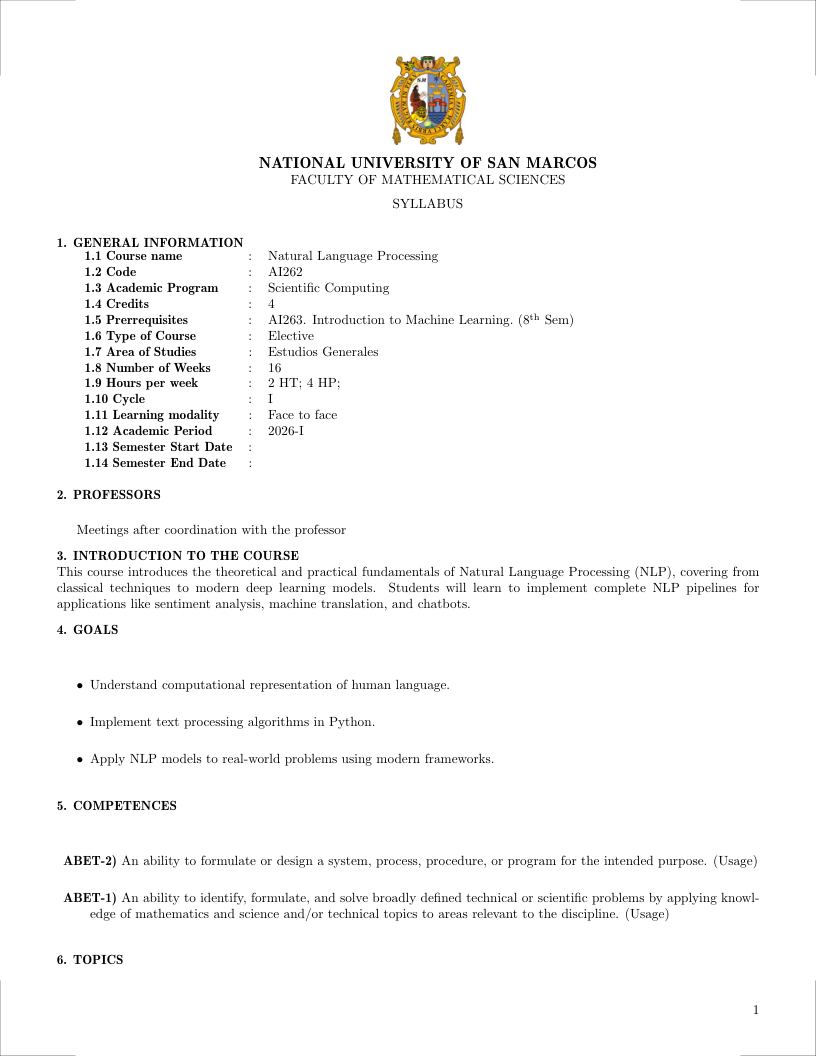
7.58. Natural Language Processing (Elective)
- Semester: 9th Sem. Credits: 4
- Hour of this course: Theory: 2 hours; Laboratory: 4 hours;
- Syllabus:
- htmlonly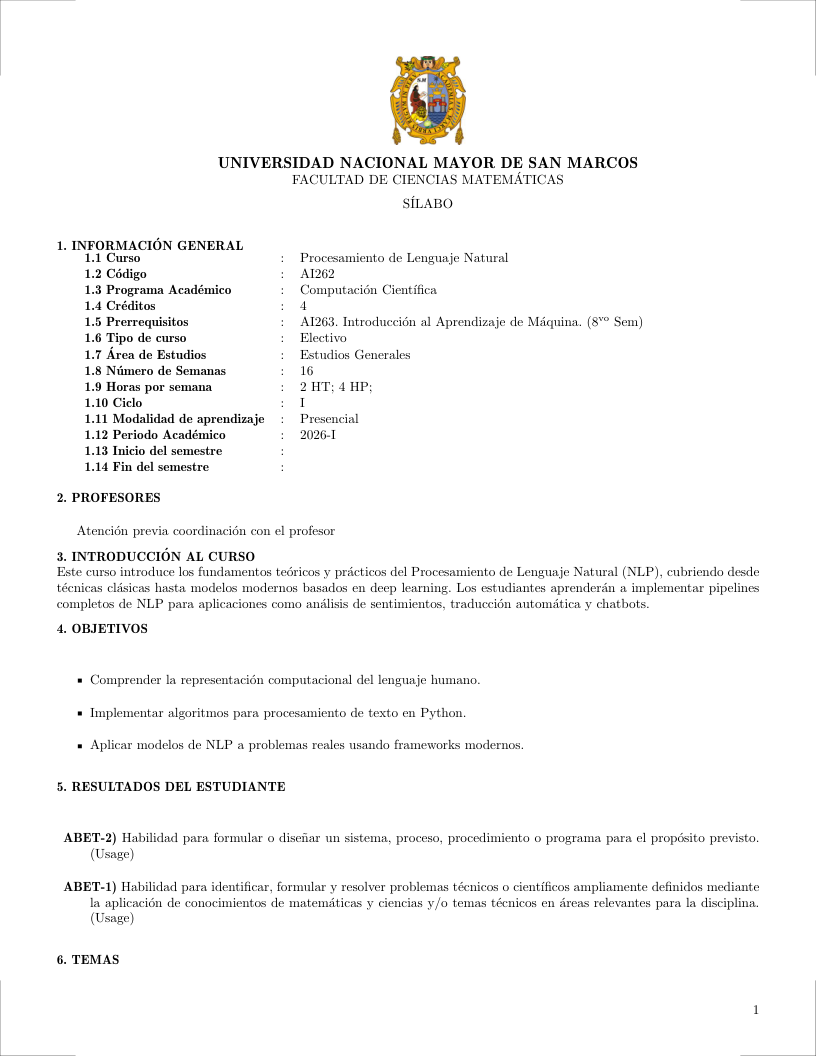
 Español (Latinoamérica)
 English
- Prerrequisites:
- AI263 Introduction to Machine Learning (8th Sem)
7.58.1. Justification ↑ Back to top
This course introduces the theoretical and practical fundamentals of Natural Language Processing (NLP), covering from classical techniques to modern deep learning models. Students will learn to implement complete NLP pipelines for applications like sentiment analysis, machine translation, and chatbots.
7.58.2. Generales Goals ↑ Back to top
- Understand computational representation of human language.
- Implement text processing algorithms in Python.
- Apply NLP models to real-world problems using modern frameworks.
7.58.3. Contribution to Outcomes ↑ Back to top
- ABET-2) An ability to formulate or design a system, process, procedure, or program for the intended purpose. (Usage)
- ABET-1) An ability to identify, formulate, and solve broadly defined technical or scientific problems by applying knowledge of mathematics and science and/or technical topics to areas relevant to the discipline. (Usage)
7.58.4. Content ↑ Back to top
7.58.4.1. NLP Fundamentals (15 hours) [Skills ABET-1,ABET-2] ↑ Back to top
Bibliography: (Jurafsky and Martin, 2021; Manning and Schütze, 1999)
Topics
- Tokenization and text representation
- N-gram models and smoothing
- Feature extraction (TF-IDF, word embeddings)
Learning Outcomes
- Preprocess text for NLP models [Usage]
- Explain limitations of classical statistical models [Familiarity]
7.58.4.2. Language Modeling (15 hours) [Skills ABET-1,ABET-2] ↑ Back to top
Bibliography: (Goldberg, 2017; Mikolov et al., 2013)
Topics
- Word2Vec, GloVe and FastText
- Recurrent Neural Networks (RNNs) for NLP
- Sequence-to-sequence models (seq2seq)
Learning Outcomes
- Train word embeddings [Usage]
- Implement basic RNNs for text generation [Assessment]
7.58.4.3. Transformers and Modern NLP (15 hours) [Skills ABET-1,ABET-2] ↑ Back to top
Bibliography: (Vaswani et al., 2017b; Devlin et al., 2019)
Topics
- Transformer architecture (self-attention)
- BERT and pre-trained models
- Fine-tuning for specific tasks
Learning Outcomes
- Apply pre-trained models with HuggingFace [Usage]
- Evaluate NLP performance metrics [Assessment]
7.58.4.4. Practical Applications (15 hours) [Skills ABET-1,ABET-2] ↑ Back to top
Bibliography: (Jurafsky and Martin, 2021; Chollet, 2021)
Topics
- Sentiment analysis with transformers
- Question-answering systems
- Model deployment with Flask/FastAPI
Learning Outcomes
- Build a complete NLP pipeline [Usage]
- Optimize models for production [Assessment]
7.58.5. Bibliography ↑ Back to top
Jurafsky, D. and Martin, J. H. (2021). Speech and Language Processing. Pearson, 3rd edition.
Manning, C. D. and Schütze, H. (1999). Foundations of Statistical Natural Language Processing. MIT Press.
Goldberg, Y. (2017). Neural Network Methods for Natural Language Processing. Morgan & Claypool.
Mikolov, T., Chen, K., Corrado, G., and Dean, J. (2013). Efficient estimation of word representations in vector space. arXiv:1301.3781.
Vaswani, A., Shazeer, N., Parmar, N., Uszkoreit, J., Jones, L., Gomez, A. N., Kaiser, L., and Polosukhin, I. (2017b). Attention is all you need. Advances in Neural Information Processing Systems, 30.
Devlin, J., Chang, M.-W., Lee, K., and Toutanova, K. (2019). Bert: Pre-training of deep bidirectional transformers for language understanding. arXiv:1810.04805.
Chollet, F. (2021). Deep Learning with Python. Manning, 2nd edition.