- ES Español (Latinoamérica)

- EN English

7.17. Linear Algebra I (Mandatory)
- Semester: 3rd Sem. Credits: 4
- Hour of this course: Theory: 2 hours; Practice: 4 hours;
- Syllabus:
- htmlonly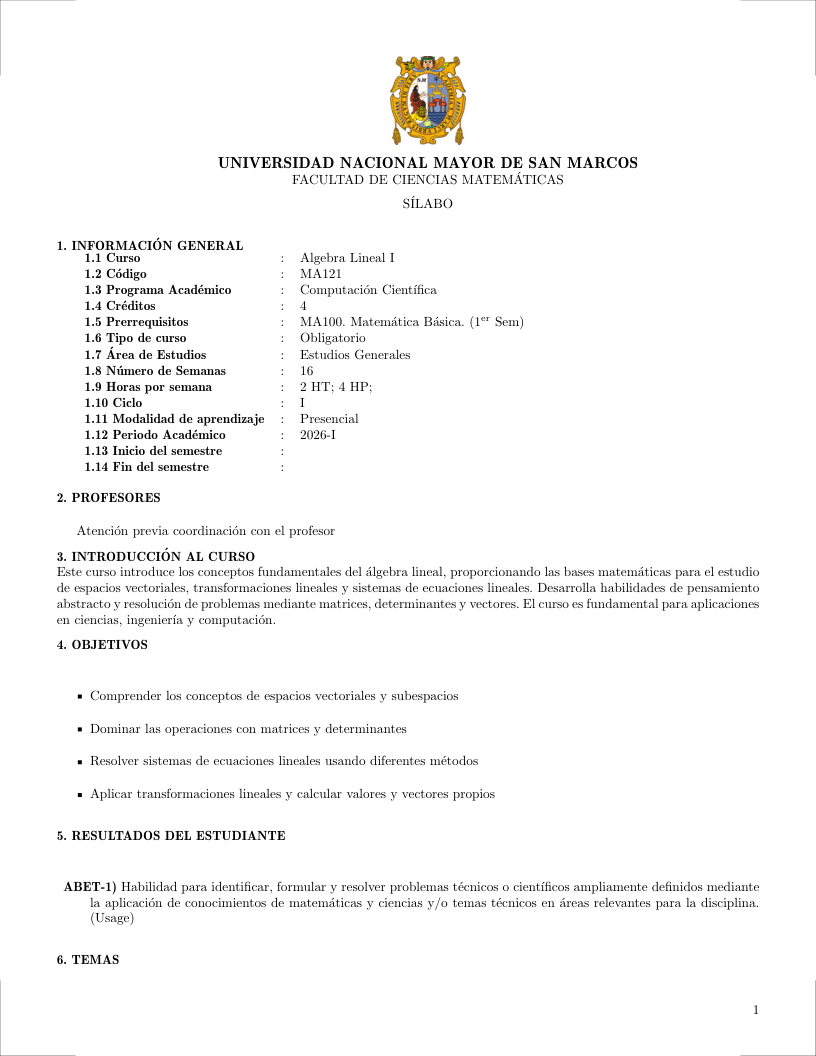
 Español (Latinoamérica)
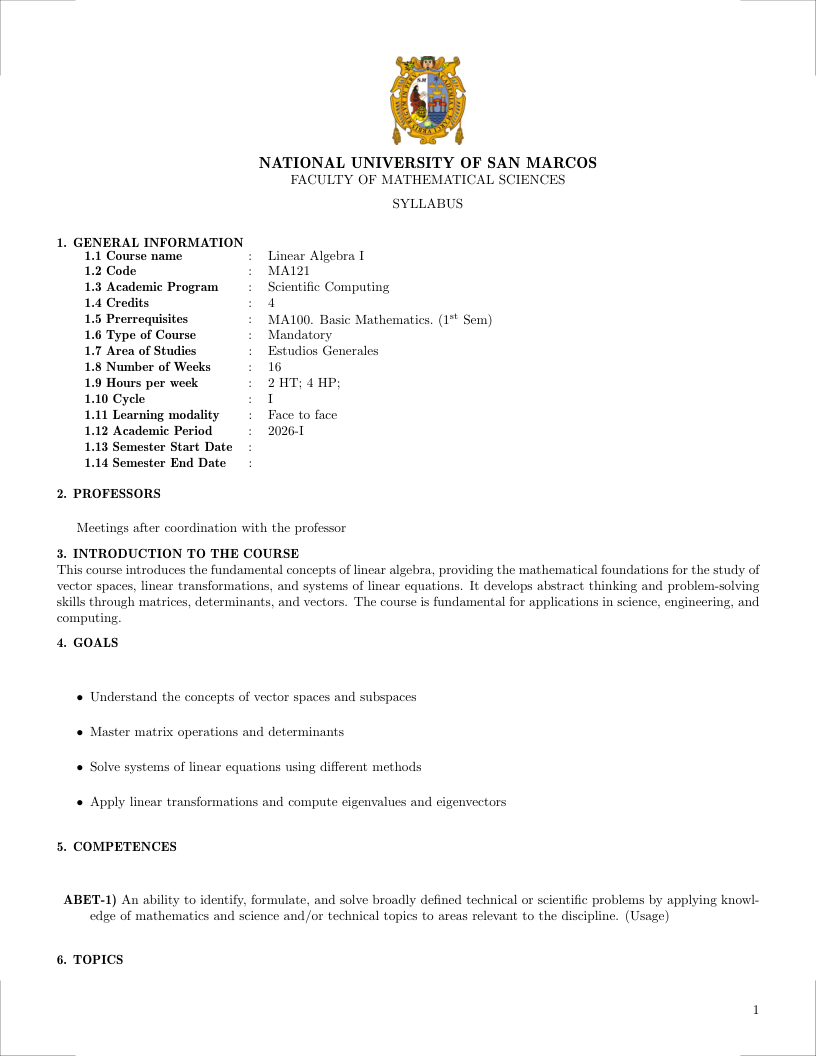 English
- Prerrequisites:
- MA100 Basic Mathematics (1st Sem)
7.17.1. Justification ↑ Back to top
This course introduces the fundamental concepts of linear algebra, providing the mathematical foundations for the study of vector spaces, linear transformations, and systems of linear equations. It develops abstract thinking and problem-solving skills through matrices, determinants, and vectors. The course is fundamental for applications in science, engineering, and computing.
7.17.2. Generales Goals ↑ Back to top
- Understand the concepts of vector spaces and subspaces
- Master matrix operations and determinants
- Solve systems of linear equations using different methods
- Apply linear transformations and compute eigenvalues and eigenvectors
7.17.3. Contribution to Outcomes ↑ Back to top
- ABET-1) An ability to identify, formulate, and solve broadly defined technical or scientific problems by applying knowledge of mathematics and science and/or technical topics to areas relevant to the discipline. (Usage)
7.17.4. Content ↑ Back to top
7.17.4.1. Numerical Linear Algebra (25 hours) [Skills ABET-1] ↑ Back to top
Bibliography: (Lay et al., 2016; Strang, 2016)
Topics
- LU decomposition and its applications
- QR decomposition and least squares problems
- Singular Value Decomposition (SVD) and its applications
- Condition number and numerical stability of linear systems
- Iterative methods for linear systems (Jacobi, Gauss-Seidel, Conjugate Gradient)
Learning Outcomes
- Implement LU and QR decomposition algorithms for solving linear systems [Usage]
- Explain the geometric and algebraic meaning of the Singular Value Decomposition [Familiarity]
- Use SVD for applications such as matrix approximation and principal component analysis [Usage]
- Analyze the stability of a linear system using its condition number [Assessment]
- Select and implement an appropriate iterative method for solving large, sparse linear systems [Assessment]
7.17.4.2. Computational Arithmetic and Error Analysis (25 hours) [Skills ABET-1] ↑ Back to top
Bibliography: (Lay et al., 2016; Strang, 2016)
Topics
- Floating-point arithmetic and the IEEE standard
- Sources of error: truncation, rounding, and discretization
- Error propagation and condition number
- Stability of numerical algorithms
- Absolute, relative, and forward/backward error
Learning Outcomes
- Define the different types of errors in numerical computation (rounding, truncation, discretization) [Familiarity]
- Explain the principles of floating-point representation and arithmetic according to the IEEE standard [Familiarity]
- Calculate the absolute and relative error of an approximation [Usage]
- Analyze the propagation of errors in a sequence of arithmetic operations [Usage]
- Distinguish between the condition of a problem and the stability of an algorithm [Assessment]
- Compute the condition number of a simple problem (e.g., matrix-vector multiplication) [Usage]
7.17.4.3. Roots Finding and Basic Numerical Optimization (25 hours) [Skills ABET-1] ↑ Back to top
Bibliography: (Lay et al., 2016; Strang, 2016)
Topics
- Bisection method and fixed-point iteration
- Newton's method and secant method for root finding
- Convergence analysis and order of convergence
- Gradient descent for univariate optimization
- Rate of convergence and stopping criteria
Learning Outcomes
- Implement root-finding algorithms (bisection, Newton, secant) and analyze their convergence [Usage]
- Classify the order of convergence of iterative methods [Assessment]
- Apply gradient descent to solve simple univariate optimization problems [Usage]
- Design appropriate stopping criteria for iterative methods [Usage]
7.17.4.4. Interpolation and Function Approximation (25 hours) [Skills ABET-1] ↑ Back to top
Bibliography: (Lay et al., 2016; Anton and Rorres, 2014)
Topics
- Polynomial interpolation (Lagrange, Newton forms)
- Spline interpolation (cubic splines)
- Least squares approximation
- Runge's phenomenon and Chebyshev nodes
- Error analysis for interpolation
Learning Outcomes
- Construct interpolating polynomials using different methods [Usage]
- Implement cubic spline interpolation [Usage]
- Apply least squares method for data fitting [Usage]
- Explain Runge's phenomenon and strategies to mitigate it [Familiarity]
- Analyze the error of an interpolation scheme [Assessment]
7.17.5. Bibliography ↑ Back to top
Lay, D. C., Lay, S. R., and McDonald, J. J. (2016). Álgebra Lineal y sus Aplicaciones. Pearson, 5th edition.
Strang, G. (2016). Introduction to Linear Algebra. Wellesley-Cambridge Press, 5th edition.
Anton, H. and Rorres, C. (2014). Álgebra Lineal con Aplicaciones. Limusa Wiley, 11th edition.