- ES Español (Latinoamérica)

- EN English

7.7. Fundamentals of Scientific Research (Mandatory)
- Semester: 1st Sem. Credits: 3
- Hour of this course: Theory: 2 hours; Practice: 2 hours;
- Syllabus:
- htmlonly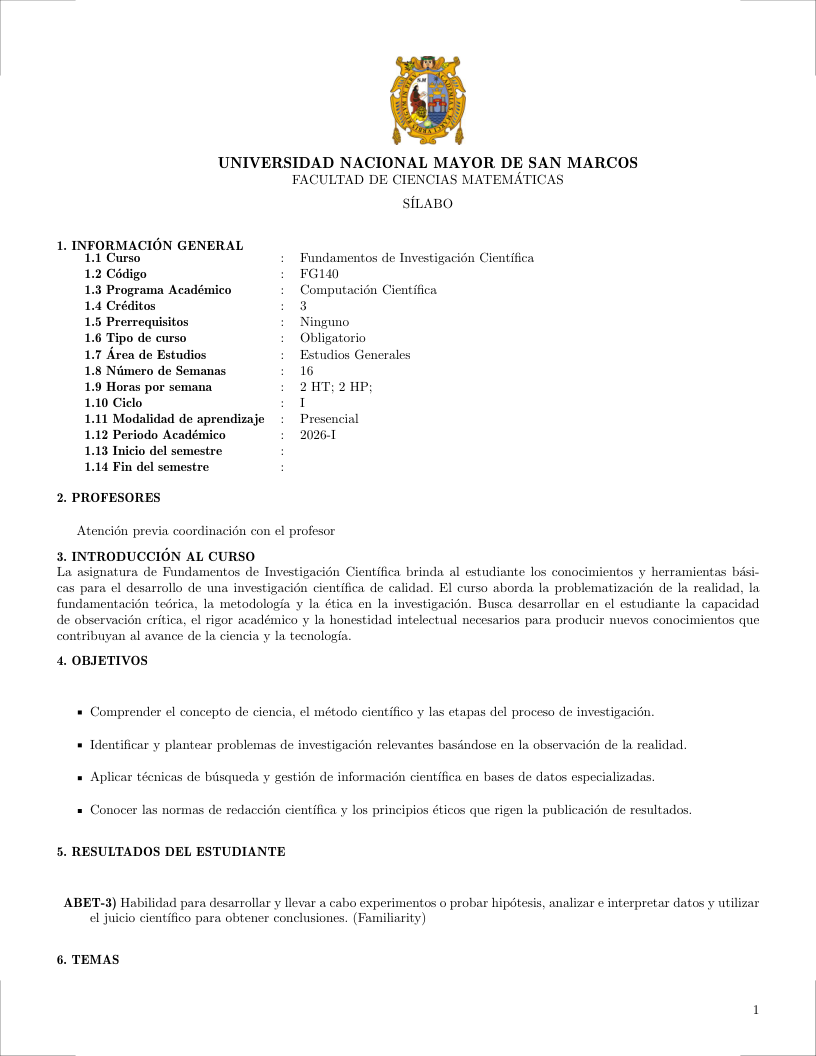
 Español (Latinoamérica)
 English
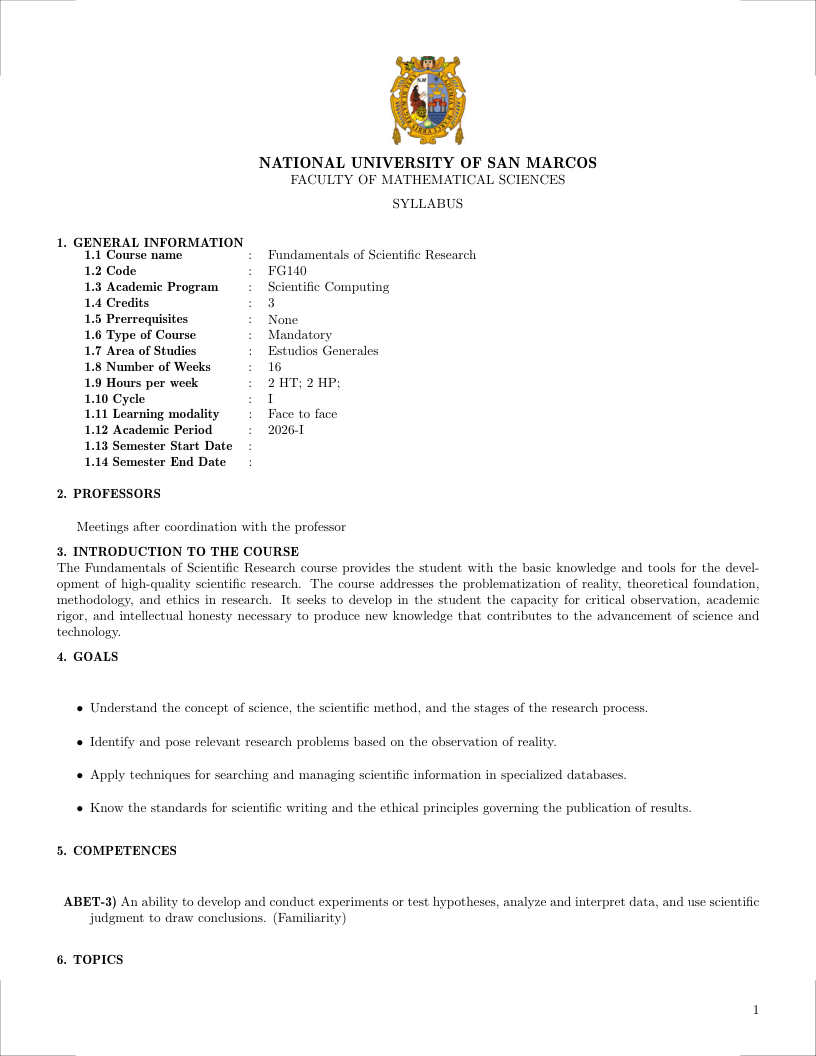
- Prerrequisites: None
7.7.1. Justification ↑ Back to top
The Fundamentals of Scientific Research course provides the student with the basic knowledge and tools for the development of high-quality scientific research. The course addresses the problematization of reality, theoretical foundation, methodology, and ethics in research. It seeks to develop in the student the capacity for critical observation, academic rigor, and intellectual honesty necessary to produce new knowledge that contributes to the advancement of science and technology.
7.7.2. Generales Goals ↑ Back to top
- Understand the concept of science, the scientific method, and the stages of the research process.
- Identify and pose relevant research problems based on the observation of reality.
- Apply techniques for searching and managing scientific information in specialized databases.
- Know the standards for scientific writing and the ethical principles governing the publication of results.
7.7.3. Contribution to Outcomes ↑ Back to top
- ABET-3) An ability to develop and conduct experiments or test hypotheses, analyze and interpret data, and use scientific judgment to draw conclusions. (Familiarity)
7.7.4. Content ↑ Back to top
7.7.4.1. Science and Scientific Method (12 hours) [Skills ABET-3] ↑ Back to top
Bibliography: (Bunge, 2014; Sampieri et al., 2014)
Topics
- Scientific knowledge: Characteristics and levels.
- Science: Classification and objectives.
- The scientific method: Stages and application.
- Ethics in research and best practices.
Learning Outcomes
- Differentiate scientific knowledge from empirical or everyday knowledge [Familiarity].
- Sequentially apply the stages of the scientific method in practical cases [Usage].
- Evaluate the importance of ethics and scientific integrity in project development [Assessment].
7.7.4.2. Scientific Information Management (12 hours) [Skills ABET-3] ↑ Back to top
Bibliography: (Rodríguez, 2013; S\'anchez2011)
Topics
- Information search: Strategies and databases.
- Bibliographic management tools (Mendeley, Zotero).
- Critical reading of scientific articles.
- Citation and reference standards (APA, Vancouver, IEEE).
Learning Outcomes
- Identify reliable information sources and high-impact academic databases [Familiarity].
- Use bibliographic managers to organize and cite sources in an academic document [Usage].
- Write a coherent and well-founded literature review on a specific topic [Assessment].
7.7.4.3. Research Project Planning (12 hours) [Skills ABET-3] ↑ Back to top
Bibliography: (Sampieri et al., 2014; Kothari, 2009)
Topics
- Identification and delimitation of the research problem.
- Formulation of the research question and objectives.
- Justification and feasibility of the research.
- Hypothesis formulation and definition of variables.
Learning Outcomes
- Recognize the fundamental components of a scientific research problem [Familiarity].
- Formulate mathematical or logical hypotheses that can be experimentally tested [Usage].
- Design the preliminary methodological framework for a rigorous scientific study [Assessment].
7.7.4.4. Scientific Writing and Communication (12 hours) [Skills ABET-3] ↑ Back to top
Bibliography: (Olson, 2014; Russey et al., 2006)
Topics
- Structure of the scientific article (IMRaD).
- Technical writing: Clarity, precision, and brevity.
- Tables, figures, and data representation.
- The publication process and peer review.
Learning Outcomes
- Understand the standard structure of scientific reports and communications [Familiarity].
- Prepare effective reports using technical language and appropriate visual representations [Usage].
- Present and orally defend research results in an inclusive manner [Assessment].
7.7.5. Bibliography ↑ Back to top
Bunge, M. (2014). La ciencia, su método y su filosofía. DeBolsillo.
Sampieri, R. H., Collado, C. F., and Baptista, M. P. (2014). Metodología de la investigación. McGraw-Hill, 6th edition.
Rodríguez, L. J. M. (2013). Cómo buscar y usar información científica: Guía para estudiantes universitarios. Universidad de Cantabria.
- (S\'anchez2011)
Kothari, C. (2009). Research Methodology: Methods and Techniques. New Age International Publishers, 2nd edition.
Olson, L. (2014). Guide to Academic and Scientific Publication. eacademia.
Russey, W., Ebel, H., and Bliefert, C. (2006). How to Write a Successful Science Thesis. Wiley-VCH.