- ES Español (Latinoamérica)

- EN English

7.44. Capstone Project I (Mandatory)
- Semester: 8th Sem. Credits: 3
- Hour of this course: Theory: 1 hours; Practice: 4 hours;
- Syllabus:
- htmlonly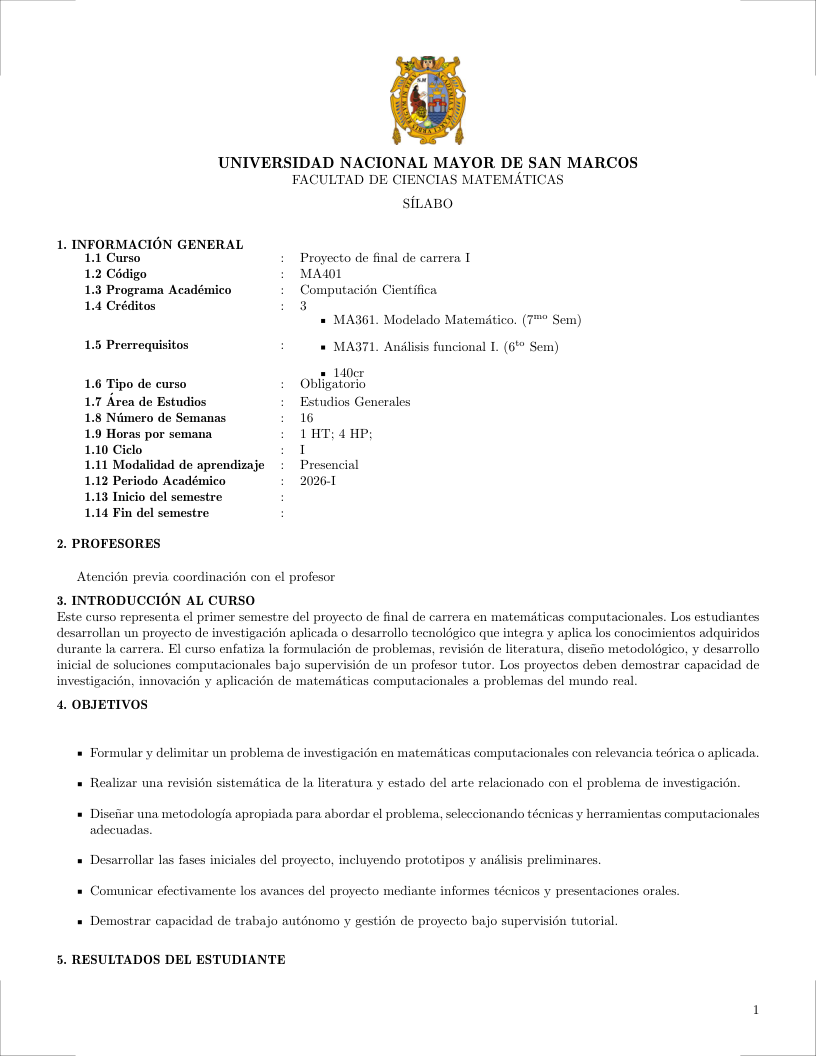
 Español (Latinoamérica)
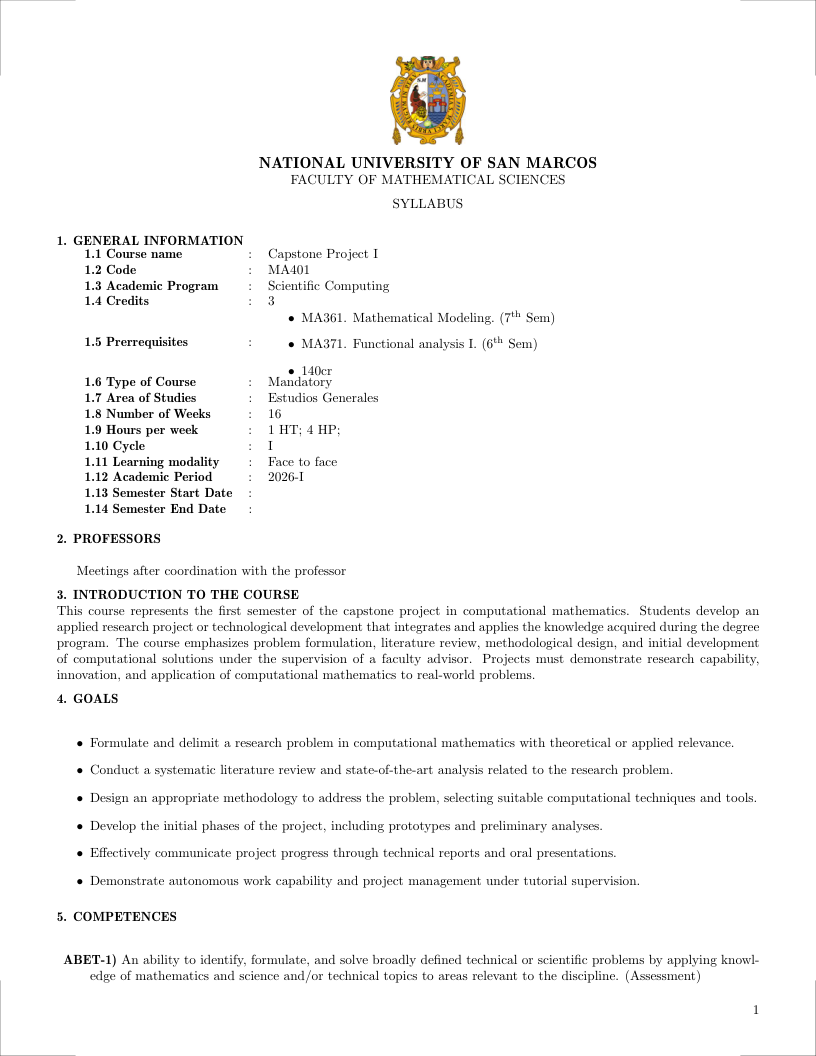 English
- Prerrequisites:
- MA361 Mathematical Modeling (7th Sem)
- MA371 Functional analysis I (6th Sem)
- 140cr
7.44.1. Justification ↑ Back to top
This course represents the first semester of the capstone project in computational mathematics. Students develop an applied research project or technological development that integrates and applies the knowledge acquired during the degree program. The course emphasizes problem formulation, literature review, methodological design, and initial development of computational solutions under the supervision of a faculty advisor. Projects must demonstrate research capability, innovation, and application of computational mathematics to real-world problems.
7.44.2. Generales Goals ↑ Back to top
- Formulate and delimit a research problem in computational mathematics with theoretical or applied relevance.
- Conduct a systematic literature review and state-of-the-art analysis related to the research problem.
- Design an appropriate methodology to address the problem, selecting suitable computational techniques and tools.
- Develop the initial phases of the project, including prototypes and preliminary analyses.
- Effectively communicate project progress through technical reports and oral presentations.
- Demonstrate autonomous work capability and project management under tutorial supervision.
7.44.3. Contribution to Outcomes ↑ Back to top
- ABET-1) An ability to identify, formulate, and solve broadly defined technical or scientific problems by applying knowledge of mathematics and science and/or technical topics to areas relevant to the discipline. (Assessment)
- ABET-2) An ability to formulate or design a system, process, procedure, or program for the intended purpose. (Assessment)
- ABET-4) An ability to communicate effectively with a range of audiences. (Assessment)
- ABET-5) An ability to understand ethical and professional responsibilities and the impact of technical and/or scientific solutions in global, economic, environmental, and societal contexts. (Assessment)
- ABET-6) An ability to function effectively on teams that establish goals, plan tasks, meet deadlines, and analyze risk and uncertainty. (Assessment)
7.44.4. Content ↑ Back to top
7.44.4.1. Project Formulation and Planning (12 hours) [Skills ABET-1,ABET-2,ABET-4,ABET-5,ABET-6] ↑ Back to top
Bibliography: (Babbie, 2016; Kothari, 2004)
Topics
- Identification and delimitation of research problems
- Systematic literature review and state-of-the-art analysis
- Formulation of research objectives and hypotheses
- Methodological design and work plan
- Development of project proposal and schedule
Learning Outcomes
- Formulate research problems with social impact [Assessment]
- Design management plans for scientific projects [Usage]
- Conduct problem studies using research methods [Usage]
- Evaluate technical and scientific feasibility of projects [Assessment]
7.44.4.2. Methodological Development and Tools (12 hours) [Skills ABET-1,ABET-2,ABET-4,ABET-5,ABET-6] ↑ Back to top
Bibliography: (Oates, 2006; Pressman, 2014)
Topics
- Selection and justification of computational methods
- Design of experiments and validation protocols
- Computational tools for project development
- Version management and technical documentation
- Ethical considerations in computational research
Learning Outcomes
- Apply ethical principles in professional research [Usage]
- Work effectively in multidisciplinary teams [Usage]
- Communicate technical progress effectively [Usage]
- Select appropriate tools for the project [Assessment]
7.44.4.3. Implementation and Initial Development (12 hours) [Skills ABET-1,ABET-2,ABET-4,ABET-5,ABET-6] ↑ Back to top
Bibliography: (Sommerville, 2015; McConnell, 2004)
Topics
- Development of prototypes and proof of concepts
- Implementation of algorithms and computational methods
- Preliminary analysis of results and validation
- Iteration and refinement of solutions
- Technical documentation of development
Learning Outcomes
- Learn independently and continuously [Usage]
- Conduct studies using research methods [Usage]
- Implement mathematical processes on computer [Usage]
- Adapt solutions based on preliminary results [Assessment]
7.44.5. Bibliography ↑ Back to top
Babbie, E. R. (2016). The Basics of Social Research. Cengage Learning, 7th edition.
Kothari, C. R. (2004). Research Methodology: Methods and Techniques. New Age International, 2nd edition.
Oates, B. J. (2006). Researching Information Systems and Computing. SAGE Publications, 1st edition.
Pressman, R. S. (2014). Software Engineering: A Practitioner's Approach. McGraw-Hill, 8th edition.
Sommerville, I. (2015). Software Engineering. Pearson, 10th edition.
McConnell, S. (2004). Code Complete: A Practical Handbook of Software Construction. Microsoft Press, 2nd edition.