- ES Español (Latinoamérica)

- EN English

7.53. Functional analysis II (Elective)
- Semester: 8th Sem. Credits: 5
- Hour of this course: Theory: 3 hours; Practice: 4 hours;
- Syllabus:
- htmlonly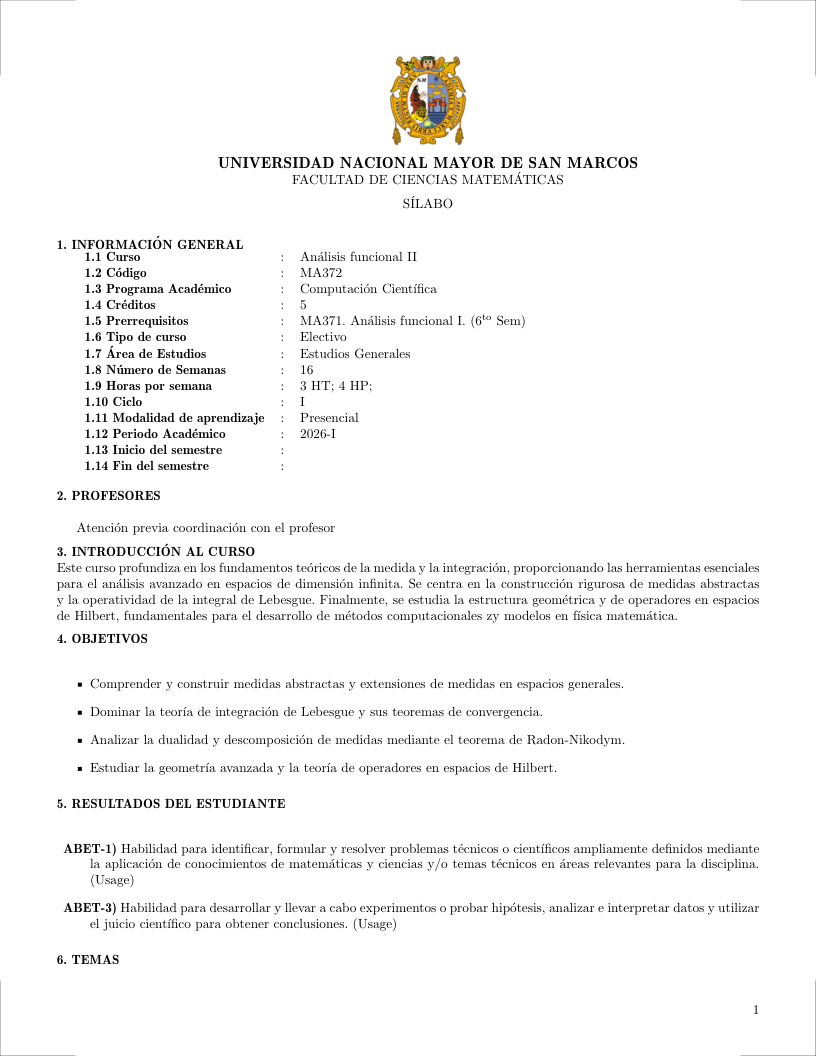
 Español (Latinoamérica)
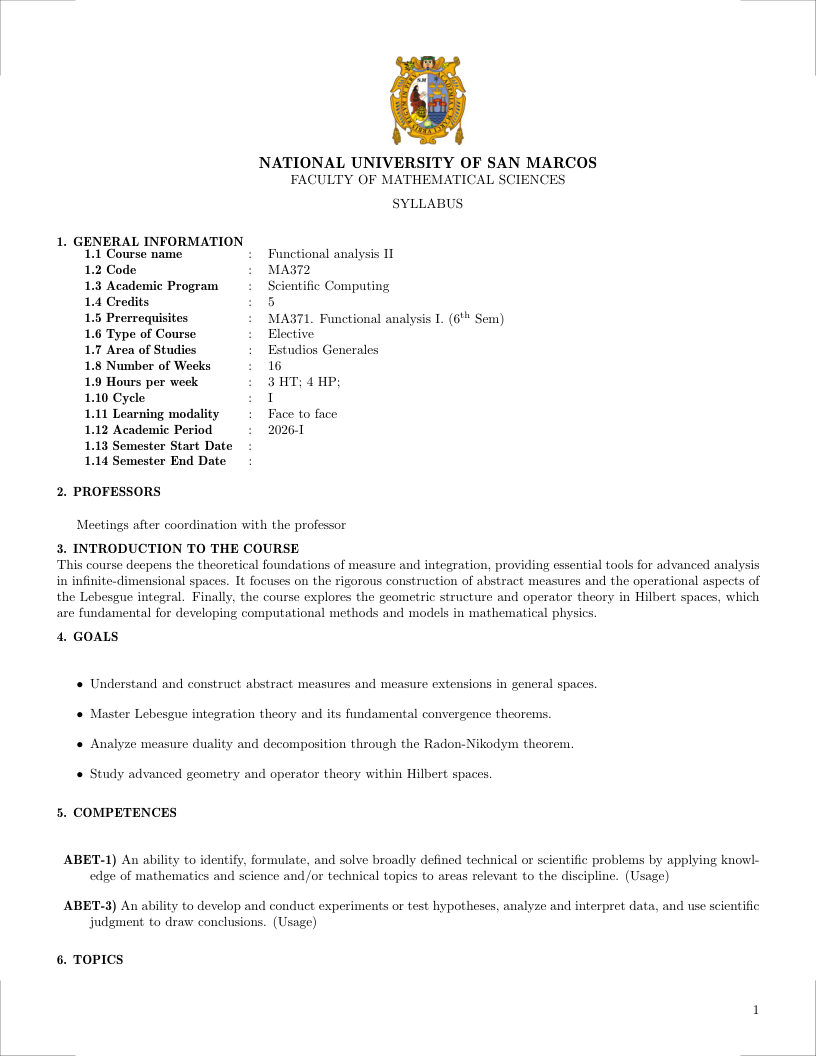 English
- Prerrequisites:
- MA371 Functional analysis I (6th Sem)
7.53.1. Justification ↑ Back to top
This course deepens the theoretical foundations of measure and integration, providing essential tools for advanced analysis in infinite-dimensional spaces. It focuses on the rigorous construction of abstract measures and the operational aspects of the Lebesgue integral. Finally, the course explores the geometric structure and operator theory in Hilbert spaces, which are fundamental for developing computational methods and models in mathematical physics.
7.53.2. Generales Goals ↑ Back to top
- Understand and construct abstract measures and measure extensions in general spaces.
- Master Lebesgue integration theory and its fundamental convergence theorems.
- Analyze measure duality and decomposition through the Radon-Nikodym theorem.
- Study advanced geometry and operator theory within Hilbert spaces.
7.53.3. Contribution to Outcomes ↑ Back to top
- ABET-1) An ability to identify, formulate, and solve broadly defined technical or scientific problems by applying knowledge of mathematics and science and/or technical topics to areas relevant to the discipline. (Usage)
- ABET-3) An ability to develop and conduct experiments or test hypotheses, analyze and interpret data, and use scientific judgment to draw conclusions. (Usage)
7.53.4. Content ↑ Back to top
7.53.4.1. Measure Theory (20 hours) [Skills ABET-1,ABET-3] ↑ Back to top
Bibliography: (Folland, 1999; Royden and Fitzpatrick, 2010)
Topics
- Algebras, \(\sigma\)-algebras, and measures
- Outer measures and the Carathéodory Extension Theorem
- Borel measures on the real line
- Signed measures and the Hahn-Jordan decomposition
- Complex measures and total variation
Learning Outcomes
- Construct measures from outer measures using the Carathéodory criterion [Assessment]
- Apply the Jordan decomposition to analyze signed measures [Usage]
- Prove regularity properties of Borel measures [Familiarity]
7.53.4.2. Integration Theory (20 hours) [Skills ABET-1,ABET-3] ↑ Back to top
Bibliography: (Folland, 1999; Brezis, 2011)
Topics
- Measurable functions and simple functions
- The Lebesgue integral: definition and fundamental properties
- Convergence theorems: Monotone Convergence, Dominated Convergence, and Fatou's Lemma
- The Radon-Nikodym Theorem and Lebesgue-Stieltjes property
- Differentiation of measures and the Fundamental Theorem of Calculus in measure spaces
Learning Outcomes
- Evaluate the convergence of function sequences under the Lebesgue integral [Assessment]
- Use the Radon-Nikodym Theorem to find probability densities or measure derivatives [Usage]
- Compare Riemann and Lebesgue integrals in terms of applicability [Familiarity]
7.53.4.3. Hilbert Spaces (20 hours) [Skills ABET-1,ABET-3] ↑ Back to top
Bibliography: (Kreyszig, 1989; Conway, 1990)
Topics
- Review of inner products and completeness
- Orthogonality, orthonormal bases, and the Gram-Schmidt process
- Riesz Representation Theorem and linear functionals
- Adjoint, self-adjoint, and unitary operators in Hilbert spaces
- Introduction to spectral theory for compact operators
Learning Outcomes
- Apply the projection theorem to solve best approximation problems [Usage]
- Identify the adjoint of classical linear operators [Assessment]
- Analyze the spectral structure of self-adjoint operators [Familiarity]
7.53.4.4. Operator Theory (20 hours) [Skills ABET-1,ABET-3] ↑ Back to top
Bibliography: (Brezis, 2011; Yosida, 1980)
Topics
- Bounded and unbounded operators: definitions and domains
- The spectrum of an operator: point, continuous, and residual spectrum
- Normal operators and the Spectral Theorem for compact operators
- Applications of operator theory in numerical analysis
Learning Outcomes
- Calculate the spectrum of various types of linear operators [Assessment]
- Apply the spectral theorem in operator decomposition [Usage]
- Solve operational problems using basic functional calculus [Assessment]
7.53.5. Bibliography ↑ Back to top
Folland, G. B. (1999). Real Analysis: Modern Techniques and Their Applications. Wiley-Interscience, 2nd edition.
Royden, H. and Fitzpatrick, P. (2010). Real Analysis. Pearson, 4th edition.
Brezis, H. (2011). Functional Analysis, Sobolev Spaces and Partial Differential Equations. Springer Science & Business Media.
Kreyszig, E. (1989). Introductory Functional Analysis with Applications. Wiley.
Conway, J. B. (1990). A Course in Functional Analysis. Springer-Verlag, 2nd edition.
Yosida, K. (1980). Functional Analysis. Springer-Verlag, 6th edition.