- ES Español (Latinoamérica)

- EN English

7.5. Environment and Sustainable Development (Mandatory)
- Semester: 1st Sem. Credits: 3
- Hour of this course: Theory: 2 hours; Practice: 2 hours;
- Syllabus:
- htmlonly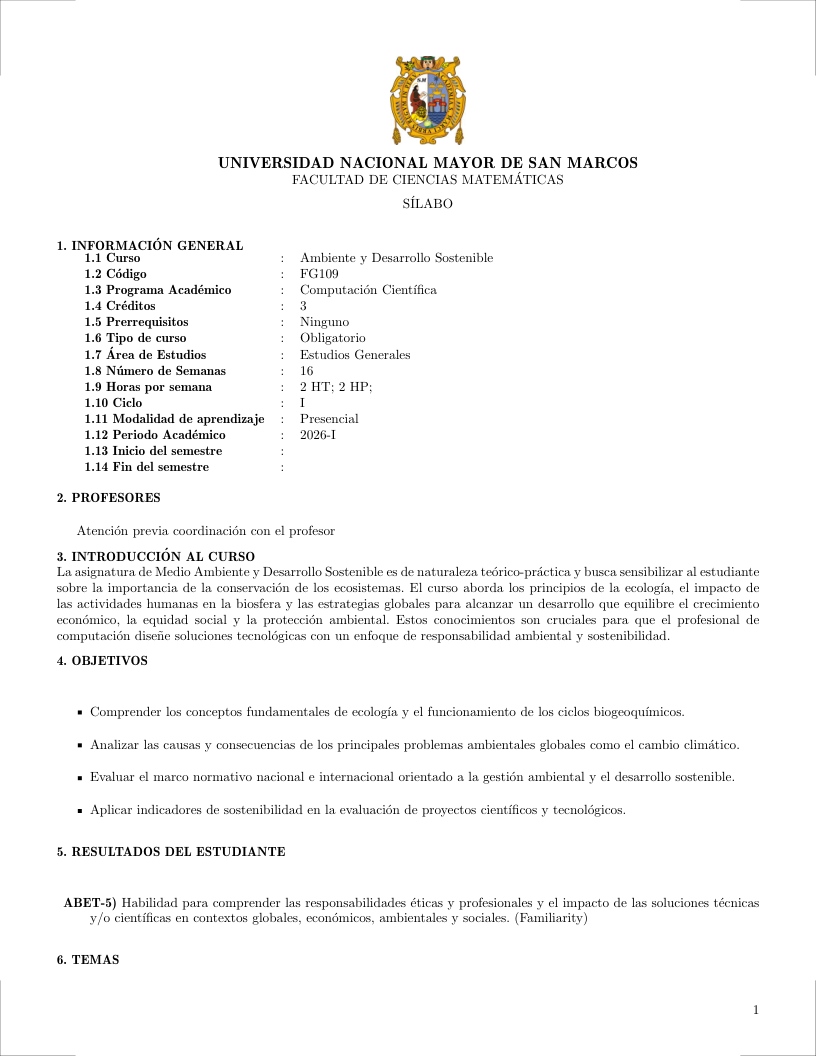
 Español (Latinoamérica)
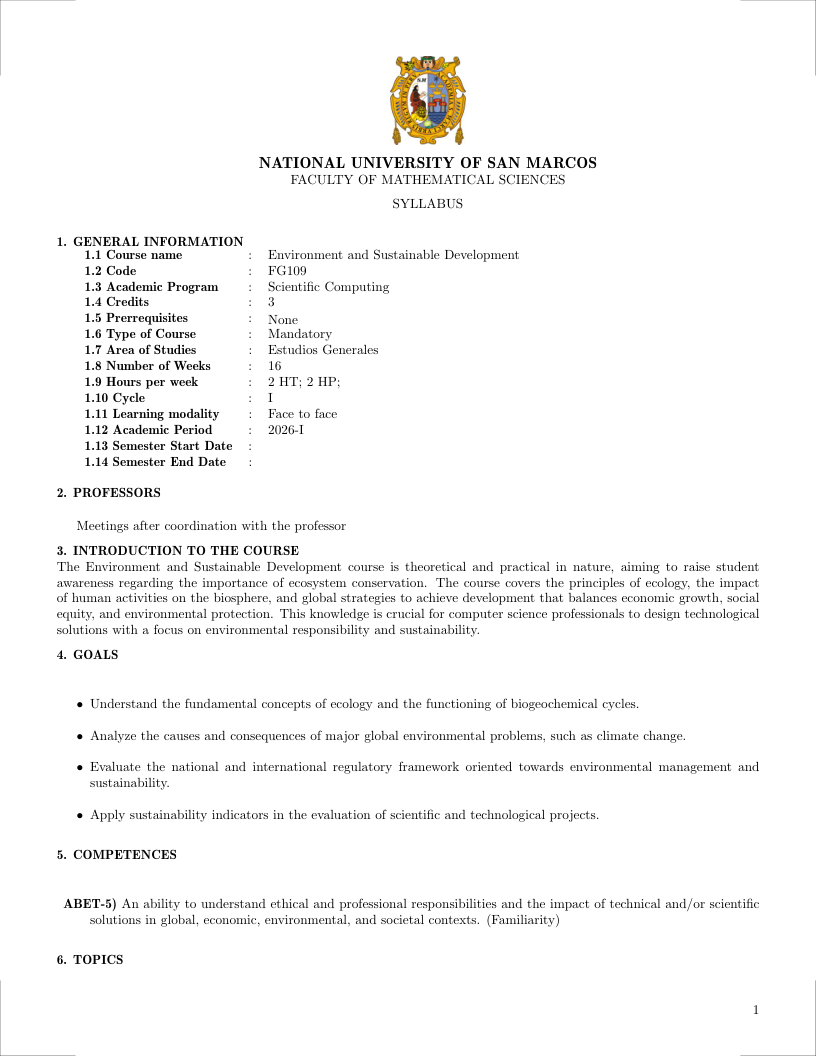 English
- Prerrequisites: None
7.5.1. Justification ↑ Back to top
The Environment and Sustainable Development course is theoretical and practical in nature, aiming to raise student awareness regarding the importance of ecosystem conservation. The course covers the principles of ecology, the impact of human activities on the biosphere, and global strategies to achieve development that balances economic growth, social equity, and environmental protection. This knowledge is crucial for computer science professionals to design technological solutions with a focus on environmental responsibility and sustainability.
7.5.2. Generales Goals ↑ Back to top
- Understand the fundamental concepts of ecology and the functioning of biogeochemical cycles.
- Analyze the causes and consequences of major global environmental problems, such as climate change.
- Evaluate the national and international regulatory framework oriented towards environmental management and sustainability.
- Apply sustainability indicators in the evaluation of scientific and technological projects.
7.5.3. Contribution to Outcomes ↑ Back to top
- ABET-5) An ability to understand ethical and professional responsibilities and the impact of technical and/or scientific solutions in global, economic, environmental, and societal contexts. (Familiarity)
7.5.4. Content ↑ Back to top
7.5.4.1. Ecology and Biodiversity (16 hours) [Skills ABET-5] ↑ Back to top
Bibliography: (Miller and Spoolman, 2012; Smith and Smith, 2001)
Topics
- Ecology: Basic concepts, ecosystems, and biomes.
- Energy flow and biogeochemical cycles in nature.
- Biodiversity: Importance, levels, and current threats.
- Ecosystem services and valuation of natural capital.
Learning Outcomes
- Identify the components of an ecosystem and the interdependence relationships among living beings [Familiarity].
- Explain the impact of biodiversity loss on the stability of natural systems [Usage].
- Evaluate the health of a local ecosystem using biological indicators and physicochemical parameters [Assessment].
7.5.4.2. Environmental Impact and Climate Change (16 hours) [Skills ABET-5] ↑ Back to top
Bibliography: (Miller and Spoolman, 2012; Starr and Taggart, 2004)
Topics
- Environmental pollution: Air, water, soil, and waste.
- The greenhouse effect and global warming.
- Impact of industrial and technological activities.
- Ecological footprint and carbon footprint: Measurement and reduction.
Learning Outcomes
- Recognize the main sources of pollution and their effects on public health and the climate [Familiarity].
- Calculate personal and institutional carbon footprints to propose mitigation measures [Usage].
- Critically analyze the environmental impact of data centers and technological infrastructure [Assessment].
7.5.4.3. Environmental Management and Regulations (16 hours) [Skills ABET-5] ↑ Back to top
Bibliography: (Strange and Bayley, 2012; Primack, 1993)
Topics
- Environmental legal framework in Peru and the Ministry of Environment.
- Environmental Impact Assessment (EIA) and certifications.
- Natural resource management: Water, energy, and protected areas.
- Environmental ethics and corporate social responsibility.
Learning Outcomes
- Describe the functions of environmental regulatory bodies at the national level [Familiarity].
- Apply ethical and legal principles in the design of environmental management plans for projects [Usage].
- Argue for the importance of transparency and citizen participation in environmental issues [Assessment].
7.5.4.4. Strategies for Sustainable Development (16 hours) [Skills ABET-5] ↑ Back to top
Bibliography: (Strange and Bayley, 2012; Miller and Spoolman, 2012)
Learning Outcomes
- Recognize the 17 Sustainable Development Goals and their relationship with scientific computing [Familiarity].
- Integrate sustainability criteria and circular economy into the software life cycle [Usage].
- Propose innovative technological solutions to solve contemporary socio-environmental challenges [Assessment].
7.5.5. Bibliography ↑ Back to top
Miller, G. T. and Spoolman, S. (2012). Living in the Environment. Cengage Learning, Canada, 17th edition.
Smith, R. L. and Smith, T. (2001). Ecología. Pearson Educación, Madrid, España, 4th edition.
Starr, C. and Taggart, R. (2004). Biología: La unidad y diversidad de la vida. Thomson Editors, México D.F.
Strange, T. and Bayley, A. (2012). Desarrollo sostenible: Integrar la economía, la sociedad y el medio ambiente. OCDE / UNAM, México.
Primack, R. (1993). Essentials of Conservation Biology. Sinauer Associates Inc., Sunderland, Massachusetts.