- ES Español (Latinoamérica)

- EN English

7.12. General Physics (Mandatory)
- Semester: 2nd Sem. Credits: 5
- Hour of this course: Theory: 3 hours; Practice: 4 hours;
- Syllabus:
- htmlonly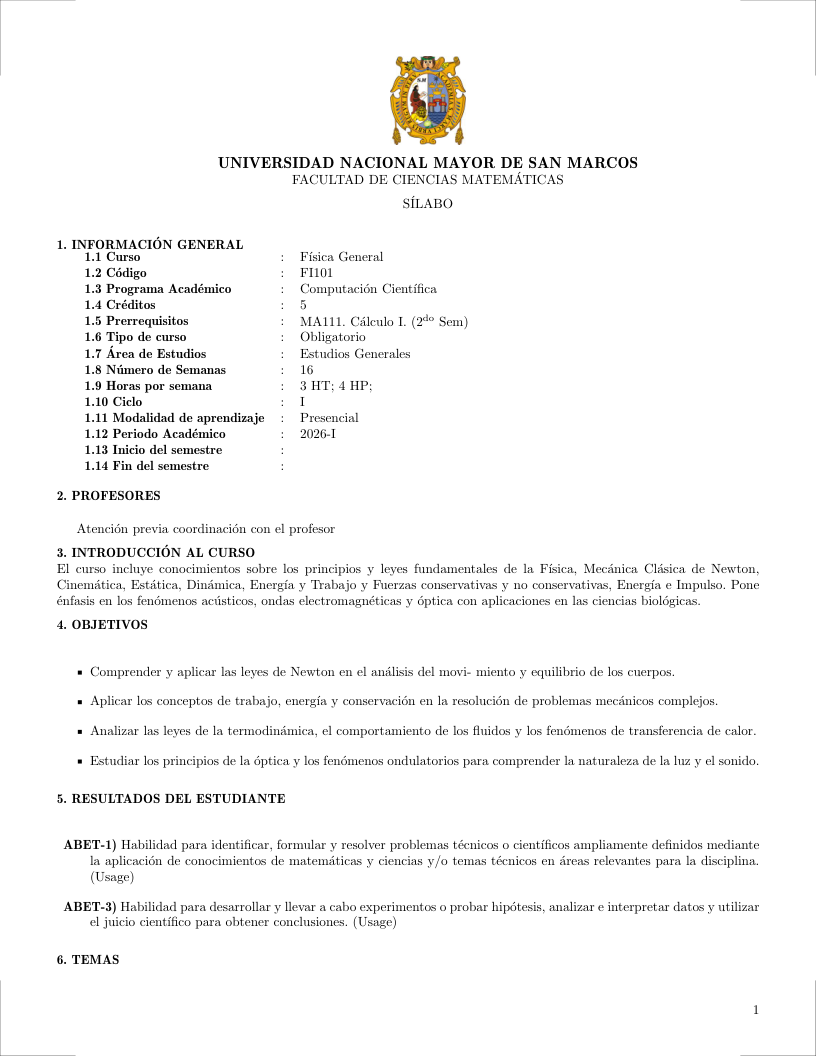
 Español (Latinoamérica)
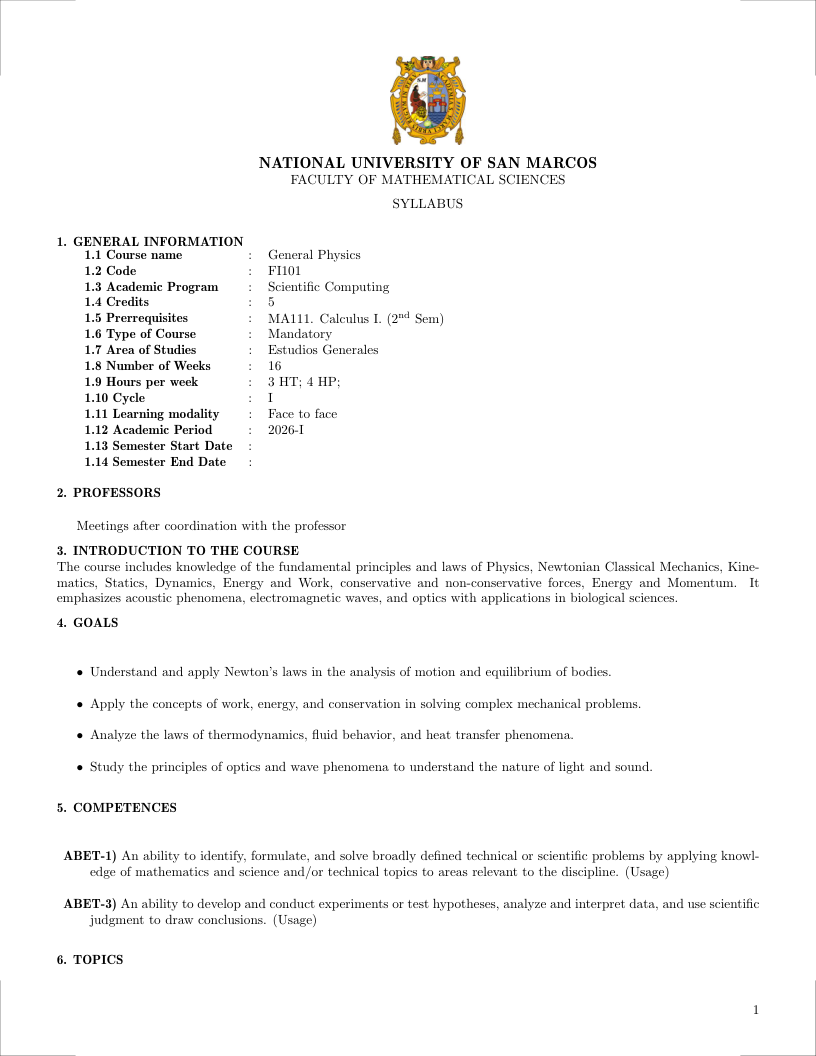 English
- Prerrequisites:
- MA111 Calculus I (2nd Sem)
7.12.1. Justification ↑ Back to top
The course includes knowledge of the fundamental principles and laws of Physics, Newtonian Classical Mechanics, Kinematics, Statics, Dynamics, Energy and Work, conservative and non-conservative forces, Energy and Momentum. It emphasizes acoustic phenomena, electromagnetic waves, and optics with applications in biological sciences.
7.12.2. Generales Goals ↑ Back to top
- Understand and apply Newton's laws in the analysis of motion and equilibrium of bodies.
- Apply the concepts of work, energy, and conservation in solving complex mechanical problems.
- Analyze the laws of thermodynamics, fluid behavior, and heat transfer phenomena.
- Study the principles of optics and wave phenomena to understand the nature of light and sound.
7.12.3. Contribution to Outcomes ↑ Back to top
- ABET-1) An ability to identify, formulate, and solve broadly defined technical or scientific problems by applying knowledge of mathematics and science and/or technical topics to areas relevant to the discipline. (Usage)
- ABET-3) An ability to develop and conduct experiments or test hypotheses, analyze and interpret data, and use scientific judgment to draw conclusions. (Usage)
7.12.4. Content ↑ Back to top
7.12.4.1. Particle and Rigid Body Mechanics (16 hours) [Skills ABET-1,ABET-3] ↑ Back to top
Bibliography: (Sears et al., 2013; Tipler and Mosca, 2010)
Topics
- Physical quantities, systems of units, and vectors.
- Kinematics: Motion in one and two dimensions.
- Dynamics: Newton's laws and their applications.
- Statics and equilibrium of the rigid body.
Learning Outcomes
- Describe the motion of bodies using kinematic and vector magnitudes [Familiarity].
- Apply Newton's laws to determine forces and accelerations in physical systems [Usage].
- Solve static equilibrium problems through the analysis of forces and torque [Assessment].
7.12.4.2. Work, Energy, and Momentum (16 hours) [Skills ABET-1,ABET-3] ↑ Back to top
Bibliography: (Sears et al., 2013; Resnick et al., 2005)
Topics
- Work and kinetic energy.
- Potential energy and conservation of mechanical energy.
- Linear momentum and impulse.
- Elastic and inelastic collisions.
Learning Outcomes
- Identify forms of energy and their transformation in conservative physical processes [Familiarity].
- Use the work-energy theorem to analyze dynamic systems [Usage].
- Apply the conservation of momentum in solving collision problems [Assessment].
7.12.4.3. Fluid Mechanics and Thermodynamics (16 hours) [Skills ABET-1,ABET-3] ↑ Back to top
Bibliography: (Sears et al., 2013; Serway and Jewett, 2018)
Topics
- Fluid statics and dynamics (Bernoulli and Archimedes).
- Temperature, heat, and laws of thermodynamics.
- Kinetic theory of gases.
- Thermodynamic processes and heat engines.
Learning Outcomes
- Understand the fundamental properties of fluids and heat transfer mechanisms [Familiarity].
- Calculate state variables in thermal processes using the laws of thermodynamics [Usage].
- Model the behavior of fluids and gases through the implementation of fundamental equations [Assessment].
7.12.4.4. Waves and Optics (16 hours) [Skills ABET-1,ABET-3] ↑ Back to top
Bibliography: (Alonso and Finn, 1971; Sears et al., 2009)
Topics
- Wave motion and acoustic phenomena.
- Nature and propagation of light.
- Geometric optics: Reflection and refraction.
- Electromagnetic waves and interference.
Learning Outcomes
- Recognize the characteristics of mechanical and electromagnetic waves in the environment [Familiarity].
- Analyze image formation in mirrors and lenses using ray tracing [Usage].
- Evaluate interference and diffraction phenomena based on the wave model of light [Assessment].
7.12.5. Bibliography ↑ Back to top
Sears, F., Zemansky, M., Young, H., and Freedman, R. (2013). Física Universitaria, Vol. 1. Pearson, 13th edition.
Tipler, P. and Mosca, G. (2010). Física para la Ciencia y la Tecnología. Vol. 1. Reverté, 6th edition.
Resnick, R., Halliday, D., and Krane, K. (2005). Física Vol. 1. CECSA, 5th edition.
Serway, R. and Jewett, J. (2018). Física para Ciencias e Ingeniería Vol. 1. Cengage Learning, 10th edition.
Alonso, M. and Finn, E. (1971). Física I. Fondo Educativo Interamericano.
Sears, F., Zemansky, M., Young, H., and Freedman, R. (2009). Física Universitaria, Vol. 2. Pearson, 12th edition.