- ES Español (Latinoamérica)

- EN English

7.33. Numerical Analysis II (Mandatory)
- Semester: 6th Sem. Credits: 4
- Hour of this course: Theory: 2 hours; Practice: 4 hours;
- Syllabus:
- htmlonly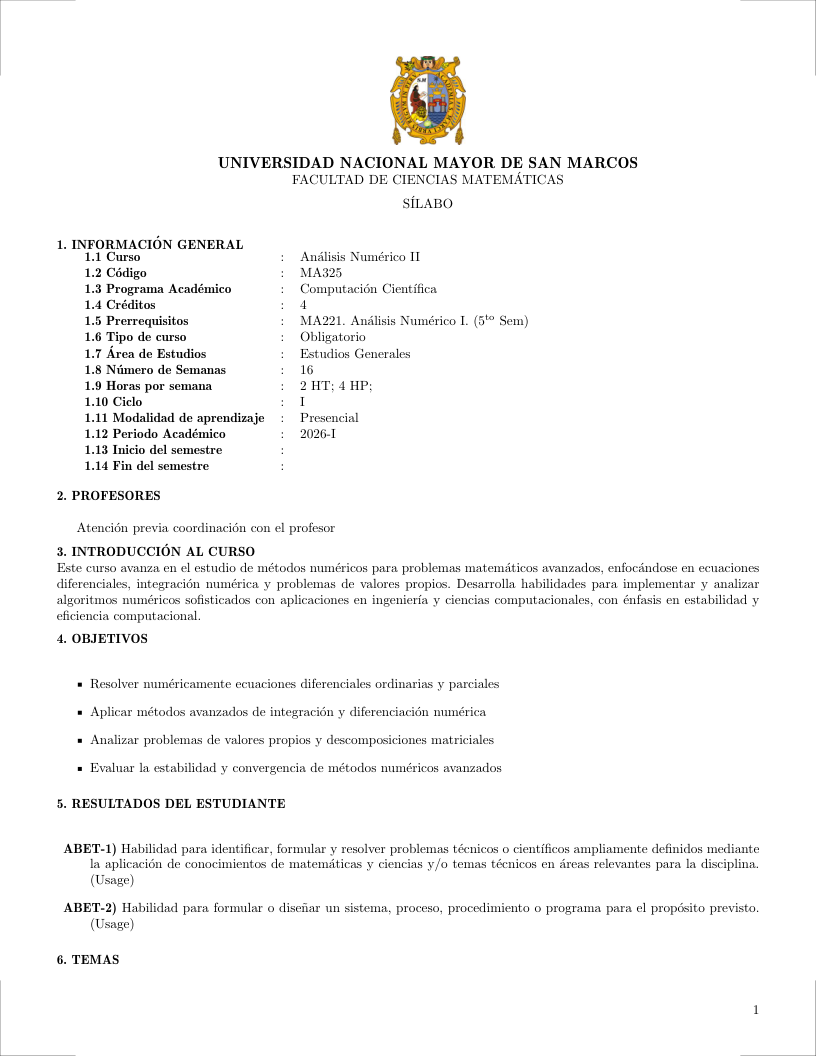
 Español (Latinoamérica)
 English
- Prerrequisites:
- MA221 Numerical Analysis I (5th Sem)
7.33.1. Justification ↑ Back to top
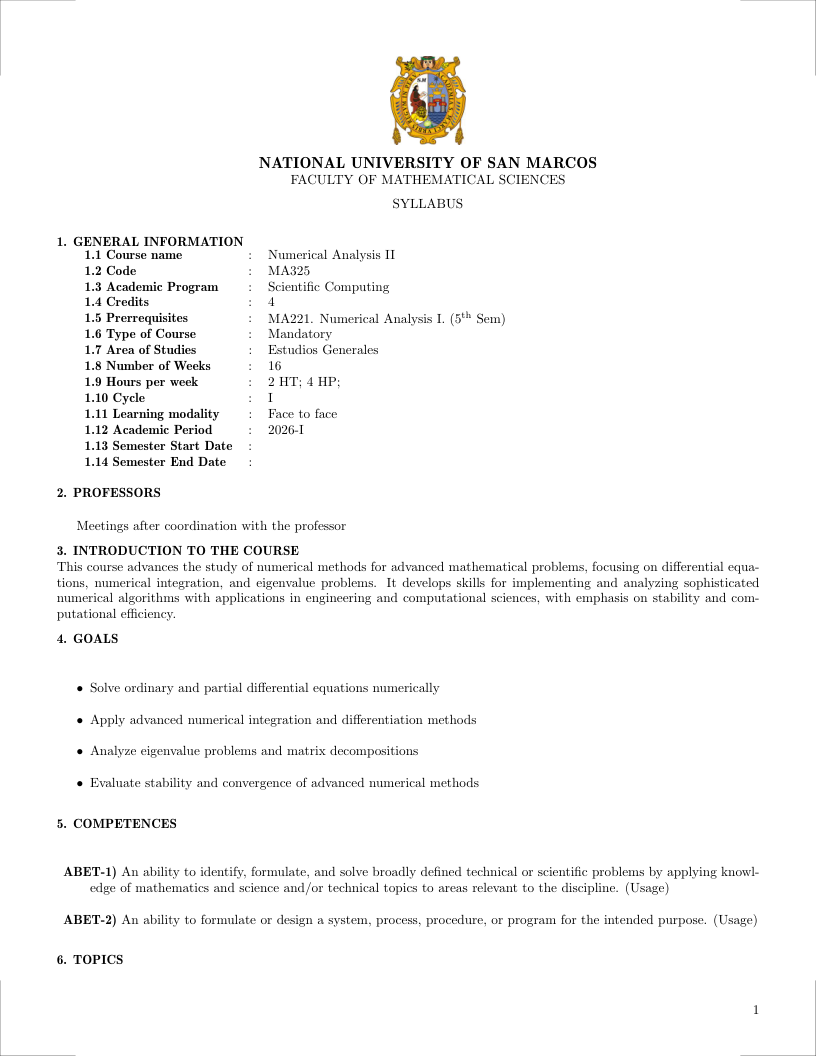
This course advances the study of numerical methods for advanced mathematical problems, focusing on differential equations, numerical integration, and eigenvalue problems. It develops skills for implementing and analyzing sophisticated numerical algorithms with applications in engineering and computational sciences, with emphasis on stability and computational efficiency.
7.33.2. Generales Goals ↑ Back to top
- Solve ordinary and partial differential equations numerically
- Apply advanced numerical integration and differentiation methods
- Analyze eigenvalue problems and matrix decompositions
- Evaluate stability and convergence of advanced numerical methods
7.33.3. Contribution to Outcomes ↑ Back to top
- ABET-1) An ability to identify, formulate, and solve broadly defined technical or scientific problems by applying knowledge of mathematics and science and/or technical topics to areas relevant to the discipline. (Usage)
- ABET-2) An ability to formulate or design a system, process, procedure, or program for the intended purpose. (Usage)
7.33.4. Content ↑ Back to top
7.33.4.1. Numerical Methods for Ordinary Differential Equations (ODEs) (20 hours) [Skills ABET-1,ABET-2] ↑ Back to top
Bibliography: (Burden et al., 2016; Chapra and Canale, 2015)
Topics
- Euler's method and its variants (forward, backward)
- Runge-Kutta methods
- Multistep methods (Adams-Bashforth, Adams-Moulton)
- Stability and convergence analysis for ODE solvers
- Systems of ODEs and higher-order ODEs
Learning Outcomes
- Implement basic ODE solvers (Euler, Runge-Kutta) [Usage]
- Analyze the stability and convergence properties of ODE numerical methods [Assessment]
- Select an appropriate numerical method for a given ODE based on stability and accuracy requirements [Assessment]
- Solve systems of ODEs and convert higher-order ODEs to first-order systems [Usage]
7.33.4.2. Numerical Differentiation and Integration (20 hours) [Skills ABET-1,ABET-2] ↑ Back to top
Bibliography: (Burden et al., 2016; Chapra and Canale, 2015)
Topics
- Finite difference approximations (forward, backward, central)
- Richardson extrapolation
- Newton-Cotes formulas (Trapezoidal rule, Simpson's rule)
- Gaussian quadrature
- Error analysis for numerical integration
Learning Outcomes
- Compute derivatives of functions using finite difference schemes [Usage]
- Apply Richardson extrapolation to improve the accuracy of numerical approximations [Usage]
- Implement numerical integration rules (Trapezoidal, Simpson, Gaussian) [Usage]
- Compare the accuracy and efficiency of different numerical integration methods [Assessment]
- Analyze the error for numerical differentiation and integration formulas [Assessment]
7.33.4.3. Numerical Linear Algebra (20 hours) [Skills ABET-1,ABET-2] ↑ Back to top
Bibliography: (Burden et al., 2016; Chapra and Canale, 2015)
Topics
- LU decomposition and its applications
- QR decomposition and least squares problems
- Singular Value Decomposition (SVD) and its applications
- Condition number and numerical stability of linear systems
- Iterative methods for linear systems (Jacobi, Gauss-Seidel, Conjugate Gradient)
Learning Outcomes
- Implement LU and QR decomposition algorithms for solving linear systems [Usage]
- Explain the geometric and algebraic meaning of the Singular Value Decomposition [Familiarity]
- Use SVD for applications such as matrix approximation and principal component analysis [Usage]
- Analyze the stability of a linear system using its condition number [Assessment]
- Select and implement an appropriate iterative method for solving large, sparse linear systems [Assessment]
7.33.4.4. Interpolation and Function Approximation (20 hours) [Skills ABET-1,ABET-2] ↑ Back to top
Bibliography: (Burden et al., 2016; Chapra and Canale, 2015)
Topics
- Polynomial interpolation (Lagrange, Newton forms)
- Spline interpolation (cubic splines)
- Least squares approximation
- Runge's phenomenon and Chebyshev nodes
- Error analysis for interpolation
Learning Outcomes
- Construct interpolating polynomials using different methods [Usage]
- Implement cubic spline interpolation [Usage]
- Apply least squares method for data fitting [Usage]
- Explain Runge's phenomenon and strategies to mitigate it [Familiarity]
- Analyze the error of an interpolation scheme [Assessment]
7.33.5. Bibliography ↑ Back to top
Burden, R. L., Faires, J. D., and Burden, A. M. (2016). Análisis Numérico. Cengage Learning, 10th edition.
Chapra, S. C. and Canale, R. P. (2015). Métodos Numéricos para Ingenieros. McGraw-Hill, 7th edition.