- ES Español (Latinoamérica)

- EN English

7.26. Calculus IV (Mandatory)
- Semester: 5th Sem. Credits: 3
- Hour of this course: Theory: 1 hours; Practice: 4 hours;
- Syllabus:
- htmlonly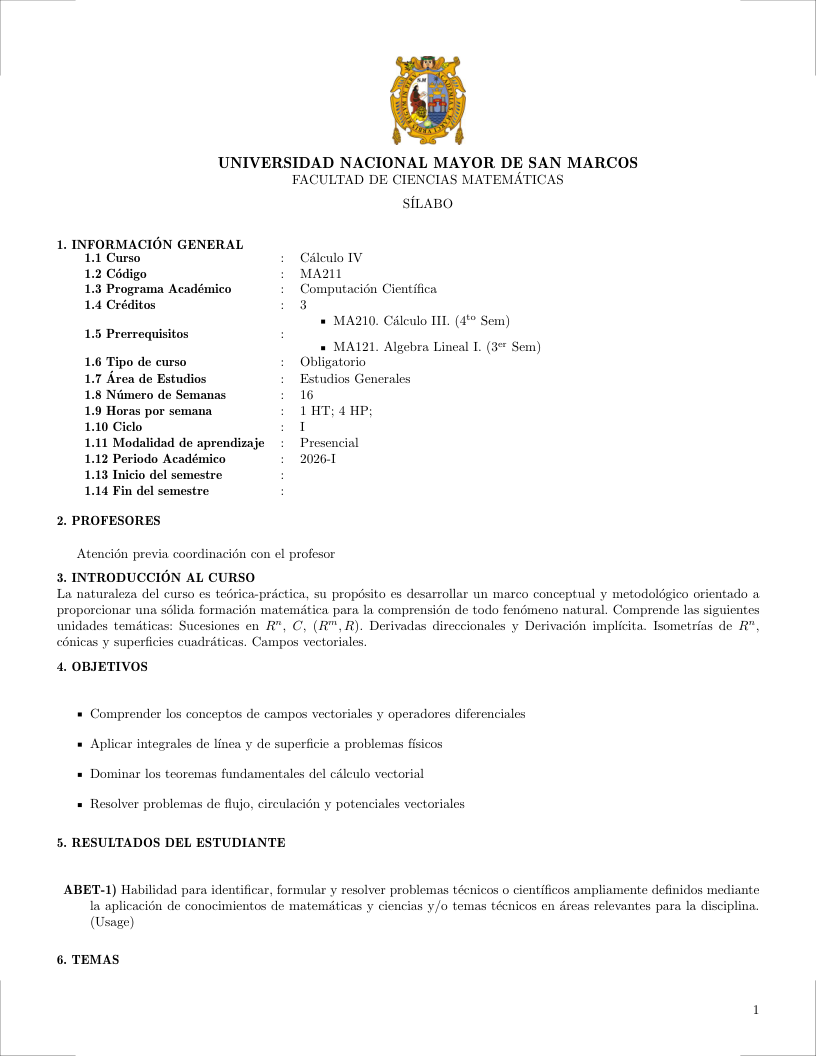
 Español (Latinoamérica)
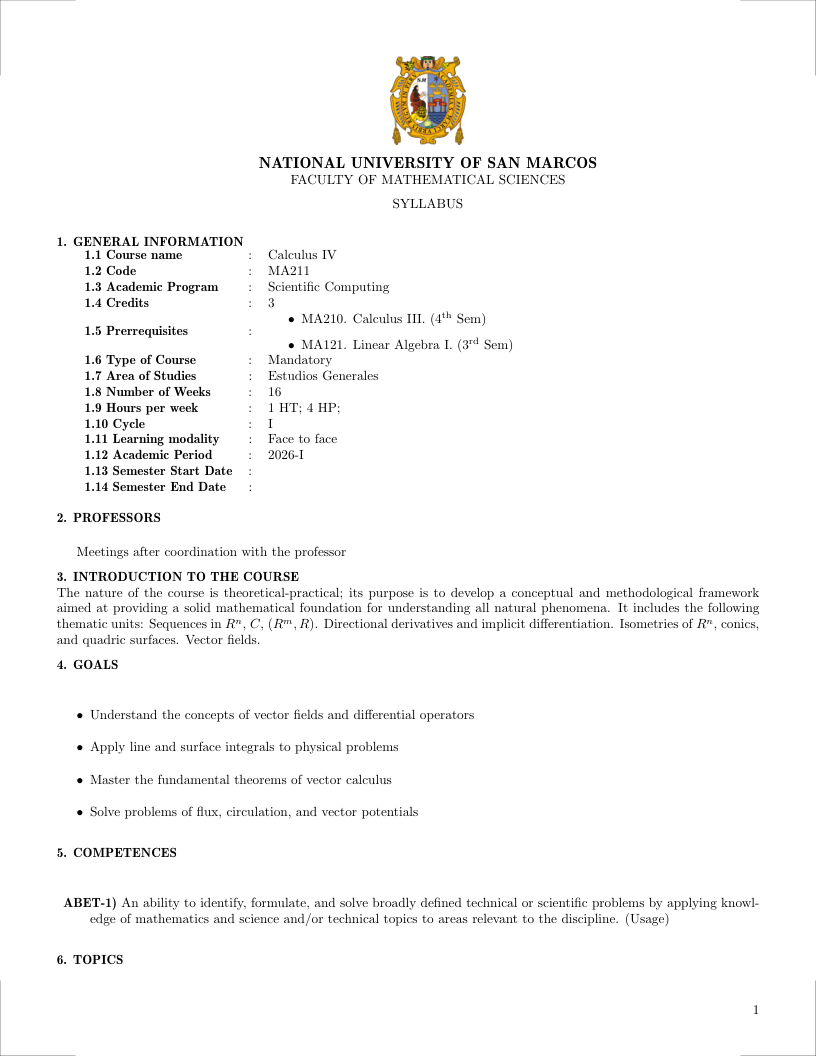 English
- Prerrequisites:
- MA210 Calculus III (4th Sem)
- MA121 Linear Algebra I (3rd Sem)
7.26.1. Justification ↑ Back to top
The nature of the course is theoretical-practical; its purpose is to develop a conceptual and methodological framework aimed at providing a solid mathematical foundation for understanding all natural phenomena. It includes the following thematic units: Sequences in \(R^n\), \(C\), \((R^m, R)\). Directional derivatives and implicit differentiation. Isometries of \(R^n\), conics, and quadric surfaces. Vector fields.
7.26.2. Generales Goals ↑ Back to top
- Understand the concepts of vector fields and differential operators
- Apply line and surface integrals to physical problems
- Master the fundamental theorems of vector calculus
- Solve problems of flux, circulation, and vector potentials
7.26.3. Contribution to Outcomes ↑ Back to top
- ABET-1) An ability to identify, formulate, and solve broadly defined technical or scientific problems by applying knowledge of mathematics and science and/or technical topics to areas relevant to the discipline. (Usage)
7.26.4. Content ↑ Back to top
7.26.4.1. Numerical Differentiation and Integration (20 hours) [Skills ABET-1] ↑ Back to top
Bibliography: (Marsden and Tromba, 2003; Stewart, 2016)
Topics
- Finite difference approximations (forward, backward, central)
- Richardson extrapolation
- Newton-Cotes formulas (Trapezoidal rule, Simpson's rule)
- Gaussian quadrature
- Error analysis for numerical integration
Learning Outcomes
- Compute derivatives of functions using finite difference schemes [Usage]
- Apply Richardson extrapolation to improve the accuracy of numerical approximations [Usage]
- Implement numerical integration rules (Trapezoidal, Simpson, Gaussian) [Usage]
- Compare the accuracy and efficiency of different numerical integration methods [Assessment]
- Analyze the error for numerical differentiation and integration formulas [Assessment]
7.26.4.2. Numerical Methods for Ordinary Differential Equations (ODEs) (20 hours) [Skills ABET-1] ↑ Back to top
Bibliography: (Marsden and Tromba, 2003; Stewart, 2016)
Topics
- Euler's method and its variants (forward, backward)
- Runge-Kutta methods
- Multistep methods (Adams-Bashforth, Adams-Moulton)
- Stability and convergence analysis for ODE solvers
- Systems of ODEs and higher-order ODEs
Learning Outcomes
- Implement basic ODE solvers (Euler, Runge-Kutta) [Usage]
- Analyze the stability and convergence properties of ODE numerical methods [Assessment]
- Select an appropriate numerical method for a given ODE based on stability and accuracy requirements [Assessment]
- Solve systems of ODEs and convert higher-order ODEs to first-order systems [Usage]
7.26.4.3. Interpolation and Function Approximation (20 hours) [Skills ABET-1] ↑ Back to top
Bibliography: (Marsden and Tromba, 2003; Stewart, 2016)
Topics
- Polynomial interpolation (Lagrange, Newton forms)
- Spline interpolation (cubic splines)
- Least squares approximation
- Runge's phenomenon and Chebyshev nodes
- Error analysis for interpolation
Learning Outcomes
- Construct interpolating polynomials using different methods [Usage]
- Implement cubic spline interpolation [Usage]
- Apply least squares method for data fitting [Usage]
- Explain Runge's phenomenon and strategies to mitigate it [Familiarity]
- Analyze the error of an interpolation scheme [Assessment]
7.26.4.4. Roots Finding and Basic Numerical Optimization (20 hours) [Skills ABET-1] ↑ Back to top
Bibliography: (Marsden and Tromba, 2003; Stewart, 2016)
Topics
- Bisection method and fixed-point iteration
- Newton's method and secant method for root finding
- Convergence analysis and order of convergence
- Gradient descent for univariate optimization
- Rate of convergence and stopping criteria
Learning Outcomes
- Implement root-finding algorithms (bisection, Newton, secant) and analyze their convergence [Usage]
- Classify the order of convergence of iterative methods [Assessment]
- Apply gradient descent to solve simple univariate optimization problems [Usage]
- Design appropriate stopping criteria for iterative methods [Usage]
7.26.5. Bibliography ↑ Back to top
Marsden, J. E. and Tromba, A. J. (2003). Cálculo Vectorial. Pearson, 5th edition.
Stewart, J. (2016). Cálculo de una variable: Trascendentes tempranas. Cengage Learning, 8th edition.