- ES Español (Latinoamérica)

- EN English

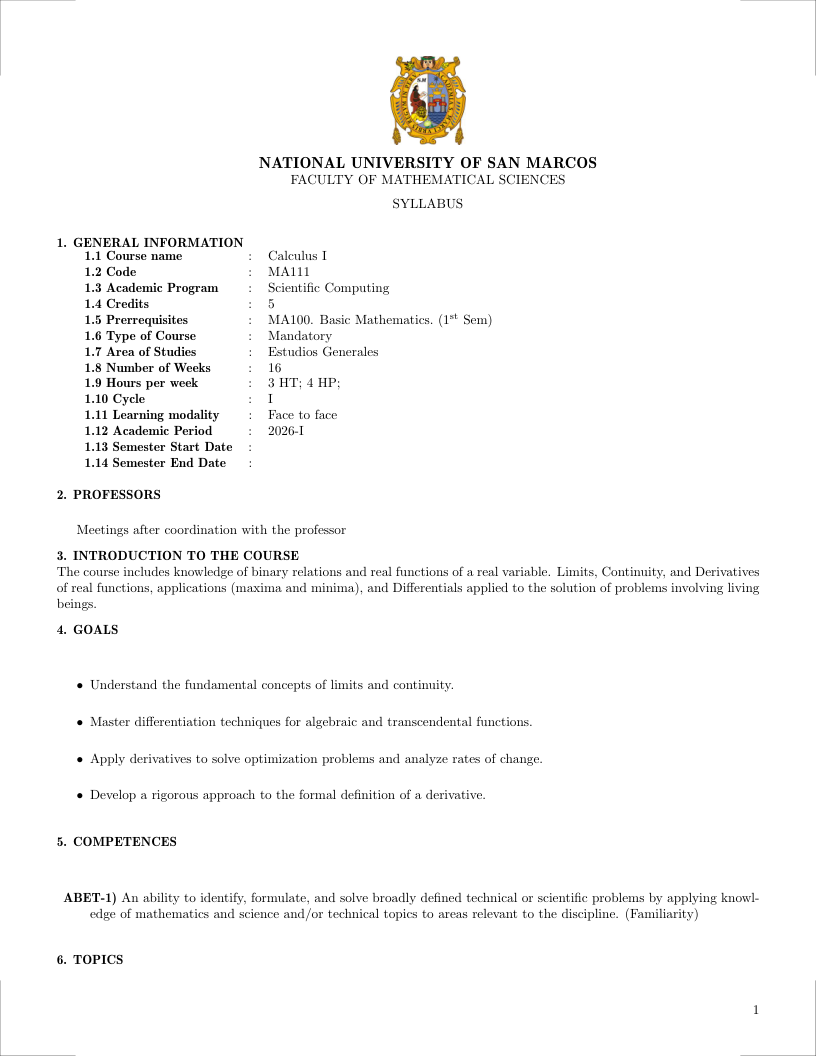
7.11. Calculus I (Mandatory)
- Semester: 2nd Sem. Credits: 5
- Hour of this course: Theory: 3 hours; Practice: 4 hours;
- Syllabus:
- htmlonly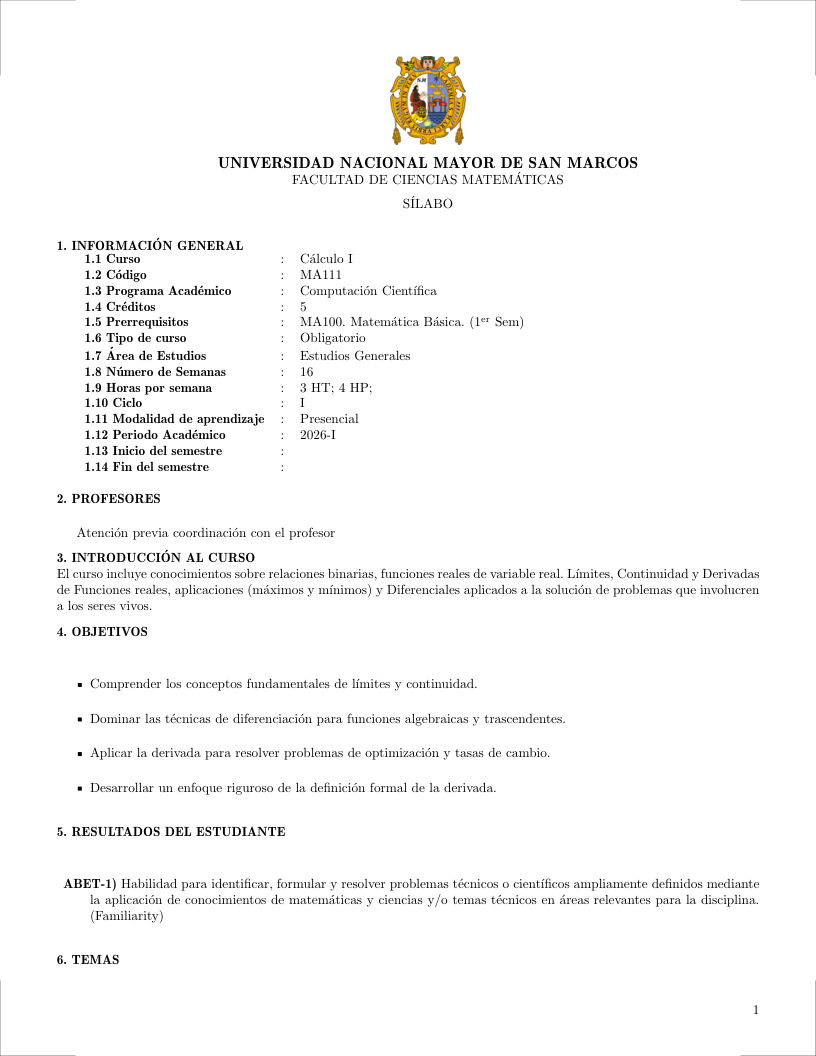
 Español (Latinoamérica)
 English
- Prerrequisites:
- MA100 Basic Mathematics (1st Sem)
7.11.1. Justification ↑ Back to top
The course includes knowledge of binary relations and real functions of a real variable. Limits, Continuity, and Derivatives of real functions, applications (maxima and minima), and Differentials applied to the solution of problems involving living beings.
7.11.2. Generales Goals ↑ Back to top
- Understand the fundamental concepts of limits and continuity.
- Master differentiation techniques for algebraic and transcendental functions.
- Apply derivatives to solve optimization problems and analyze rates of change.
- Develop a rigorous approach to the formal definition of a derivative.
7.11.3. Contribution to Outcomes ↑ Back to top
- ABET-1) An ability to identify, formulate, and solve broadly defined technical or scientific problems by applying knowledge of mathematics and science and/or technical topics to areas relevant to the discipline. (Familiarity)
7.11.4. Content ↑ Back to top
7.11.4.1. Computational Arithmetic and Error Analysis (25 hours) [Skills ABET-1] ↑ Back to top
Bibliography: (Stewart, 2016; Larson and Edwards, 2018)
Topics
- Floating-point arithmetic and the IEEE standard
- Sources of error: truncation, rounding, and discretization
- Error propagation and condition number
- Stability of numerical algorithms
- Absolute, relative, and forward/backward error
Learning Outcomes
- Define the different types of errors in numerical computation (rounding, truncation, discretization) [Familiarity]
- Explain the principles of floating-point representation and arithmetic according to the IEEE standard [Familiarity]
- Calculate the absolute and relative error of an approximation [Usage]
- Analyze the propagation of errors in a sequence of arithmetic operations [Usage]
- Distinguish between the condition of a problem and the stability of an algorithm [Assessment]
- Compute the condition number of a simple problem (e.g., matrix-vector multiplication) [Usage]
7.11.4.2. Roots Finding and Basic Numerical Optimization (25 hours) [Skills ABET-1] ↑ Back to top
Bibliography: (Stewart, 2016; Thomas et al., 2014)
Topics
- Bisection method and fixed-point iteration
- Newton's method and secant method for root finding
- Convergence analysis and order of convergence
- Gradient descent for univariate optimization
- Rate of convergence and stopping criteria
Learning Outcomes
- Implement root-finding algorithms (bisection, Newton, secant) and analyze their convergence [Usage]
- Classify the order of convergence of iterative methods [Assessment]
- Apply gradient descent to solve simple univariate optimization problems [Usage]
- Design appropriate stopping criteria for iterative methods [Usage]
7.11.5. Bibliography ↑ Back to top
Stewart, J. (2016). Cálculo de una variable: Trascendentes tempranas. Cengage Learning, 8th edition.
Larson, R. and Edwards, B. H. (2018). Cálculo. Cengage Learning, 10th edition.
Thomas, G. B., Weir, M. D., and Hass, J. (2014). Cálculo de una variable. Pearson, 13th edition.