- ES Español (Latinoamérica)

- EN English

7.4. Gender and Society (Mandatory)
- Semester: 1st Sem. Credits: 2
- Hour of this course: Theory: 1 hours; Practice: 2 hours;
- Syllabus:
- htmlonly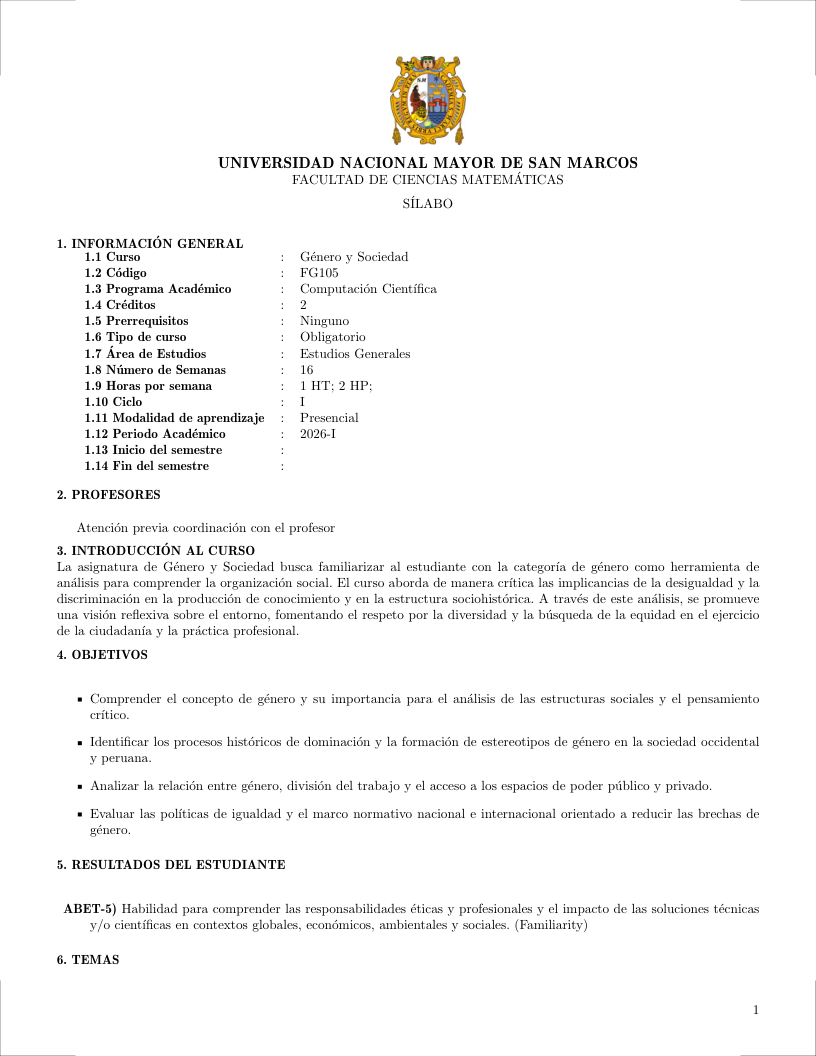
 Español (Latinoamérica)
 English
- Prerrequisites: None
7.4.1. Justification ↑ Back to top
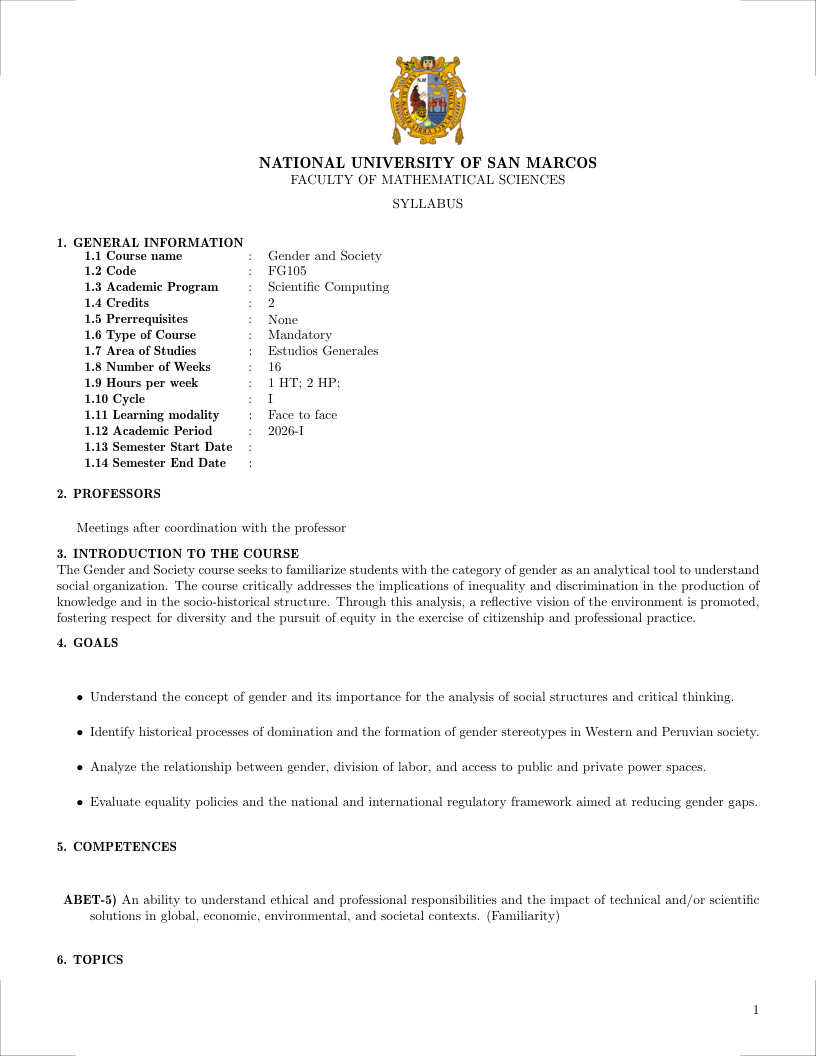
The Gender and Society course seeks to familiarize students with the category of gender as an analytical tool to understand social organization. The course critically addresses the implications of inequality and discrimination in the production of knowledge and in the socio-historical structure. Through this analysis, a reflective vision of the environment is promoted, fostering respect for diversity and the pursuit of equity in the exercise of citizenship and professional practice.
7.4.2. Generales Goals ↑ Back to top
- Understand the concept of gender and its importance for the analysis of social structures and critical thinking.
- Identify historical processes of domination and the formation of gender stereotypes in Western and Peruvian society.
- Analyze the relationship between gender, division of labor, and access to public and private power spaces.
- Evaluate equality policies and the national and international regulatory framework aimed at reducing gender gaps.
7.4.3. Contribution to Outcomes ↑ Back to top
- ABET-5) An ability to understand ethical and professional responsibilities and the impact of technical and/or scientific solutions in global, economic, environmental, and societal contexts. (Familiarity)
7.4.4. Content ↑ Back to top
7.4.4.1. Fundamental Concepts of Gender (8 hours) [Skills ] ↑ Back to top
Bibliography: (Butler, 2007; Lamas, 1996)
Topics
- Sex and gender: Conceptual and biological distinctions.
- Gender as an analytical category in the social sciences.
- Gender socialization and the construction of identities.
- Stereotypes, prejudices, and gender roles today.
Learning Outcomes
- Distinguish the biological bases of sex from the social and cultural construction of gender [Familiarity].
- Explain how gender stereotypes influence the perception of the environment and communication [Usage].
- Critically analyze the production of knowledge from an inclusive gender perspective [Assessment].
7.4.4.2. Gender, History, and Social Structure (8 hours) [Skills ] ↑ Back to top
Bibliography: (Federici, 2010; Quijano, 1988)
Topics
- Historical evolution of gender relations.
- The sexual division of labor: Public and private spaces.
- Gender and coloniality in Latin America.
- Patriarchy and systems of domination in Peruvian history.
Learning Outcomes
- Identify historical milestones that have shaped gender gaps in Latin American society [Familiarity].
- Describe the impact of the division of labor on the economic and social development of women [Usage].
- Evaluate how historical power structures affect current sustainability and social equity [Assessment].
7.4.4.3. Gender, Power, and Citizenship (8 hours) [Skills ] ↑ Back to top
Bibliography: (Fuller, 2004; Pateman, 2016)
Topics
- Gender and the exercise of citizenship in the 21st century.
- Political participation and access to decision-making positions.
- Gender-based violence: Definitions, types, and statistics.
- Masculinities and changes in power relations.
Learning Outcomes
- Recognize the various forms of gender-based violence and existing prevention mechanisms [Familiarity].
- Apply ethical principles in the analysis of power relations between genders [Usage].
- Argue for the importance of diversity and inclusion in the development of civil society [Assessment].
7.4.4.4. Public Policies and Regulatory Framework (8 hours) [Skills ] ↑ Back to top
Bibliography: (Durand, 2014; MIMP, 2019)
Topics
- International legal framework: CEDAW and the SDGs.
- National Gender Equality Policy in Peru.
- Gender perspective in public management and social projects.
- Current challenges for substantive equality.
Learning Outcomes
- Identify the main international treaties ratified by Peru regarding gender [Familiarity].
- Integrate the gender perspective in the planning and management of multidisciplinary projects [Usage].
- Evaluate the impact of public equality policies on national health, safety, and economy [Assessment].
7.4.5. Bibliography ↑ Back to top
Butler, J. (2007). El género en disputa: El feminismo y la subversión de la identidad. Paidós.
Lamas, M. (1996). El género: La construcción cultural de la diferencia sexual. PUEG.
Federici, S. (2010). Calibán y la bruja: Mujeres, cuerpo y acumulación originaria. Traficantes de Sueños.
Quijano, A. (1988). Modernidad, identidad y utopía en América Latina. Sociedad y Política.
Fuller, N. (2004). Jerarquías de género y ciudadanía. Pontificia Universidad Católica del Perú.
Pateman, C. (2016). El contrato sexual. Anthropos.
Durand, A. (2014). Género y Ciudadanía: Retos para la inclusión en el Perú. UNMSM.
MIMP (2019). Política nacional de igualdad de género. Technical report, Ministerio de la Mujer y Poblaciones Vulnerables, Lima, Perú.