- ES Español (Latinoamérica)

- EN English

7.6. Methods of managing university personnel (Mandatory)
- Semester: 1st Sem. Credits: 2
- Hour of this course: Theory: 1 hours; Practice: 2 hours;
- Syllabus:
- htmlonly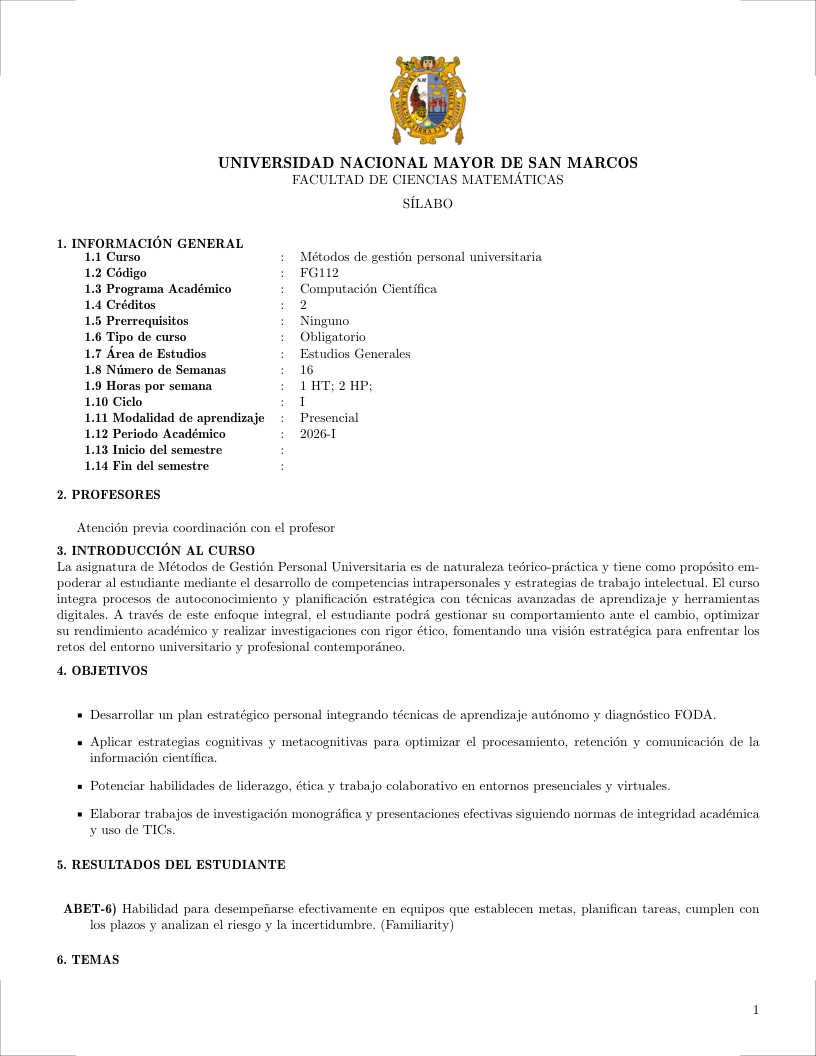
 Español (Latinoamérica)
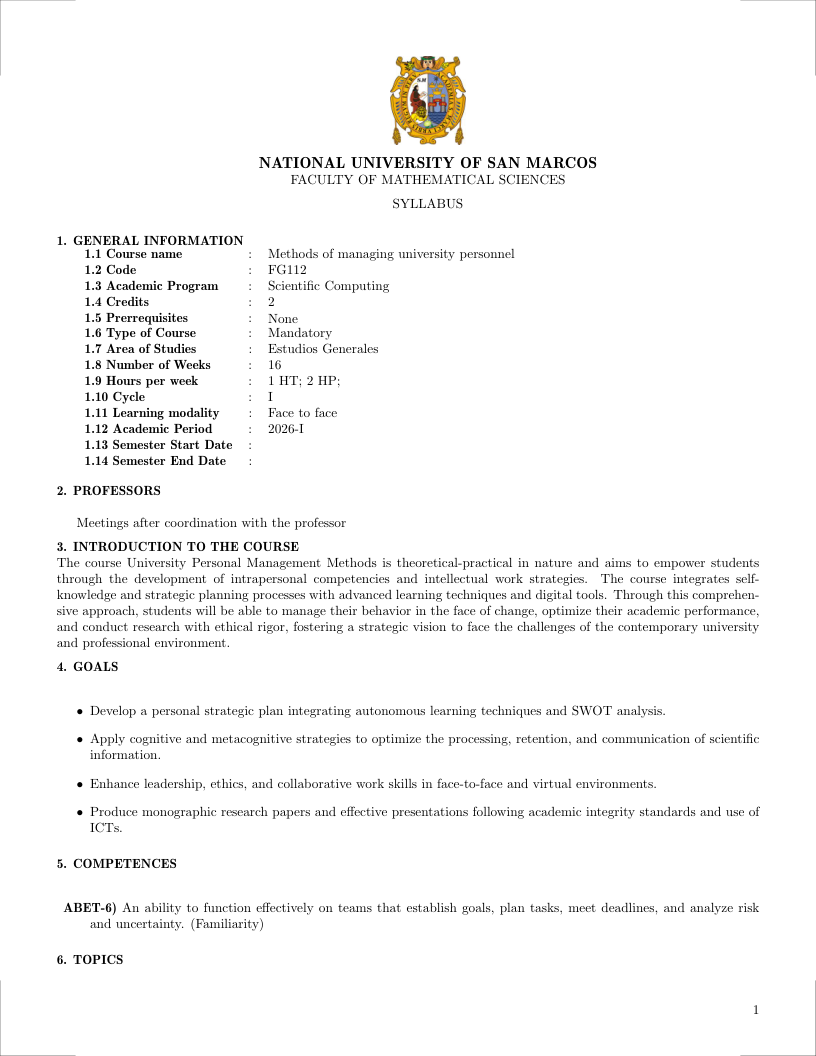 English
- Prerrequisites: None
7.6.1. Justification ↑ Back to top
The course University Personal Management Methods is theoretical-practical in nature and aims to empower students through the development of intrapersonal competencies and intellectual work strategies. The course integrates self-knowledge and strategic planning processes with advanced learning techniques and digital tools. Through this comprehensive approach, students will be able to manage their behavior in the face of change, optimize their academic performance, and conduct research with ethical rigor, fostering a strategic vision to face the challenges of the contemporary university and professional environment.
7.6.2. Generales Goals ↑ Back to top
- Develop a personal strategic plan integrating autonomous learning techniques and SWOT analysis.
- Apply cognitive and metacognitive strategies to optimize the processing, retention, and communication of scientific information.
- Enhance leadership, ethics, and collaborative work skills in face-to-face and virtual environments.
- Produce monographic research papers and effective presentations following academic integrity standards and use of ICTs.
7.6.3. Contribution to Outcomes ↑ Back to top
- ABET-6) An ability to function effectively on teams that establish goals, plan tasks, meet deadlines, and analyze risk and uncertainty. (Familiarity)
7.6.4. Content ↑ Back to top
7.6.4.1. Strategic Management and Learning (12 hours) [Skills ] ↑ Back to top
Bibliography: (Alcaide, 2021; Bernardo and Méndez, 2020; Fischman, 2018)
Topics
- Basic concepts of management and university learning.
- Self-knowledge and personal diagnosis (SWOT).
- Personal vision, mission, and values.
- Cognitive processes, attention, and learning strategies.
- Metacognition: Learning to learn and self-regulation.
Learning Outcomes
- Identify the principles of management and cognitive factors involved in academic success [Familiarity].
- Develop a strategic planning matrix oriented towards individual development [Usage].
- Evaluate the alignment between personal values and continuous learning processes [Assessment].
7.6.4.2. Intellectual Work Techniques and ICTs (12 hours) [Skills ] ↑ Back to top
Bibliography: (Pallarés, 2017; Novak, 2019; Lazzati, 2019)
Topics
- Comprehensive reading, underlining, and note-taking.
- Visual organizers: Concept and mind maps.
- Time management and personal productivity.
- Personal Learning Environment (PLE) and Web 2.0 tools.
- Collaborative work in virtual environments.
Learning Outcomes
- Recognize the usefulness of visual organizers and ICT tools in studying [Familiarity].
- Use synthesis techniques and time management to optimize performance [Usage].
- Design an efficient personal learning environment integrating digital and productivity tools [Assessment].
7.6.4.3. Leadership, Ethics, and Research (12 hours) [Skills ] ↑ Back to top
Bibliography: (Cortina, 2021; Montenegro and Núñez, 2022; Sampieri and Mendoza, 2018)
Topics
- Leadership: Styles, theories, and conflict management.
- The monograph: Structure, search, and source selection.
- Ethical use of information and plagiarism prevention (Citation standards).
- Social responsibility and professional ethics in project management.
Learning Outcomes
- Understand the methodological structure of research and the principles of effective leadership [Familiarity].
- Select reliable information sources for solving management problems [Usage].
- Write academic documents respecting intellectual property and ethical principles [Assessment].
7.6.4.4. Communication and Decision Making (12 hours) [Skills ] ↑ Back to top
Bibliography: (Bernardo and Méndez, 2020; Lazzati, 2019; Zimbardo and Gerrig, 2017)
Topics
- The decision-making process: Models and risks.
- Inclusive academic communication: Synchronous and asynchronous.
- Oral presentations and preparation of visual aids.
- Emotional intelligence and proactive adaptation to change.
Learning Outcomes
- Identify the critical stages for decision-making and effective communication [Familiarity].
- Apply assertive communication strategies to lead and present project results [Usage].
- Resolve conflict situations and make decisions based on critical thinking and emotional intelligence [Assessment].
7.6.5. Bibliography ↑ Back to top
Alcaide, F. (2021). Aprendiendo de los mejores: Tu desarrollo personal es tu destino. Alienta Editorial, Barcelona.
Bernardo, J. and Méndez, J. (2020). Estrategias de aprendizaje para universitarios: Un enfoque práctico y digital. Pirámide, Madrid.
Fischman, D. (2018). El camino del líder: Historias ancestrales y vivencias personales. Planeta, Lima.
Pallarés, E. (2017). Estudiar con éxito: Técnicas y hábitos para aprender mejor. Paraninfo, Madrid.
Novak, J. (2019). Aprender a aprender: 30 años después. Morata, Madrid.
Lazzati, S. (2019). Decisiones gerenciales: Anatomía y proceso. Granica, Buenos Aires.
Cortina, A. (2021). Ética para líderes: La responsabilidad de gobernar. Paidós, Barcelona.
Montenegro, M. and Núñez, R. (2022). Guía metodológica para la investigación y elaboración de monografías. Fondo Editorial PUCP, Lima.
Sampieri, R. H. and Mendoza, C. (2018). Metodología de la investigación: Las rutas cuantitativa, cualitativa y mixta. McGraw-Hill, México D.F.
Zimbardo, P. and Gerrig, R. (2017). Psicología y vida (Edición 19). Pearson, México D.F.