- ES Español (Latinoamérica)

- EN English

7.47. Quantum Mechanics (Elective)
- Semester: 8th Sem. Credits: 5
- Hour of this course: Theory: 4 hours; Practice: 2 hours;
- Syllabus:
- htmlonly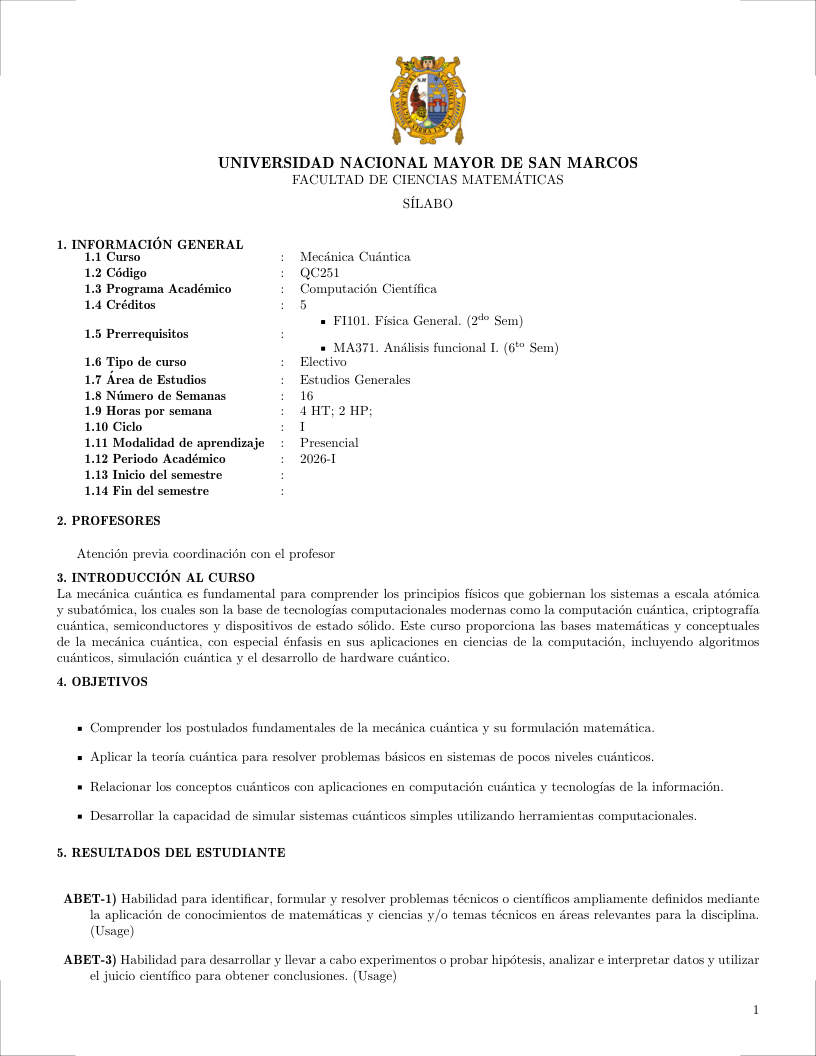
 Español (Latinoamérica)
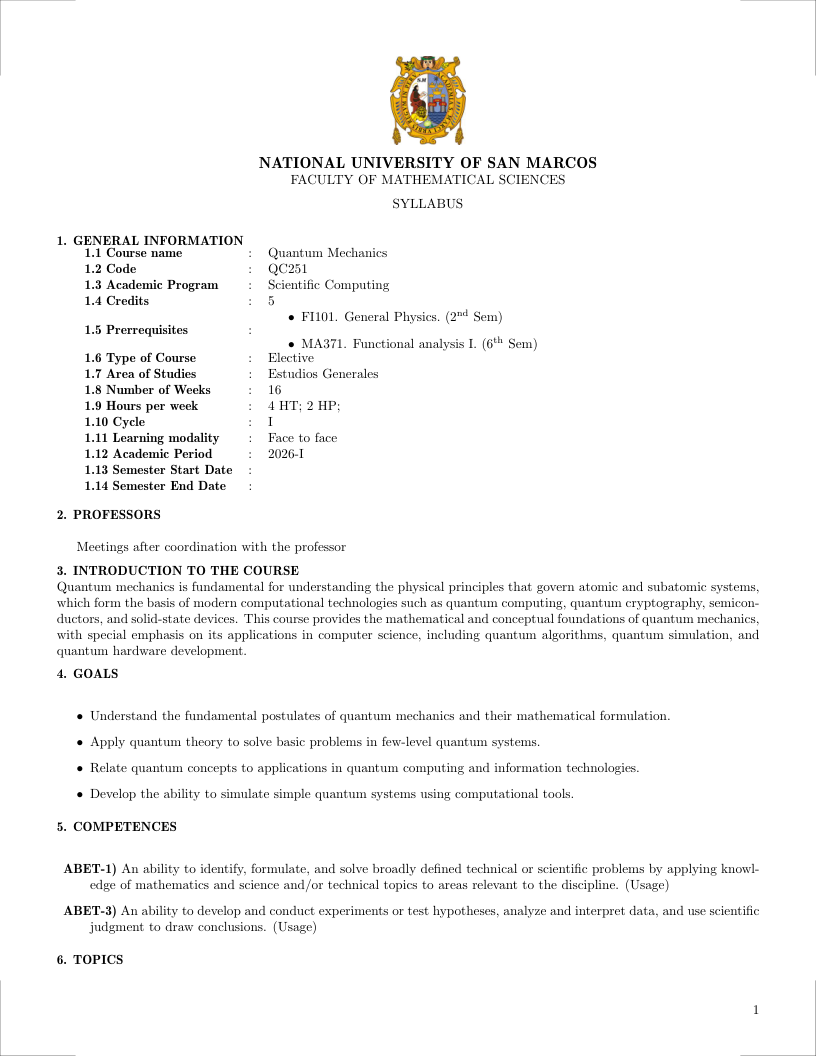 English
- Prerrequisites:
- FI101 General Physics (2nd Sem)
- MA371 Functional analysis I (6th Sem)
7.47.1. Justification ↑ Back to top
Quantum mechanics is fundamental for understanding the physical principles that govern atomic and subatomic systems, which form the basis of modern computational technologies such as quantum computing, quantum cryptography, semiconductors, and solid-state devices. This course provides the mathematical and conceptual foundations of quantum mechanics, with special emphasis on its applications in computer science, including quantum algorithms, quantum simulation, and quantum hardware development.
7.47.2. Generales Goals ↑ Back to top
- Understand the fundamental postulates of quantum mechanics and their mathematical formulation.
- Apply quantum theory to solve basic problems in few-level quantum systems.
- Relate quantum concepts to applications in quantum computing and information technologies.
- Develop the ability to simulate simple quantum systems using computational tools.
7.47.3. Contribution to Outcomes ↑ Back to top
- ABET-1) An ability to identify, formulate, and solve broadly defined technical or scientific problems by applying knowledge of mathematics and science and/or technical topics to areas relevant to the discipline. (Usage)
- ABET-3) An ability to develop and conduct experiments or test hypotheses, analyze and interpret data, and use scientific judgment to draw conclusions. (Usage)
7.47.4. Content ↑ Back to top
7.47.4.1. Fundamentals of Quantum Mechanics (12 hours) [Skills ABET-1,ABET-3] ↑ Back to top
Bibliography: (Griffiths and Schroeter, 2018; Nielsen and Chuang, 2010a)
Topics
- Crisis of classical physics: blackbody radiation, photoelectric effect.
- Wave-particle duality and complementarity principle.
- Postulates of quantum mechanics: wave function, operators, and expectation values.
- Time-dependent and time-independent Schrödinger equation.
- Born's probabilistic interpretation.
Learning Outcomes
- Explain the limitations of classical physics that motivated the development of quantum mechanics. [Familiarity]
- State the fundamental postulates of quantum mechanics. [Familiarity]
- Interpret the physical meaning of the wave function and its relation to probabilities. [Usage]
- Formulate simple problems using the Schrödinger equation. [Assessment]
7.47.4.2. Simple Quantum Systems (14 hours) [Skills ABET-1,ABET-3] ↑ Back to top
Bibliography: (Griffiths and Schroeter, 2018; McIntyre et al., 2012)
Topics
- Particle in a one-dimensional and three-dimensional box.
- Quantum harmonic oscillator: algebraic solution and Hermite polynomials.
- Quantum tunneling through potential barriers.
- Finite potential well and bound states.
- Ladder operators for the harmonic oscillator.
Learning Outcomes
- Solve the Schrödinger equation analytically for simple quantum systems. [Familiarity]
- Calculate energy levels and wave functions for symmetric potential wells. [Usage]
- Explain the quantum tunneling phenomenon and its technological applications. [Assessment]
- Use ladder operators to manipulate quantum states. [Assessment]
7.47.4.3. Linear Algebra in Quantum Mechanics (10 hours) [Skills ABET-1,ABET-3] ↑ Back to top
Bibliography: (Shankar, 2012; Nielsen and Chuang, 2010a)
Topics
- Hilbert spaces and Dirac notation.
- Linear operators, Hermitian and unitary operators.
- Eigenvalues and eigenvectors in quantum systems.
- Matrix representations of quantum operators.
- Tensor product and composite spaces.
Learning Outcomes
- Use Dirac notation to represent quantum states. [Familiarity]
- Differentiate between Hermitian, unitary, and projection operators. [Usage]
- Construct matrix representations of simple quantum operators. [Usage]
- Apply the tensor product to describe composite quantum systems. [Assessment]
7.47.4.4. Angular Momentum and Spin (8 hours) [Skills ABET-1,ABET-3] ↑ Back to top
Bibliography: (Griffiths and Schroeter, 2018; McIntyre et al., 2012)
Topics
- Orbital angular momentum: operators and eigenfunctions.
- Spin: the intrinsic degree of freedom.
- Pauli matrices and spin-1/2 representation.
- Coupling of angular momenta.
- Identical particles and Pauli exclusion principle.
Learning Outcomes
- Calculate angular momentum eigenvalues for simple systems. [Familiarity]
- Manipulate spin states using Pauli matrices. [Usage]
- Apply the Pauli exclusion principle to fermion systems. [Assessment]
- Explain the importance of spin in technologies such as magnetic resonance. [Assessment]
7.47.4.5. Perturbation Theory (10 hours) [Skills ABET-1,ABET-3] ↑ Back to top
Bibliography: (Griffiths and Schroeter, 2018; Shankar, 2012)
Topics
- Time-independent perturbations: nondegenerate and degenerate theory.
- Corrections to energy levels and wave functions.
- Time-dependent perturbations: Fermi's golden rule.
- Radiation-induced transitions.
- Variational method for ground states.
Learning Outcomes
- Apply nondegenerate perturbation theory to simple quantum systems. [Familiarity]
- Calculate energy level corrections due to small perturbations. [Usage]
- Use Fermi's golden rule to calculate transition rates. [Assessment]
- Apply the variational method to estimate ground state energies. [Assessment]
7.47.4.6. Applications in Quantum Computing (10 hours) [Skills ABET-1,ABET-3] ↑ Back to top
Bibliography: (Nielsen and Chuang, 2010a; Rieffel and Polak, 2011)
Topics
- Qubits: representation and basic operations.
- Quantum gates and elementary quantum circuits.
- Quantum entanglement and no-cloning theorem.
- Simple quantum algorithms: Deutsch-Jozsa and quantum teleportation.
- Simulation of quantum systems on classical computers.
- Implementation of quantum algorithms using frameworks like Qiskit or Cirq.
Learning Outcomes
- Represent and manipulate qubits using Dirac notation. [Familiarity]
- Explain the concept of quantum entanglement and its applications. [Usage]
- Implement simple quantum circuits using quantum programming frameworks. [Usage]
- Simulate few-qubit quantum systems in computational environments. [Assessment]
- Describe the fundamental advantages of quantum computing over classical computing. [Assessment]
7.47.5. Bibliography ↑ Back to top
Griffiths, D. J. and Schroeter, D. F. (2018). Introduction to Quantum Mechanics. Cambridge University Press, 3rd edition. Texto estándar para cursos introductorios de mecánica cuántica, con explicaciones claras y problemas bien seleccionados.
Nielsen, M. A. and Chuang, I. L. (2010a). Quantum Computation and Quantum Information. Cambridge University Press, 10th anniversary edition. La biblia de la computación cuántica, conecta teoría cuántica con aplicaciones en computación e información.
McIntyre, D. H., Manogue, C. A., and Tate, J. (2012). Quantum Mechanics: A Paradigms Approach. Pearson. Enfoque moderno con aplicaciones experimentales y conexiones con tecnologías actuales.
Shankar, R. (2012). Principles of Quantum Mechanics. Springer, 2nd edition. Excelente para el formalismo matemático y tratamiento riguroso de los fundamentos.
Rieffel, E. G. and Polak, W. H. (2011). Quantum Computing: A Gentle Introduction. MIT Press. Introducción accesible a la computación cuántica, ideal para estudiantes de ciencias de la computación.