- ES Español (Latinoamérica)

- EN English

7.59. Time series analysis (Elective)
- Semester: 9th Sem. Credits: 4
- Hour of this course: Theory: 2 hours; Practice: 4 hours;
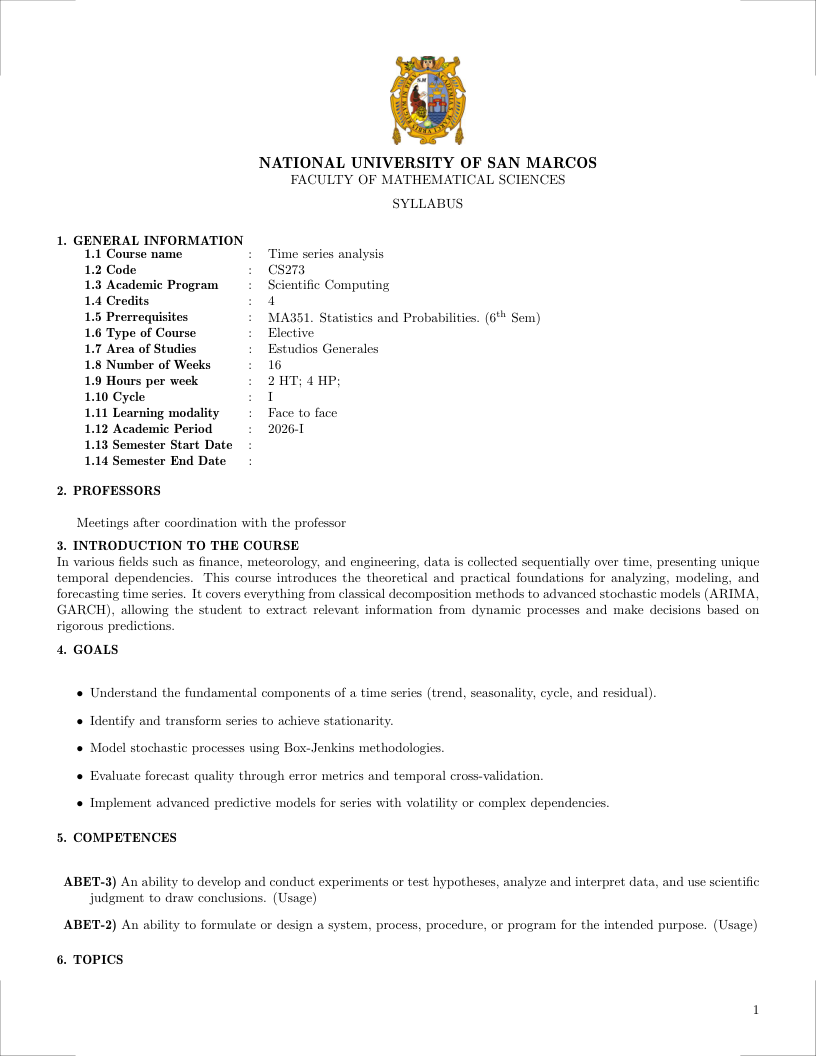
- Syllabus:
- htmlonly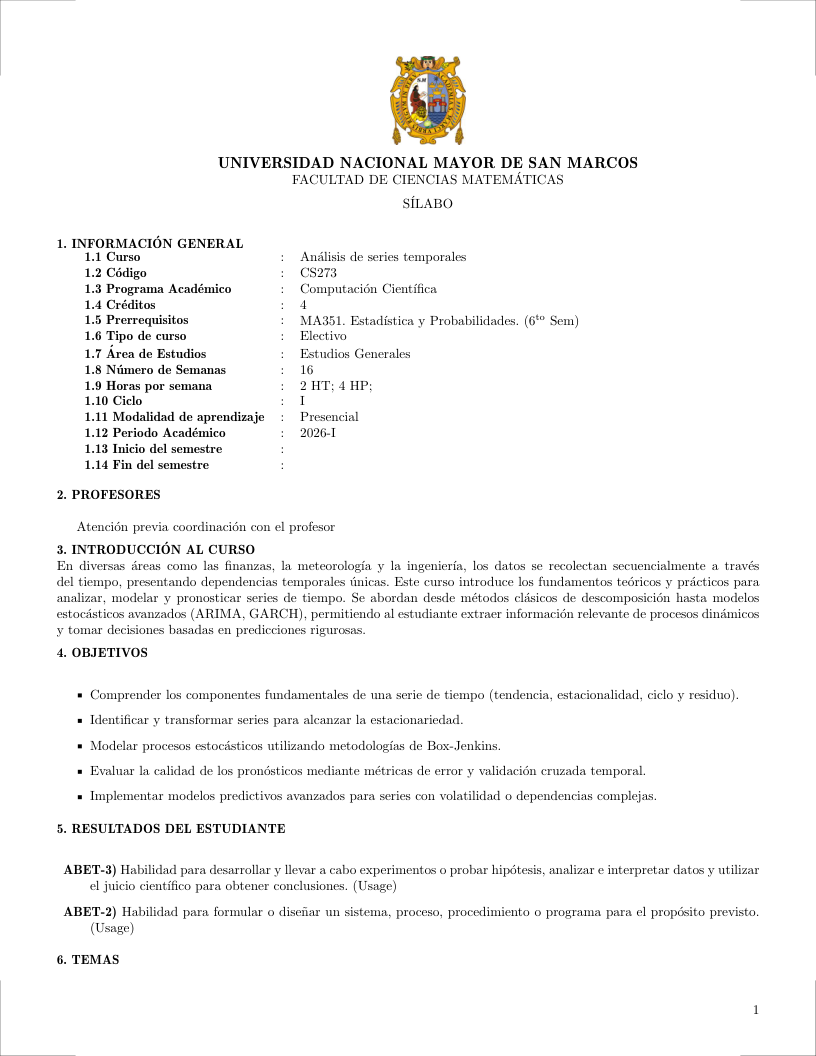
 Español (Latinoamérica)
 English
- Prerrequisites:
- MA351 Statistics and Probabilities (6th Sem)
7.59.1. Justification ↑ Back to top
In various fields such as finance, meteorology, and engineering, data is collected sequentially over time, presenting unique temporal dependencies. This course introduces the theoretical and practical foundations for analyzing, modeling, and forecasting time series. It covers everything from classical decomposition methods to advanced stochastic models (ARIMA, GARCH), allowing the student to extract relevant information from dynamic processes and make decisions based on rigorous predictions.
7.59.2. Generales Goals ↑ Back to top
- Understand the fundamental components of a time series (trend, seasonality, cycle, and residual).
- Identify and transform series to achieve stationarity.
- Model stochastic processes using Box-Jenkins methodologies.
- Evaluate forecast quality through error metrics and temporal cross-validation.
- Implement advanced predictive models for series with volatility or complex dependencies.
7.59.3. Contribution to Outcomes ↑ Back to top
- ABET-3) An ability to develop and conduct experiments or test hypotheses, analyze and interpret data, and use scientific judgment to draw conclusions. (Usage)
- ABET-2) An ability to formulate or design a system, process, procedure, or program for the intended purpose. (Usage)
7.59.4. Content ↑ Back to top
7.59.4.1. Introduction and Fundamental Concepts (8 hours) [Skills ABET-2,ABET-3] ↑ Back to top
Bibliography: (Hyndman and Athanasopoulos, 2021; Box et al., 2015)
Topics
- Definition and examples of time series.
- Series components: Trend, Seasonality, and Noise.
- Lag and difference operators.
- Smoothing operations: Simple and weighted moving averages.
Learning Outcomes
- Decompose a time series into its basic components [Usage].
- Identify visual patterns of temporal dependence in real data [Familiarity].
7.59.4.2. Stationarity and Autocorrelation Functions (8 hours) [Skills ABET-2,ABET-3] ↑ Back to top
Bibliography: (Shumway and Stoffer, 2017; Box et al., 2015)
Topics
- Weak and strong stationarity.
- Autocorrelation Function (ACF) and Partial Autocorrelation Function (PACF).
- White noise and Random Walk.
- Unit root tests (Augmented Dickey-Fuller).
Learning Outcomes
- Determine if a series is stationary using statistical tests [Usage].
- Interpret correlograms to identify possible stochastic models [Assessment].
7.59.4.3. Linear Process Models (AR and MA) (8 hours) [Skills ABET-2,ABET-3] ↑ Back to top
Bibliography: (Shumway and Stoffer, 2017; Brockwell and Davis, 2016)
Topics
- Autoregressive processes (AR).
- Moving Average processes (MA).
- Invertibility and stability conditions.
- Parameter estimation and information criteria (AIC, BIC).
Learning Outcomes
- Model linear dependencies in stationary time series [Usage].
- Select the optimal model order based on statistical criteria [Assessment].
7.59.4.4. Box-Jenkins Methodology and ARIMA Models (8 hours) [Skills ABET-2,ABET-3] ↑ Back to top
Bibliography: (Box et al., 2015; Hyndman and Athanasopoulos, 2021)
Topics
- Integrated models (ARIMA).
- Identification, estimation, and diagnostic checking.
- Residual analysis and Ljung-Box test.
- Seasonal models (SARIMA).
Learning Outcomes
- Implement the full Box-Jenkins modeling cycle [Usage].
- Validate model adequacy through residual analysis [Assessment].
7.59.4.5. Forecasting and Model Evaluation (8 hours) [Skills ABET-2,ABET-3] ↑ Back to top
Bibliography: (Hyndman and Athanasopoulos, 2021; Brockwell and Davis, 2016)
Topics
- Point forecasts and confidence intervals.
- Error metrics: MAE, RMSE, MAPE, and MASE.
- Time Series Cross-Validation (Time Series Split).
- Forecast combinations.
Learning Outcomes
- Generate future predictions with their respective uncertainty margins [Usage].
- Rigorously compare the performance of multiple predictive models [Assessment].
7.59.4.6. Volatility Models (ARCH and GARCH) (8 hours) [Skills ABET-2,ABET-3] ↑ Back to top
Bibliography: (Tsay, 2010; Shumway and Stoffer, 2017)
Topics
- Conditional heteroskedasticity in financial series.
- ARCH (Autoregressive Conditional Heteroskedasticity) models.
- GARCH models and their extensions.
- Risk estimation and Value at Risk (VaR).
Learning Outcomes
- Identify the presence of volatility clustering in financial data [Usage].
- Model conditional variance of complex dynamic processes [Assessment].
7.59.4.7. Ethics and Responsibility in Forecasting (8 hours) [Skills ABET-2,ABET-3] ↑ Back to top
Bibliography: (Hyndman and Athanasopoulos, 2021)
Topics
- Socioeconomic consequences of erroneous forecasts.
- Transparency in communicating uncertainty.
- Ethical use of sensitive temporal data and privacy.
- Biases in automated prediction algorithms.
Learning Outcomes
- Recognize the ethical impact of decisions based on predictions [Familiarity].
- Communicate model limitations and risks to stakeholders [Usage].
7.59.4.8. Implementation and Real-World Applications (8 hours) [Skills ABET-2,ABET-3] ↑ Back to top
Bibliography: (Tsay, 2010; Hyndman and Athanasopoulos, 2021)
Topics
- Computational tools (R: `forecast`, `fable`; Python: `statsmodels`).
- Automation of forecasting workflows.
- Applications in energy demand, inventory, and markets.
- Presentation of a final prediction project.
Learning Outcomes
- Develop automated forecasting systems using specialized software [Assessment].
- Solve a real prediction problem by integrating all course stages [Assessment].
7.59.5. Bibliography ↑ Back to top
Hyndman, R. J. and Athanasopoulos, G. (2021). Forecasting: Principles and Practice. OTexts, 3rd edition.
Box, G. E. P., Jenkins, G. M., Reinsel, G. C., and Ljung, G. M. (2015). Time Series Analysis: Forecasting and Control. Wiley, 5th edition.
Shumway, R. H. and Stoffer, D. S. (2017). Time Series Analysis and Its Applications: With R Examples. Springer, 4th edition.
Brockwell, P. J. and Davis, R. A. (2016). Introduction to Time Series and Forecasting. Springer, 3rd edition.
Tsay, R. S. (2010). Analysis of Financial Time Series. Wiley, 3rd edition.