- ES Español (Latinoamérica)

- EN English

3.18. AR2B1 Multidisciplinary Coordination (Mandatory)
- Semester: 3rd Sem. Credits: 4
- Hour of this course: Theory: 4 hours; Practice: 4 hours;
- Syllabus:
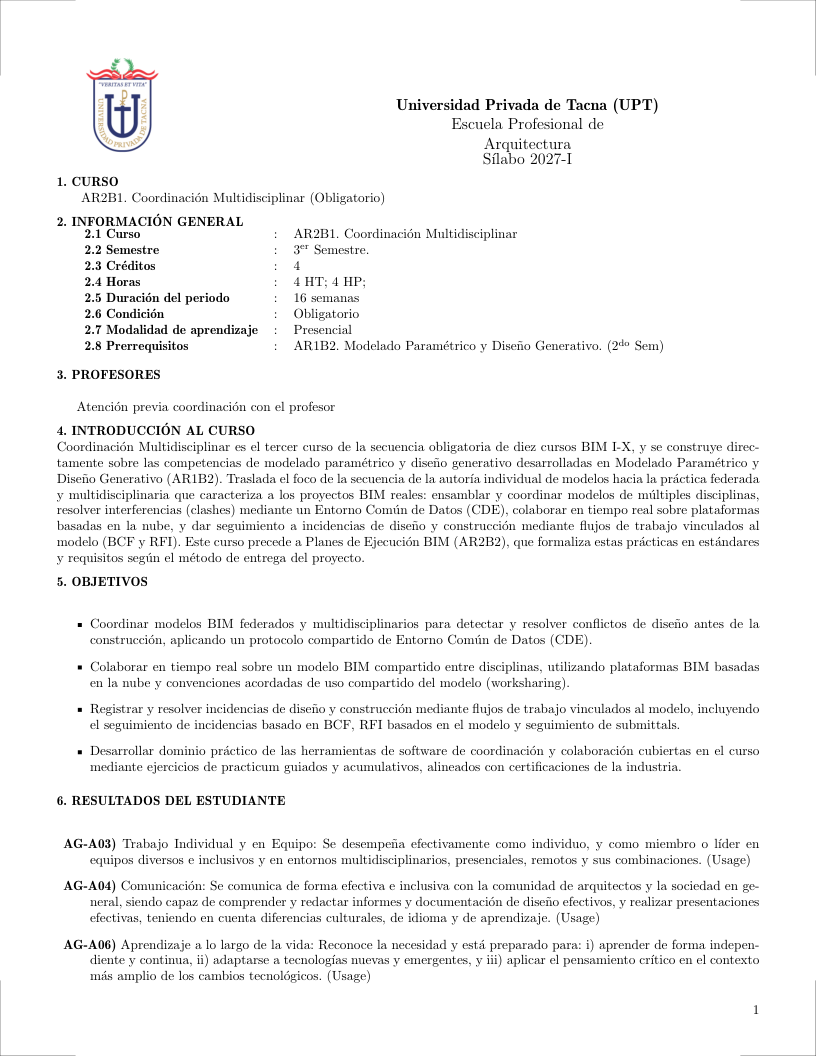
 Español (Latinoamérica)
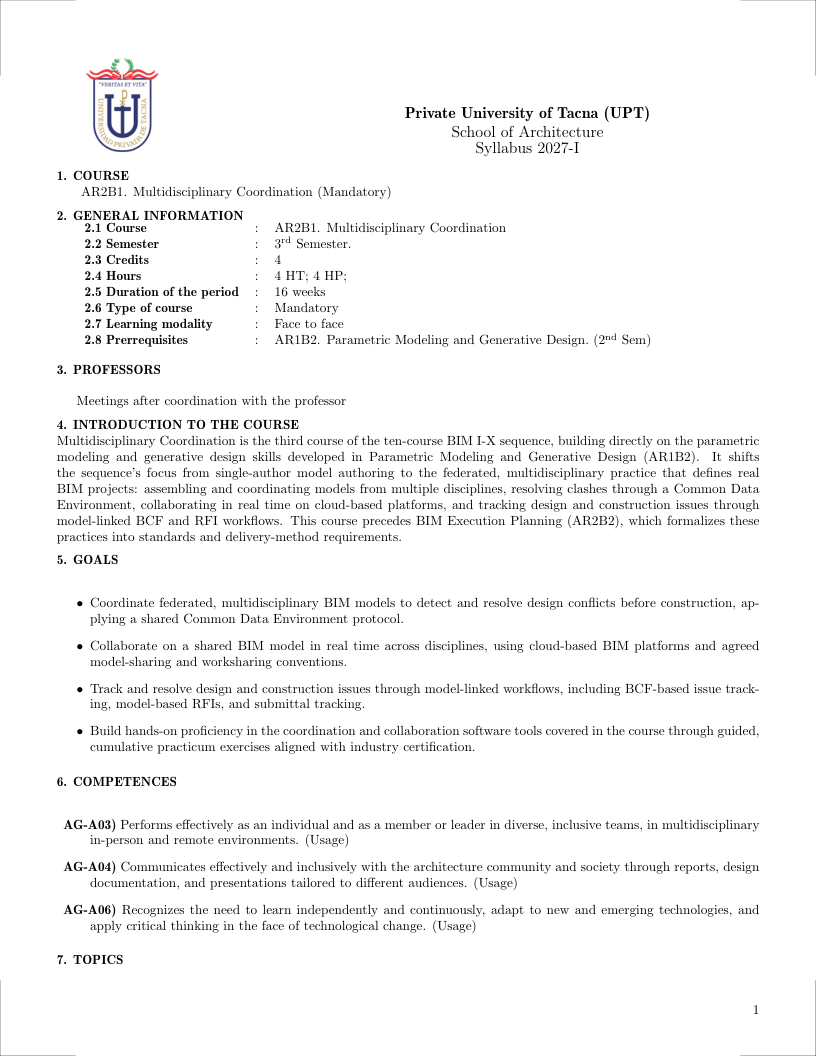 English
- Prerrequisites:
- ES Español (Latinoamérica)
- EN English
3.18.1. Justification Back to top
Multidisciplinary Coordination is the third course of the ten-course BIM I-X sequence, building directly on the parametric modeling and generative design skills developed in Parametric Modeling and Generative Design (AR1B2). It shifts the sequence's focus from single-author model authoring to the federated, multidisciplinary practice that defines real BIM projects: assembling and coordinating models from multiple disciplines, resolving clashes through a Common Data Environment, collaborating in real time on cloud-based platforms, and tracking design and construction issues through model-linked BCF and RFI workflows. This course precedes BIM Execution Planning (AR2B2), which formalizes these practices into standards and delivery-method requirements.
- ES Español (Latinoamérica)
- EN English
3.18.2. Generales Goals Back to top
- Coordinate federated, multidisciplinary BIM models to detect and resolve design conflicts before construction, applying a shared Common Data Environment protocol.
- Collaborate on a shared BIM model in real time across disciplines, using cloud-based BIM platforms and agreed model-sharing and worksharing conventions.
- Track and resolve design and construction issues through model-linked workflows, including BCF-based issue tracking, model-based RFIs, and submittal tracking.
- Build hands-on proficiency in the coordination and collaboration software tools covered in the course through guided, cumulative practicum exercises aligned with industry certification.
- ES Español (Latinoamérica)
- EN English
3.18.3. Contribution to Outcomes Back to top
- AG-A03) Performs effectively as an individual and as a member or leader in diverse, inclusive teams, in multidisciplinary in-person and remote environments. (Usage)
- AG-A04) Communicates effectively and inclusively with the architecture community and society through reports, design documentation, and presentations tailored to different audiences. (Usage)
- AG-A06) Recognizes the need to learn independently and continuously, adapt to new and emerging technologies, and apply critical thinking in the face of technological change. (Usage)
- ES Español (Latinoamérica)
- EN English
3.18.4. Content Back to top
- ES Español (Latinoamérica)
- EN English
3.18.4.1. Multidisciplinary Model Coordination (24 hours) [Skills AG-A03] Back to top
Bibliography: (Sacks et al., 2018)
Topics
- BIM coordination and clash detection: federated model assembly, hard and soft clash detection in Navisworks or Solibri, clash resolution workflows, and the reduction of RFIs
- IFC and open BIM standards: the IFC schema for vendor-neutral model exchange, BCF (BIM Collaboration Format) for issue tracking, and openBIM coordination workflows across authoring platforms
- Common Data Environment (CDE): shared, work-in-progress, published, and archive states for model and document management; naming conventions and version control in a multi-party project
Learning Outcomes
- Describe the role of model coordination in a multidisciplinary project, including federated models, clash detection, and the Common Data Environment [Familiarity]
- Apply BIM coordination tools to detect and resolve clashes in a federated building model, documenting issues through a Common Data Environment workflow [Usage]
- Evaluate a model-coordination protocol for a construction project, assessing federation strategy, clash-detection coverage, and CDE governance [Assessment]
- ES Español (Latinoamérica)
- EN English
3.18.4.2. Collaborative BIM Workflows (24 hours) [Skills AG-A03] Back to top
Bibliography: (Hardin and McCool, 2015b)
Topics
- BIM collaboration: federated models, clash detection and resolution, model-based quantity takeoff for estimating
- Cloud-based BIM collaboration platforms: real-time multi-user editing (BIM 360/ACC, BIMcloud, Trimble Connect), permissions, and worksharing
Learning Outcomes
- Describe how cloud-based BIM collaboration platforms support real-time, multi-user, multidisciplinary model development [Familiarity]
- Develop a BIM collaboration protocol for a project, specifying model sharing standards, clash detection frequency, and meeting rhythms [Usage]
- Evaluate a project's BIM collaboration setup for its effectiveness in supporting multidisciplinary, real-time teamwork [Assessment]
- ES Español (Latinoamérica)
- EN English
3.18.4.3. Model-Based Issue and RFI Management (24 hours) [Skills AG-A04] Back to top
Bibliography: (Hardin and McCool, 2015b)
Topics
- BCF (BIM Collaboration Format)-based issue tracking: creating, assigning, and closing model-linked issues across authoring platforms
- Model-based requests for information (RFIs): linking an RFI to specific model elements and views, and tracking its resolution back into the model
- Submittal tracking tied to model elements: linking product data and shop-drawing submittals to the BIM elements they specify
Learning Outcomes
- Describe how BCF-based issue tracking, model-based RFIs, and submittal tracking keep design and construction issues linked to specific model elements [Familiarity]
- Create, assign, and track a set of model-linked issues through BCF, and link a submittal or RFI to the model elements it affects [Usage]
- Evaluate a project's model-based issue log for traceability, timely resolution, and completeness of the links between issues and model elements [Assessment]
- ES Español (Latinoamérica)
- EN English
3.18.4.4. BIM Software Practicum (24 hours) [Skills AG-A06] Back to top
Bibliography: (Hardin and McCool, 2015b)
Topics
- Guided, graded software exercises in the BIM tool(s) specific to the course's theme (authoring, coordination, scheduling, analysis, or FM platforms), building toward a cumulative course deliverable
- Practice aligned with vendor or industry certification exams (Autodesk Certified Professional, buildingSMART openBIM) relevant to the course's software focus
Learning Outcomes
- Describe the practicum structure for the course's BIM software focus and the deliverable it builds toward [Familiarity]
- Complete a sequence of guided exercises in the course's BIM software focus, building toward a cumulative practicum deliverable [Usage]
- Evaluate the student's own practicum deliverable against the software proficiency expected for the course's BIM theme [Assessment]
- ES Español (Latinoamérica)
- EN English
3.18.5. Bibliography Back to top
Sacks, R., Eastman, C., Lee, G., and Teicholz, P. (2018). BIM Handbook: A Guide to Building Information Modeling for Owners, Designers, Engineers, Contractors, and Facility Managers. Wiley, 3rd edition.
Hardin, B. and McCool, D. (2015b). BIM and Construction Management: Proven Tools, Methods, and Workflows. Wiley, 2nd edition.