- ES Español (Latinoamérica)

- EN English

3.46. AR404 Innovation and Entrepreneurship (Mandatory)
- Semester: 10th Sem. Credits: 4
- Hour of this course: Theory: 4 hours;
- Syllabus:
 Español (Latinoamérica)
 English
- Prerrequisites: None
- ES Español (Latinoamérica)
- EN English
3.46.1. Justification Back to top
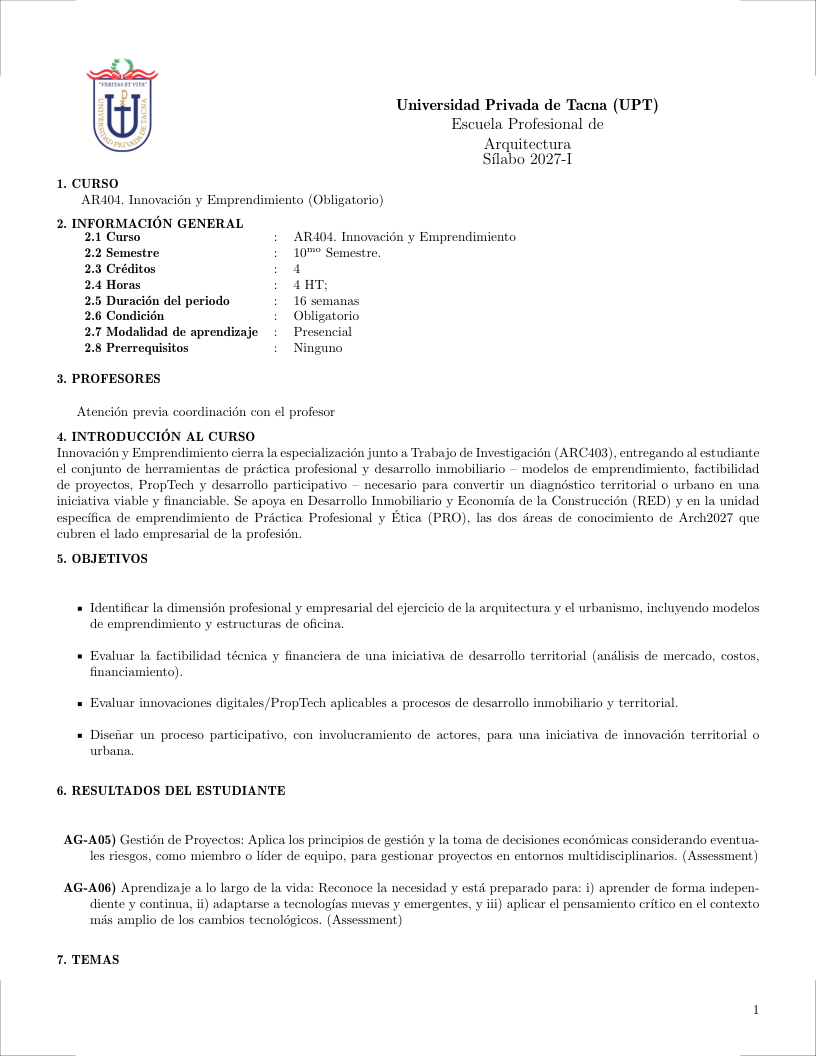
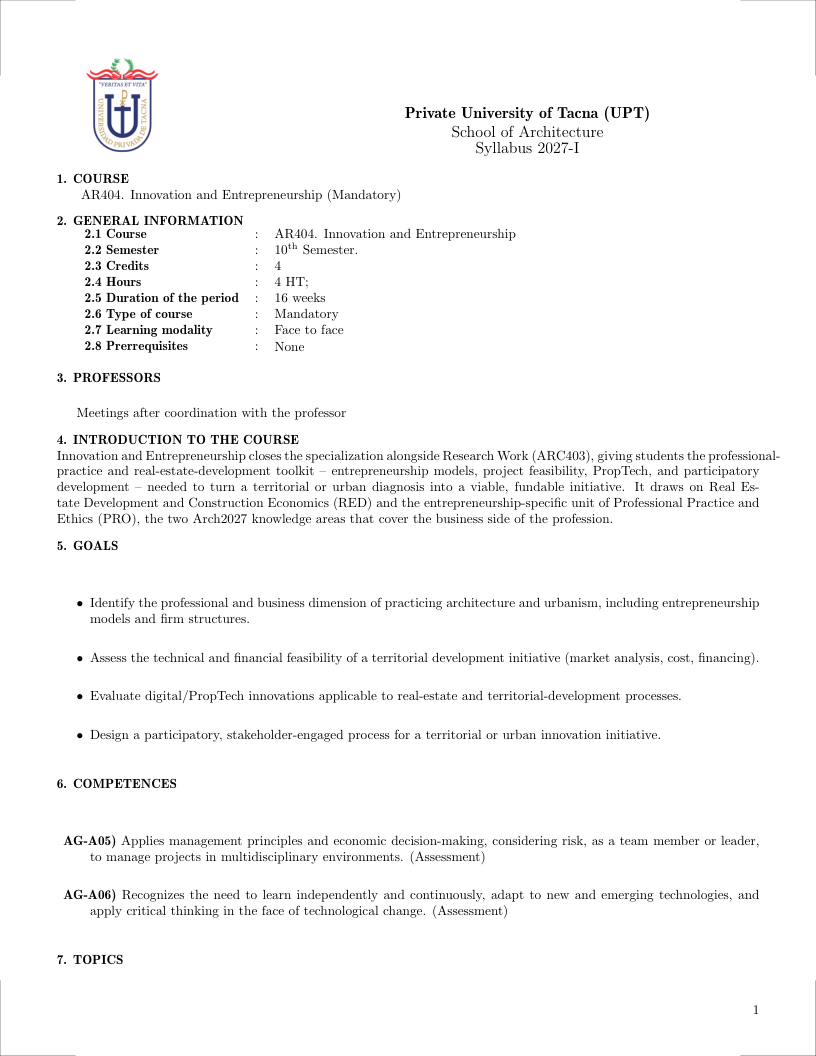
Innovation and Entrepreneurship closes the specialization alongside Research Work (ARC403), giving students the professional-practice and real-estate-development toolkit – entrepreneurship models, project feasibility, PropTech, and participatory development – needed to turn a territorial or urban diagnosis into a viable, fundable initiative. It draws on Real Estate Development and Construction Economics (RED) and the entrepreneurship-specific unit of Professional Practice and Ethics (PRO), the two Arch2027 knowledge areas that cover the business side of the profession.
- ES Español (Latinoamérica)
- EN English
3.46.2. Generales Goals Back to top
- Identify the professional and business dimension of practicing architecture and urbanism, including entrepreneurship models and firm structures.
- Assess the technical and financial feasibility of a territorial development initiative (market analysis, cost, financing).
- Evaluate digital/PropTech innovations applicable to real-estate and territorial-development processes.
- Design a participatory, stakeholder-engaged process for a territorial or urban innovation initiative.
- ES Español (Latinoamérica)
- EN English
3.46.3. Contribution to Outcomes Back to top
- AG-A05) Applies management principles and economic decision-making, considering risk, as a team member or leader, to manage projects in multidisciplinary environments. (Assessment)
- AG-A06) Recognizes the need to learn independently and continuously, adapt to new and emerging technologies, and apply critical thinking in the face of technological change. (Assessment)
- ES Español (Latinoamérica)
- EN English
3.46.4. Content Back to top
- ES Español (Latinoamérica)
- EN English
3.46.4.1. Business of Architecture and Entrepreneurship (16 hours) [Skills AG-A05] Back to top
Bibliography: (Osterwalder and Pigneur, 2010)
Topics
- Architectural firm management: business structures (sole proprietorship, LLC, corporation), financial management (overhead, billable rates, utilization rate, profit margin),
- Fee structures and negotiation: hourly, percentage of construction cost, lump sum, and design-build fees; calculating multiplier and break-even rate
- Business development and marketing: identifying target project types, proposal writing, interview preparation, client relationship management (CRM),
- Entrepreneurial architecture: product-based practice (design-build of prefab units, furniture, components), architect as developer, start-up models (co-working, remote practice)
- Intellectual property in architecture: copyright ownership of architectural works (US Copyright Act, Berne Convention), licensing of drawings and digital models, moral rights,
Learning Outcomes
- Identify the key financial metrics of architectural practice (utilization rate, multiplier, break-even rate) and describe common fee structures and their risks and benefits [Familiarity]
- Prepare a simple business plan for a hypothetical architectural firm, including target markets, fee strategy, staffing plan, and financial projections for the first three years [Usage]
- Evaluate a firm's financial performance using P&L statements, balance sheets, and KPI benchmarks from AIA or RIBA business surveys [Assessment]
- ES Español (Latinoamérica)
- EN English
3.46.4.2. Development Process and Feasibility (16 hours) [Skills AG-A05] Back to top
Bibliography: (Peiser and Hamilton, 2019)
Topics
- Development phases: site identification, option agreement, due diligence, entitlement (zoning, permits), design
- Due diligence for development sites: title review, environmental assessment (Phase I and II), geotechnical investigation, zoning analysis, utility availability,
- Entitlements and permitting: land use approvals (rezoning, variances, conditional use permits), building permits, impact fees (school, traffic, parks)
- Feasibility study components: market support, site suitability, regulatory pathway, construction feasibility, financial pro forma (with sensitivity analysis),
- Real estate pro forma basics: projected net operating income (NOI = gross potential rent minus vacancy allowance minus operating expenses), debt service coverage ratio (DSCR),
Learning Outcomes
- Describe the major stages of the real estate development process - predevelopment, construction, lease-up, disposition - and the due diligence [Familiarity]
- Prepare a feasibility study for a proposed development, including market analysis, site due diligence summary, entitlement pathway, construction cost estimate, [Usage]
- Evaluate a development pro forma for financial viability, identifying understated risk (vacancy, construction contingency) [Assessment]
- ES Español (Latinoamérica)
- EN English
3.46.4.3. PropTech and Digital Real Estate Innovation (16 hours) [Skills AG-A06] Back to top
Bibliography: (Saull and Bayer, 2020)
Topics
- PropTech categories: marketing and leasing (listing platforms, CRM), asset and property management (tenant portals, maintenance platforms), data
- AI in real estate: automated valuation models (AVM), rent prediction models, tenant behavior analytics, and AI for site selection (site scoring, foot traffic analysis)
- Blockchain in real estate: tokenization of real estate assets (fractional ownership), smart contracts for lease
- Smart building data for real estate: IoT sensor data (occupancy, energy, indoor environmental quality) used for performance-based leasing, predictive maintenance,
- Commercial real estate tech (CREtech): online leasing platforms (VTS, Reonomy), virtual tours and 3D scanning, flex-space management software,
Learning Outcomes
- Describe the main categories of PropTech (marketing, management, analytics, investment, construction) and how they affect real estate development and operations [Familiarity]
- Propose a PropTech solution to a real estate development or management problem (e.g., lease-up velocity, tenant retention, valuation accuracy), specifying the data sources [Usage]
- Evaluate a PropTech startup or platform for its value to developers or investors, assessing its data accuracy, integration capabilities, regulatory compliance, [Assessment]
- ES Español (Latinoamérica)
- EN English
3.46.4.4. Stakeholder and Participatory Development (16 hours) [Skills AG-A06] Back to top
Bibliography: (Brown, 2009)
Topics
- Levels of stakeholder participation in development: inform, consult, involve, collaborate, empower (Arnstein's ladder)
- Community benefits agreements (CBA): negotiating community benefits (local hiring, affordable housing, public space) in exchange for development approval, legal enforceability
- Stakeholder mapping and analysis: identifying interest, influence, and impact on the development; designing engagement strategies for supportive, neutral,
- Inclusive development models: land trusts, cooperative housing, community land banks, and public-community partnerships that give residents a stake in development outcomes
- Participatory budgeting in development: allocating a portion of public infrastructure budget through community vote
Learning Outcomes
- Describe the levels of stakeholder participation in development and the mechanisms (CBA, participatory budgeting, land trust) for inclusive development [Familiarity]
- Develop a community engagement plan for a real estate development project, identifying stakeholders, choosing participation methods, [Usage]
- Evaluate a community benefits agreement or participatory process for representativeness, enforceability, and impact on equitable development outcomes [Assessment]
- ES Español (Latinoamérica)
- EN English
3.46.5. Bibliography Back to top
Osterwalder, A. and Pigneur, Y. (2010). Business Model Generation. Wiley, 1st edition.
Peiser, R. B. and Hamilton, D. (2019). Professional Real Estate Development: The ULI Guide to the Business. Urban Land Institute, 4th edition.
Saull, A. and Bayer, A. (2020). The PropTech Guide. self-published / Future PropTech, 1st edition.
Brown, T. (2009). Change by Design. Harper Business, 1st edition.