- ES Español (Latinoamérica)

- EN English

3.47. AR4B1 AI-Assisted Automation (Mandatory)
- Semester: 10th Sem. Credits: 4
- Hour of this course: Theory: 4 hours; Practice: 4 hours;
- Syllabus:
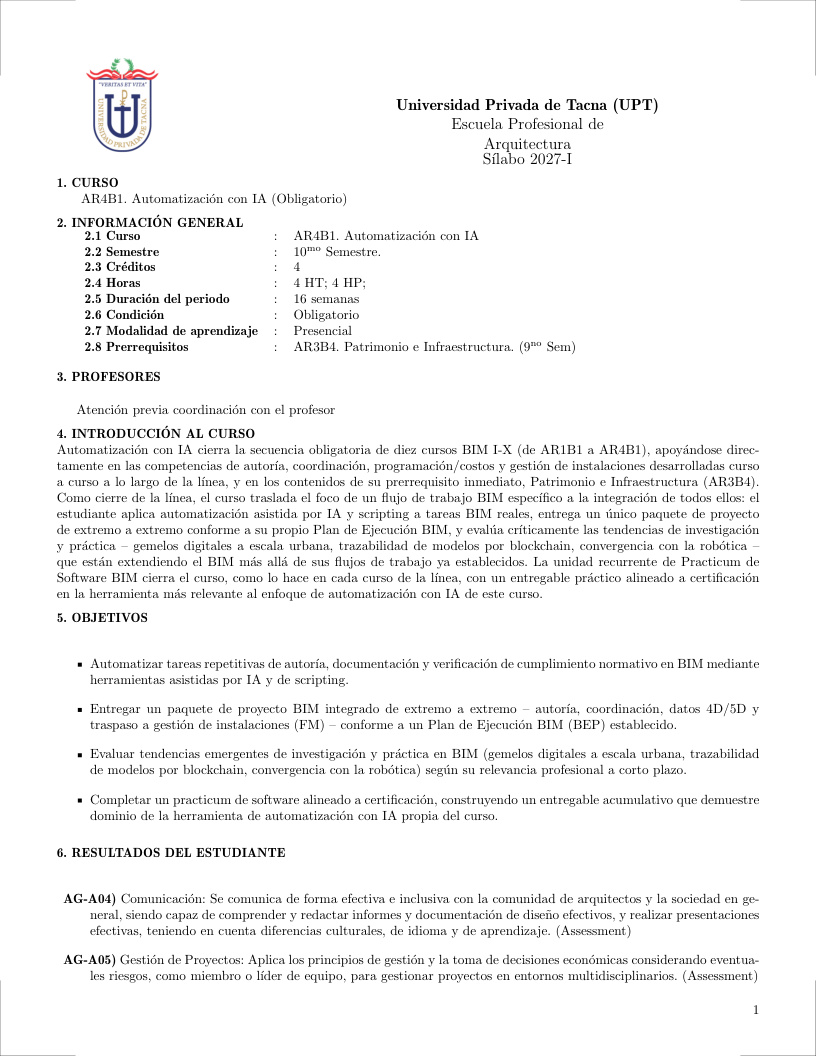
 Español (Latinoamérica)
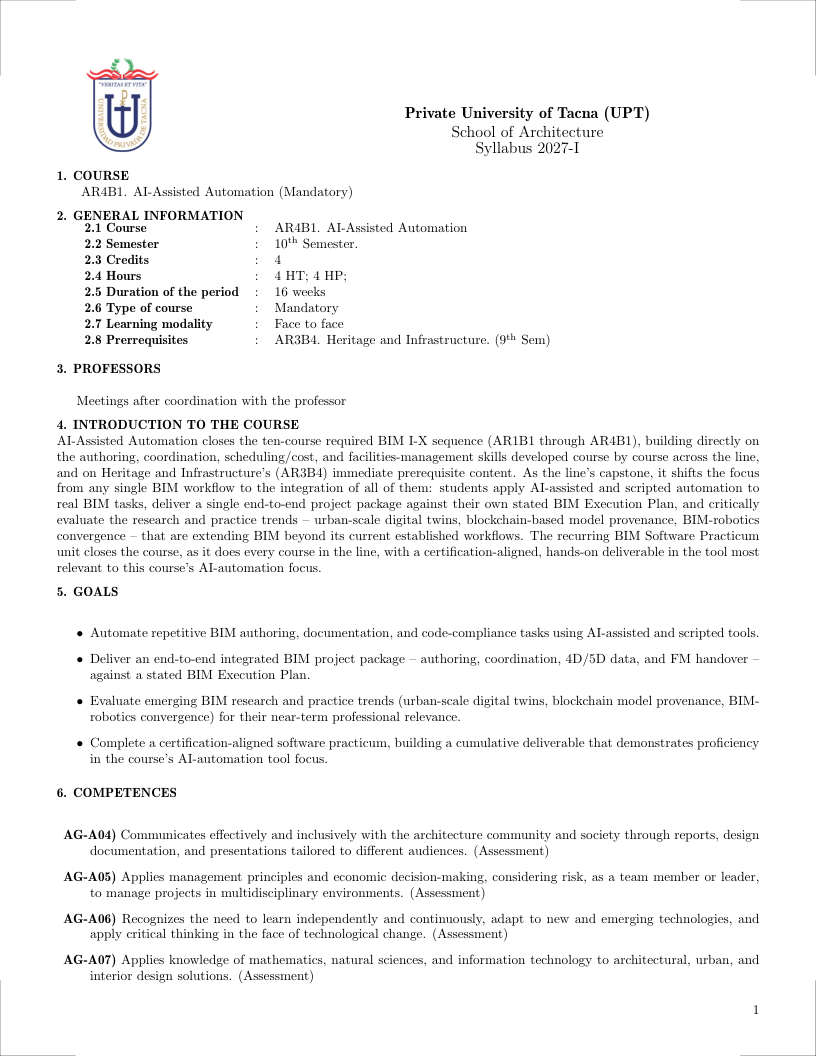 English
- Prerrequisites:
- AR3B4 Heritage and Infrastructure (9th Sem)
- ES Español (Latinoamérica)
- EN English
3.47.1. Justification Back to top
AI-Assisted Automation closes the ten-course required BIM I-X sequence (AR1B1 through AR4B1), building directly on the authoring, coordination, scheduling/cost, and facilities-management skills developed course by course across the line, and on Heritage and Infrastructure's (AR3B4) immediate prerequisite content. As the line's capstone, it shifts the focus from any single BIM workflow to the integration of all of them: students apply AI-assisted and scripted automation to real BIM tasks, deliver a single end-to-end project package against their own stated BIM Execution Plan, and critically evaluate the research and practice trends – urban-scale digital twins, blockchain-based model provenance, BIM-robotics convergence – that are extending BIM beyond its current established workflows. The recurring BIM Software Practicum unit closes the course, as it does every course in the line, with a certification-aligned, hands-on deliverable in the tool most relevant to this course's AI-automation focus.
- ES Español (Latinoamérica)
- EN English
3.47.2. Generales Goals Back to top
- Automate repetitive BIM authoring, documentation, and code-compliance tasks using AI-assisted and scripted tools.
- Deliver an end-to-end integrated BIM project package – authoring, coordination, 4D/5D data, and FM handover – against a stated BIM Execution Plan.
- Evaluate emerging BIM research and practice trends (urban-scale digital twins, blockchain model provenance, BIM-robotics convergence) for their near-term professional relevance.
- Complete a certification-aligned software practicum, building a cumulative deliverable that demonstrates proficiency in the course's AI-automation tool focus.
- ES Español (Latinoamérica)
- EN English
3.47.3. Contribution to Outcomes Back to top
- AG-A04) Communicates effectively and inclusively with the architecture community and society through reports, design documentation, and presentations tailored to different audiences. (Assessment)
- AG-A05) Applies management principles and economic decision-making, considering risk, as a team member or leader, to manage projects in multidisciplinary environments. (Assessment)
- AG-A06) Recognizes the need to learn independently and continuously, adapt to new and emerging technologies, and apply critical thinking in the face of technological change. (Assessment)
- AG-A07) Applies knowledge of mathematics, natural sciences, and information technology to architectural, urban, and interior design solutions. (Assessment)
- ES Español (Latinoamérica)
- EN English
3.47.4. Content Back to top
- ES Español (Latinoamérica)
- EN English
3.47.4.1. AI-Assisted BIM Automation (24 hours) [Skills AG-A06] Back to top
Bibliography: (del Campo and Manninger, 2022)
Topics
- AI-assisted BIM automation: generative design for structural and MEP routing, automated code compliance checking, NLP-based specification extraction
- BIM automation and scripting: automating repetitive tasks (door and window schedules, room data sheets), generative layout for bathrooms and parking
- AI-assisted code compliance checking: NLP for parsing building-code provisions, automated rule checking of BIM models against applicable codes
Learning Outcomes
- Describe how AI and scripted automation can generate, check, and optimize BIM content, and identify tasks that are good candidates for automation [Familiarity]
- Automate a repetitive BIM task (schedule generation, code-compliance check, or layout generation) using a scripted or AI-assisted tool [Usage]
- Evaluate an AI-assisted or scripted BIM automation tool for its accuracy, reliability, and actual time savings over manual methods [Assessment]
- ES Español (Latinoamérica)
- EN English
3.47.4.2. Integrated BIM Project Delivery (Capstone) (24 hours) [Skills AG-A04,AG-A05] Back to top
Bibliography: (Eastman et al., 2018)
Topics
- Integrating a project's full BIM workflow: authoring, federation and clash resolution, 4D/5D linkage, and FM-ready handover data, delivered as a single coherent package
- Executing a BIM Execution Plan end to end on a real project deliverable, tracking its stated BIM goals and LOD matrix against what was actually produced
Learning Outcomes
- Describe how a BIM Execution Plan's stated goals connect authoring, coordination, scheduling/cost, and FM handover into a single integrated project workflow [Familiarity]
- Deliver an integrated BIM project package covering authoring, coordination, 4D/5D data, and FM handover, following a stated BIM Execution Plan [Usage]
- Evaluate an integrated BIM project deliverable against its own BIM Execution Plan, judging completeness and internal consistency across authoring, coordination, and handover data [Assessment]
- ES Español (Latinoamérica)
- EN English
3.47.4.3. Emerging Trends in BIM Practice (24 hours) [Skills AG-A06] Back to top
Bibliography: (Sawhney et al., 2020)
Topics
- Urban-scale digital twins combining building BIM, infrastructure BIM, and city-scale sensor networks for planning and resilience analysis
- Blockchain and distributed-ledger proposals for BIM model provenance, version authenticity, and smart contracts tied to model milestones
- Convergence of BIM with construction robotics and autonomous site monitoring, extending the AI-assisted automation already covered in BIM.AIAutomation
Learning Outcomes
- Describe two or three emerging research or practice directions that are extending BIM beyond its current established workflows [Familiarity]
- Discuss, with supporting evidence, the practical maturity and adoption barriers of one emerging BIM trend [Usage]
- Evaluate the likely near-term impact of an emerging BIM trend on professional practice in the student's own context [Assessment]
- ES Español (Latinoamérica)
- EN English
3.47.4.4. BIM Software Practicum (24 hours) [Skills AG-A07] Back to top
Bibliography: (Davidson, 2015)
Topics
- Guided, graded software exercises in the BIM tool(s) specific to the course's theme (authoring, coordination, scheduling, analysis, or FM platforms), building toward a cumulative course deliverable
- Practice aligned with vendor or industry certification exams (Autodesk Certified Professional, buildingSMART openBIM) relevant to the course's software focus
Learning Outcomes
- Describe the practicum structure for the course's BIM software focus and the deliverable it builds toward [Familiarity]
- Complete a sequence of guided exercises in the course's BIM software focus, building toward a cumulative practicum deliverable [Usage]
- Evaluate the student's own practicum deliverable against the software proficiency expected for the course's BIM theme [Assessment]
- ES Español (Latinoamérica)
- EN English
3.47.5. Bibliography Back to top
del Campo, M. and Manninger, S. (2022). Neural Architecture: Design and Artificial Intelligence. ORO Editions, 1st edition.
Eastman, C., Teicholz, P., Sacks, R., and Liston, K. (2018). BIM Handbook: A Guide to Building Information Modeling for Owners, Managers, Designers, Engineers, and Contractors. Wiley, 3rd edition.
Sawhney, A., Riley, M., and Irizarry, J., editors (2020). Construction 4.0: An Innovation Platform for the Built Environment. Routledge, 1st edition.
Davidson, S. (2015). Grasshopper: Visual Scripting for Rhinoceros 3D. self-published / McNeel, 1st edition.