- ES Español (Latinoamérica)

- EN English

3.35. AR3B2 Sustainability and Circular Economy (Mandatory)
- Semester: 7th Sem. Credits: 4
- Hour of this course: Theory: 4 hours; Practice: 4 hours;
- Syllabus:
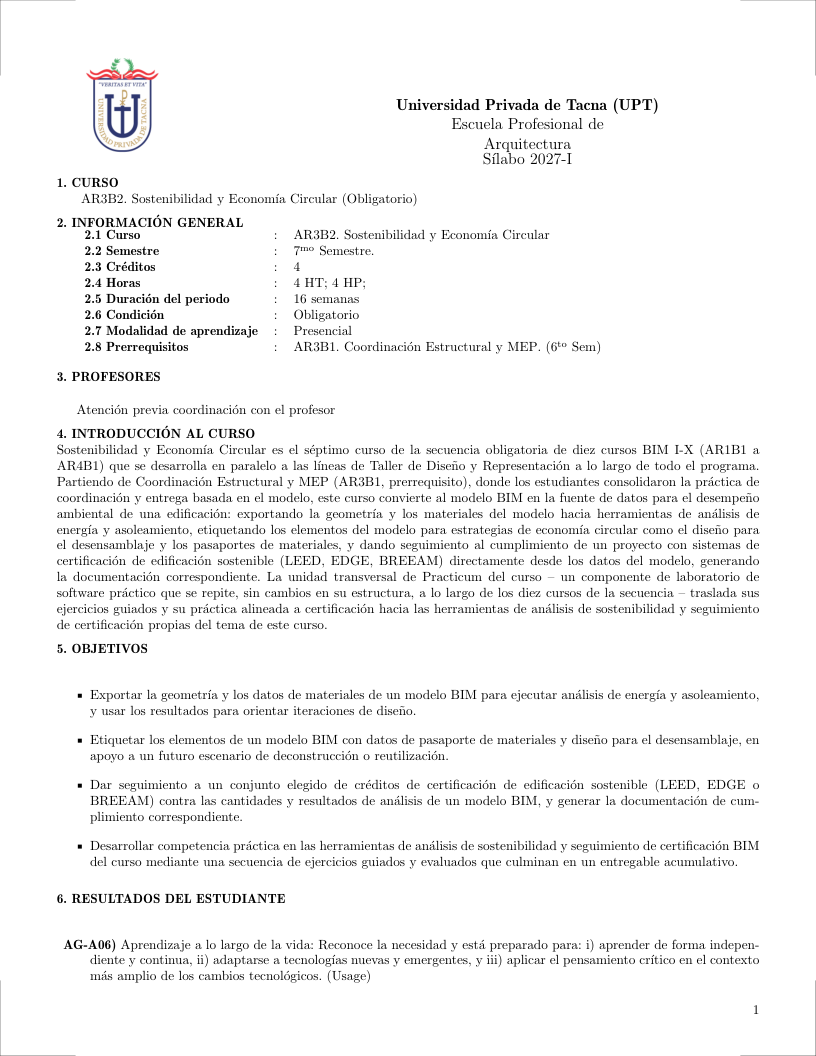
 Español (Latinoamérica)
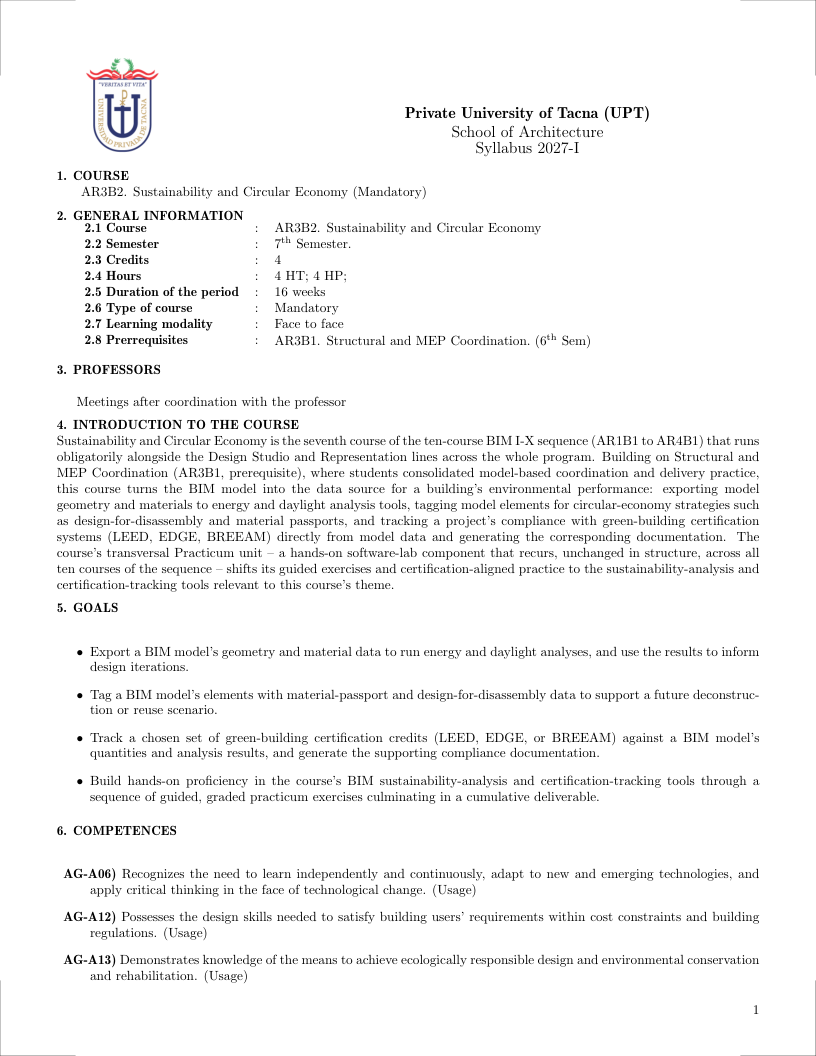 English
- Prerrequisites:
- AR3B1 Structural and MEP Coordination (6th Sem)
- ES Español (Latinoamérica)
- EN English
3.35.1. Justification Back to top
Sustainability and Circular Economy is the seventh course of the ten-course BIM I-X sequence (AR1B1 to AR4B1) that runs obligatorily alongside the Design Studio and Representation lines across the whole program. Building on Structural and MEP Coordination (AR3B1, prerequisite), where students consolidated model-based coordination and delivery practice, this course turns the BIM model into the data source for a building's environmental performance: exporting model geometry and materials to energy and daylight analysis tools, tagging model elements for circular-economy strategies such as design-for-disassembly and material passports, and tracking a project's compliance with green-building certification systems (LEED, EDGE, BREEAM) directly from model data and generating the corresponding documentation. The course's transversal Practicum unit – a hands-on software-lab component that recurs, unchanged in structure, across all ten courses of the sequence – shifts its guided exercises and certification-aligned practice to the sustainability-analysis and certification-tracking tools relevant to this course's theme.
- ES Español (Latinoamérica)
- EN English
3.35.2. Generales Goals Back to top
- Export a BIM model's geometry and material data to run energy and daylight analyses, and use the results to inform design iterations.
- Tag a BIM model's elements with material-passport and design-for-disassembly data to support a future deconstruction or reuse scenario.
- Track a chosen set of green-building certification credits (LEED, EDGE, or BREEAM) against a BIM model's quantities and analysis results, and generate the supporting compliance documentation.
- Build hands-on proficiency in the course's BIM sustainability-analysis and certification-tracking tools through a sequence of guided, graded practicum exercises culminating in a cumulative deliverable.
- ES Español (Latinoamérica)
- EN English
3.35.3. Contribution to Outcomes Back to top
- AG-A06) Recognizes the need to learn independently and continuously, adapt to new and emerging technologies, and apply critical thinking in the face of technological change. (Usage)
- AG-A12) Possesses the design skills needed to satisfy building users' requirements within cost constraints and building regulations. (Usage)
- AG-A13) Demonstrates knowledge of the means to achieve ecologically responsible design and environmental conservation and rehabilitation. (Usage)
- ES Español (Latinoamérica)
- EN English
3.35.4. Content Back to top
- ES Español (Latinoamérica)
- EN English
3.35.4.1. BIM for Sustainability Analysis (24 hours) [Skills AG-A13] Back to top
Bibliography: (de Wilde, 2018)
Topics
- BIM-integrated energy analysis: gbXML export from BIM authoring tools to energy-simulation engines, and iterative design-stage energy performance feedback
- BIM-integrated daylight and solar analysis: linking BIM massing and material data to daylight simulation (Insight, IES-VE) and solar-access studies
- Embedding sustainability data in BIM objects: embodied-carbon data (EPDs) and material-passport information attached to BIM elements for lifecycle assessment
Learning Outcomes
- Describe how BIM models can be exported or linked to energy, daylight, and sustainability-analysis tools, and explain the data requirements for each [Familiarity]
- Export a BIM model's geometry and material data to run an energy or daylight analysis, and use the results to inform a design iteration [Usage]
- Evaluate a BIM-based sustainability analysis for data accuracy and the appropriateness of its design recommendations [Assessment]
- ES Español (Latinoamérica)
- EN English
3.35.4.2. BIM for Circular Economy and Material Reuse (24 hours) [Skills AG-A13] Back to top
Bibliography: (Addis, 2006)
Topics
- Design-for-disassembly principles embedded in BIM: reversible connections, material separation, and modeling components for future deconstruction
- Material passports and material banks: tagging BIM elements with reuse potential, provenance, and end-of-life data for future material recovery
- Deconstruction sequencing and planning using a BIM model, mirroring 4D construction scheduling in reverse
Learning Outcomes
- Describe how BIM data (material passports, reversible-connection tagging) can support circular-economy design decisions [Familiarity]
- Tag a BIM model's elements with material-passport and design-for-disassembly data to support a future deconstruction or reuse scenario [Usage]
- Evaluate a BIM-based circular-economy strategy for a project, judging the completeness of its material-passport data and the feasibility of its deconstruction plan [Assessment]
- ES Español (Latinoamérica)
- EN English
3.35.4.3. BIM-Supported Green Building Certification (24 hours) [Skills AG-A12] Back to top
Bibliography: (U.S. Green Building Council, 2013)
Topics
- Certification credit tracking from model data: linking BIM quantities and performance analysis results to LEED, EDGE, or BREEAM credit requirements
- Generating certification documentation (narratives, calculations, drawings) directly from BIM model data and schedules
Learning Outcomes
- Describe how BIM model data can be linked to green-building certification credit requirements and documentation [Familiarity]
- Track a chosen set of green-building certification credits against a BIM model's quantities and analysis results [Usage]
- Evaluate a BIM-based certification compliance package for completeness and consistency with the model it was generated from [Assessment]
- ES Español (Latinoamérica)
- EN English
3.35.4.4. BIM Software Practicum (24 hours) [Skills AG-A06] Back to top
Bibliography: (Krygiel and Nies, 2008)
Topics
- Guided, graded software exercises in the BIM tool(s) specific to the course's theme (authoring, coordination, scheduling, analysis, or FM platforms), building toward a cumulative course deliverable
- Practice aligned with vendor or industry certification exams (Autodesk Certified Professional, buildingSMART openBIM) relevant to the course's software focus
Learning Outcomes
- Describe the practicum structure for the course's BIM software focus and the deliverable it builds toward [Familiarity]
- Complete a sequence of guided exercises in the course's BIM software focus, building toward a cumulative practicum deliverable [Usage]
- Evaluate the student's own practicum deliverable against the software proficiency expected for the course's BIM theme [Assessment]
- ES Español (Latinoamérica)
- EN English
3.35.5. Bibliography Back to top
de Wilde, P. (2018). Building Performance Analysis. Wiley, 1st edition.
Addis, B. (2006). Building with Reclaimed Components and Materials: A Design Handbook for Reuse and Recycling. Earthscan, 1st edition.
U.S. Green Building Council (2013). LEED v4 Reference Guide for Building Design and Construction. USGBC, 1st edition.
Krygiel, E. and Nies, B. (2008). Green BIM: Successful Sustainable Design with Building Information Modeling. Sybex, 1st edition.