- ES Español (Latinoamérica)

- EN English

5.35. Introduction to Machine Learning (Mandatory)
- Semester: 6th Sem. Credits: 4
- Hour of this course: Theory: 2 hours; Laboratory: 4 hours;
- Syllabus:
- htmlonly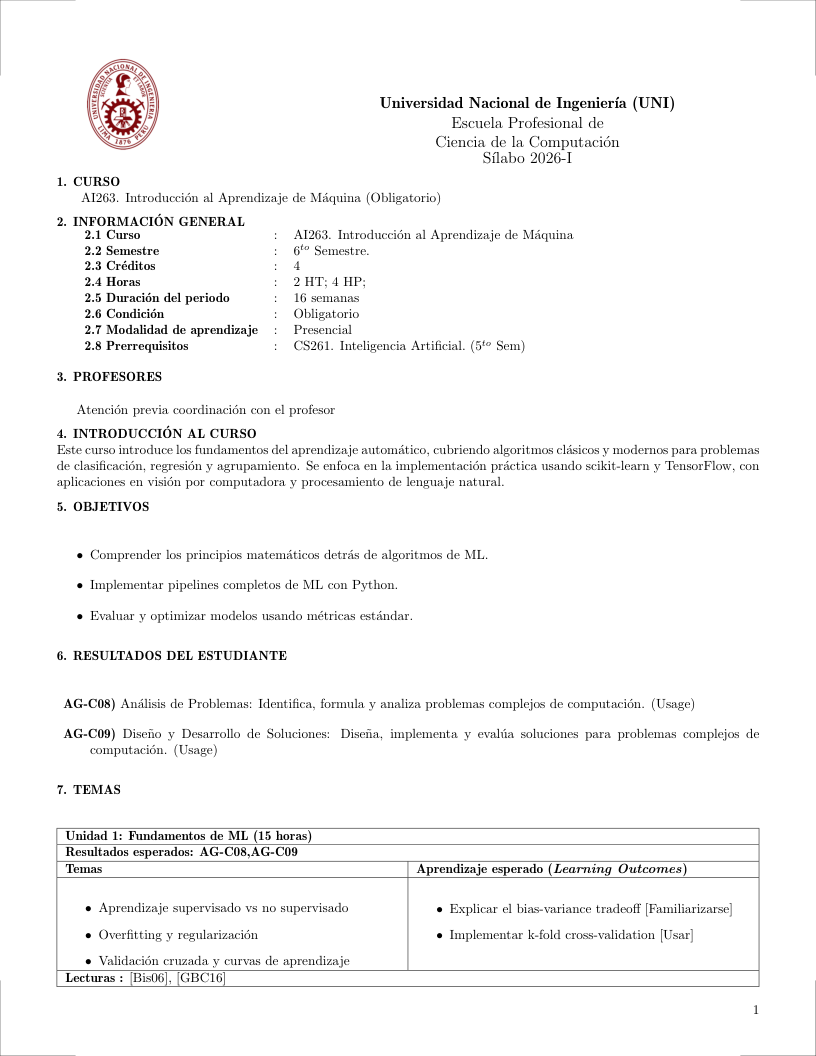
 Español (Latinoamérica)
 English
 - Prerrequisites:
- CS261 Artificial Intelligence (5th Sem)
5.35.1. Justification ↑ Back to top
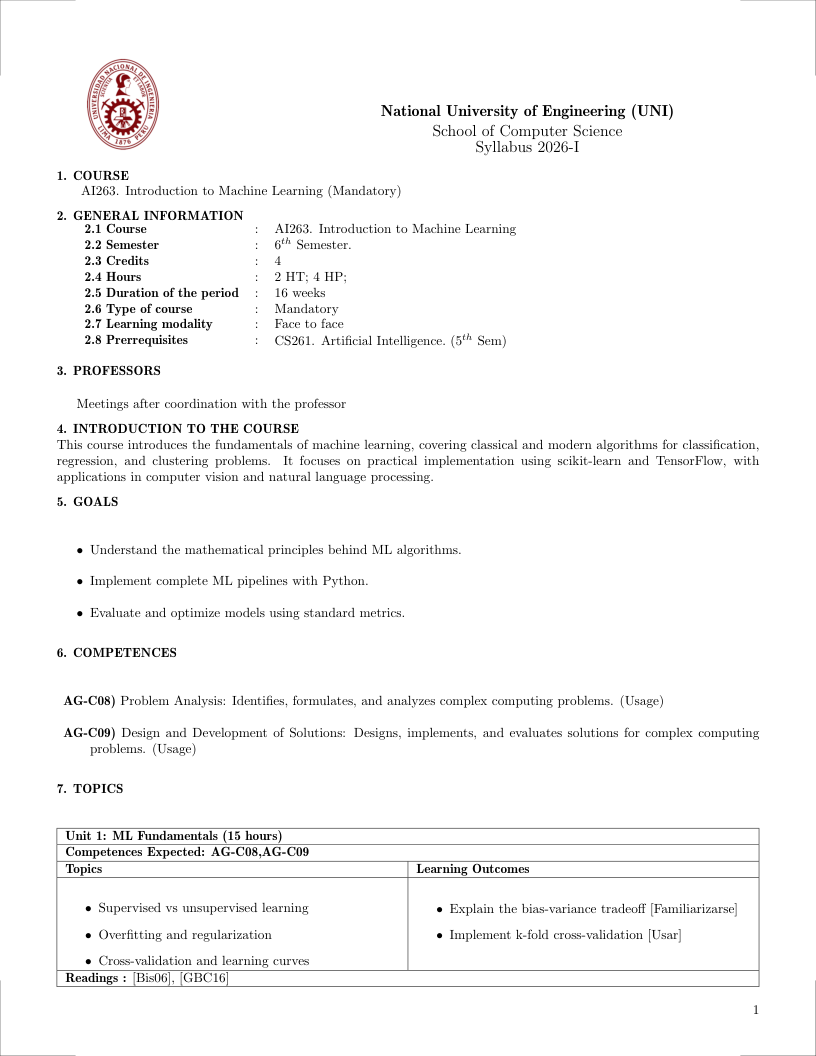
This course introduces the fundamentals of machine learning, covering classical and modern algorithms for classification, regression, and clustering problems. It focuses on practical implementation using scikit-learn and TensorFlow, with applications in computer vision and natural language processing.
5.35.2. Generales Goals ↑ Back to top
- Understand the mathematical principles behind ML algorithms.
- Implement complete ML pipelines with Python.
- Evaluate and optimize models using standard metrics.
5.35.3. Contribution to Outcomes ↑ Back to top
- AG-C08) Problem Analysis: Identifies, formulates, and analyzes complex computing problems. (Usage)
- AG-C09) Design and Development of Solutions: Designs, implements, and evaluates solutions for complex computing problems. (Usage)
5.35.4. Content ↑ Back to top
5.35.4.1. ML Fundamentals (15 hours) [Skills AG-C08,AG-C09] ↑ Back to top
Bibliography: (Bishop, 2006; Goodfellow et al., 2016a)
Topics
- Supervised vs unsupervised learning
- Overfitting and regularization
- Cross-validation and learning curves
Learning Outcomes
- Explain the bias-variance tradeoff [Familiarity]
- Implement k-fold cross-validation [Usage]
5.35.4.2. Linear Models (15 hours) [Skills AG-C08,AG-C09] ↑ Back to top
Bibliography: (Hastie et al., 2009; Murphy, 2012)
Topics
- Linear and logistic regression
- Support Vector Machines (SVM)
- Linear discriminant analysis
Learning Outcomes
- Program linear models with scikit-learn [Usage]
- Interpret regression coefficients [Assessment]
5.35.4.3. Ensembles and Trees (15 hours) [Skills AG-C08,AG-C09] ↑ Back to top
Bibliography: (Hastie et al., 2009; Géron, 2022)
Topics
- Decision trees and random forests
- Gradient Boosting (XGBoost, LightGBM)
- Stacking and voting
Learning Outcomes
- Optimize hyperparameters with GridSearch [Usage]
- Visualize decision trees [Assessment]
5.35.4.4. Basic Neural Networks (15 hours) [Skills AG-C08,AG-C09] ↑ Back to top
Bibliography: (Goodfellow et al., 2016a; Chollet, 2021)
Topics
- Multilayer perceptrons (MLP)
- Backpropagation and optimizers
- Introduction to Keras/TensorFlow
Learning Outcomes
- Build simple neural networks [Usage]
- Monitor training with TensorBoard [Assessment]
5.35.5. Bibliography ↑ Back to top
Bishop, C. M. (2006). Pattern Recognition and Machine Learning. Springer.
Goodfellow, I., Bengio, Y., and Courville, A. (2016a). Deep Learning. MIT Press.
Hastie, T., Tibshirani, R., and Friedman, J. (2009). The Elements of Statistical Learning. Springer, 2nd edition.
Murphy, K. P. (2012). Machine Learning: A Probabilistic Perspective. MIT Press.
Géron, A. (2022). Hands-On Machine Learning with Scikit-Learn, Keras, and TensorFlow. O'Reilly, 3rd edition.
Chollet, F. (2021). Deep Learning with Python. Manning, 2nd edition.