- ES Español (Latinoamérica)

- EN English

5.2. Linear Algebra (Mandatory)
- Semester: 1st Sem. Credits: 4
- Hour of this course: Theory: 3 hours; Practice: 2 hours;
- Syllabus:
- htmlonly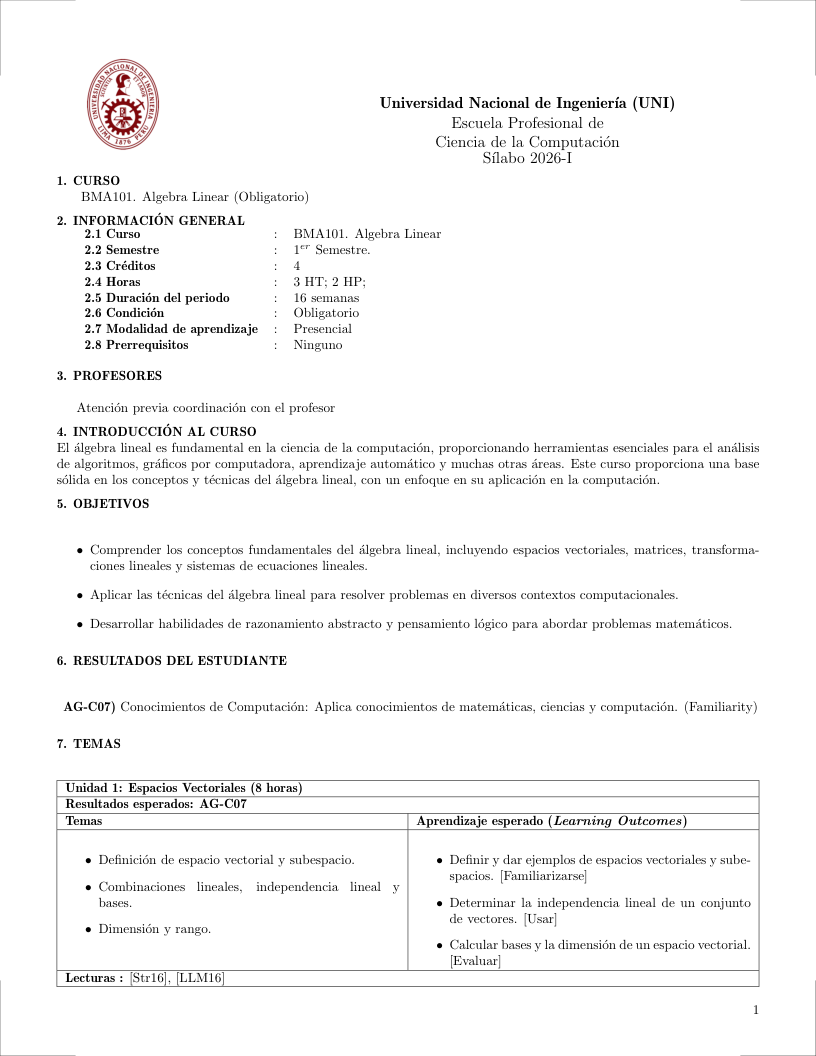
 Español (Latinoamérica)
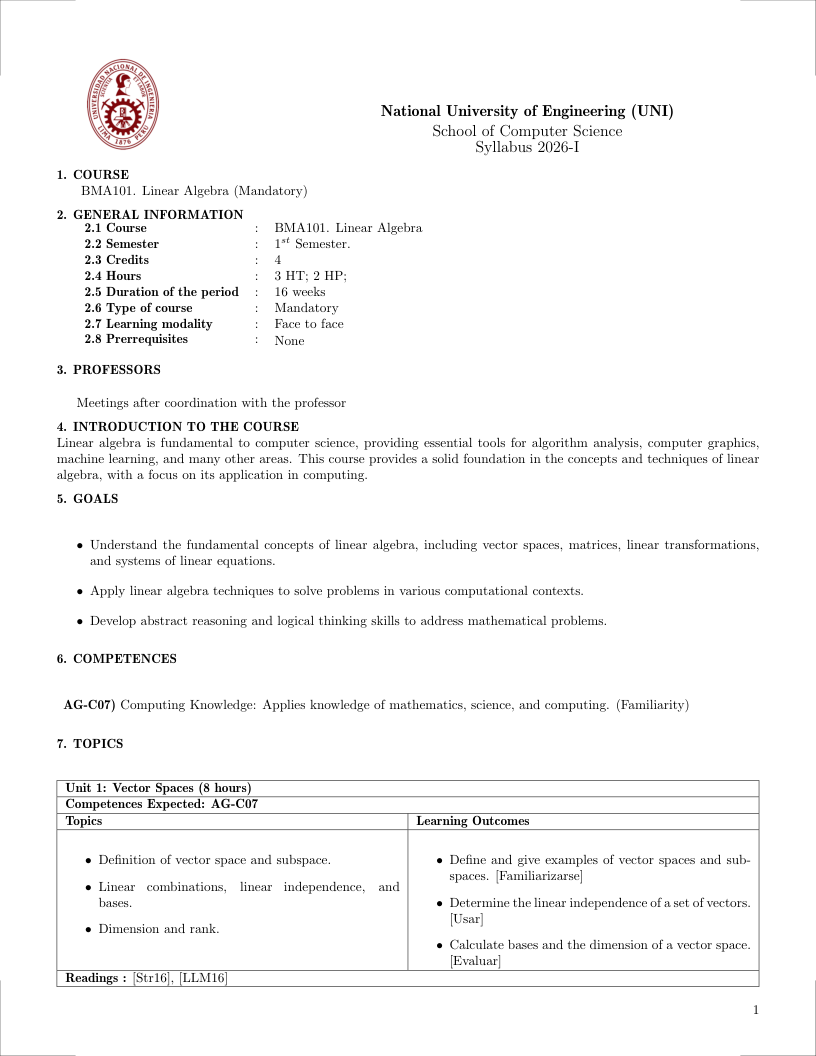 English
 - Prerrequisites: None
5.2.1. Justification ↑ Back to top
Linear algebra is a fundamental mathematical tool shared by computer science and engineering disciplines, providing the foundations for structural analysis, circuit networks, control systems, data processing, and algorithm design. This course provides a solid foundation in the concepts and techniques of elementary and advanced linear algebra, with emphasis on its application in scientific and engineering contexts.
5.2.2. Generales Goals ↑ Back to top
- Understand the fundamental concepts of linear algebra, including vector spaces, linear transformations, and matrix theory.
- Apply linear algebra techniques to solve systems of equations and eigenvalue/eigenvector problems arising from scientific and engineering contexts.
- Develop skills in abstract reasoning and logical thinking to address mathematical problems.
5.2.3. Contribution to Outcomes ↑ Back to top
- AG-C07) Computing Knowledge: Applies knowledge of mathematics, science, and computing. (Familiarity)
5.2.4. Content ↑ Back to top
5.2.4.1. Matrices and Systems of Linear Equations (19 hours) [Skills AG-C07] ↑ Back to top
Bibliography: (Strang, 2016; Lay et al., 2016)
Topics
- Matrix algebra: addition, scalar multiplication, matrix multiplication, transpose, types of matrices, and the inverse of a matrix
- Solving systems of linear equations via Gaussian elimination and Gauss-Jordan; row echelon form, rank, and consistency of systems
- Determinants: definition, properties, Cramer's rule, and geometric interpretation
- Matrix decompositions: LU, QR, and singular value decomposition (SVD)
Learning Outcomes
- Identify types of matrices and perform basic matrix algebra operations, including computing the inverse of a matrix [Familiarity]
- Solve systems of linear equations using Gaussian elimination or Gauss-Jordan, determining the rank and consistency of the system [Usage]
- Apply Cramer's rule and the LU, QR, and SVD decompositions to solve linear systems and factor matrices [Assessment]
5.2.4.2. Vector Spaces and Linear Transformations (14 hours) [Skills AG-C07] ↑ Back to top
Bibliography: (Strang, 2016; Lay et al., 2016)
Topics
- Vector spaces and subspaces; bases, dimension, and linear independence
- Linear maps, kernel and image, rank-nullity theorem, and matrix representations
Learning Outcomes
- Identify whether a set with given operations forms a vector space and determine a basis [Familiarity]
- Determine the kernel, image, and matrix representation of a linear map, verifying the rank-nullity theorem [Usage]
- Apply linear transformations to model and solve problems involving change of basis and composition of maps [Assessment]
5.2.4.3. Eigenvalues, Inner Product Spaces, and Quadratic Forms (15 hours) [Skills AG-C07] ↑ Back to top
Bibliography: (Strang, 2016; Lay et al., 2016)
Topics
- Eigenvalues and eigenvectors; diagonalization and the spectral theorem
- Inner product spaces, orthogonality, Gram-Schmidt process, and least squares
- Quadratic forms and definiteness: classification as positive, negative, or indefinite via eigenvalues
Learning Outcomes
- Identify the eigenvalues and eigenvectors of a matrix and determine whether it is diagonalizable [Familiarity]
- Compute the diagonalization of matrices via the spectral theorem and apply the Gram-Schmidt process to obtain orthogonal bases [Usage]
- Apply least squares methods and the classification of quadratic forms via eigenvalues to solve approximation and optimization problems [Assessment]
5.2.5. Bibliography ↑ Back to top
Strang, G. (2016). Introduction to Linear Algebra. Wellesley-Cambridge Press.
Lay, D. C., Lay, S. R., and McDonald, J. J. (2016). Linear Algebra and Its Applications. Pearson.