- ES Español (Latinoamérica)

- EN English

5.41. Professional Ethics (Mandatory)
- Semester: 7th Sem. Credits: 2
- Hour of this course: Theory: 1 hours; Practice: 2 hours;
- Syllabus:
- htmlonly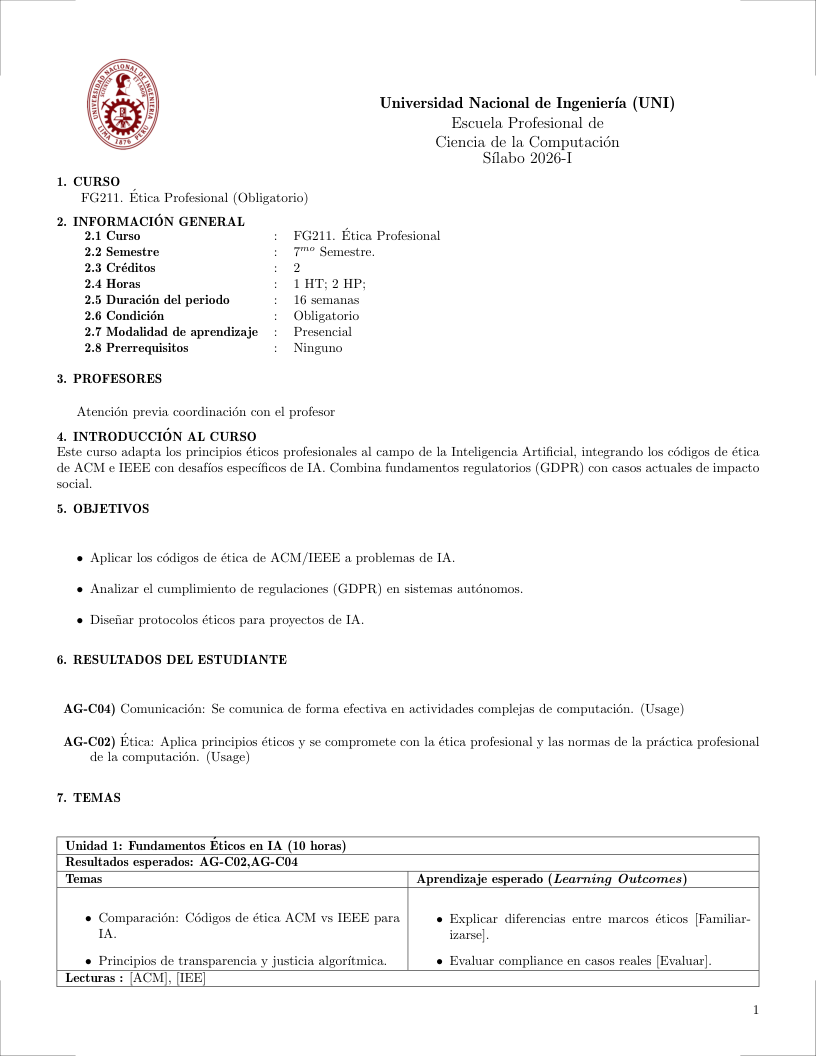
 Español (Latinoamérica)
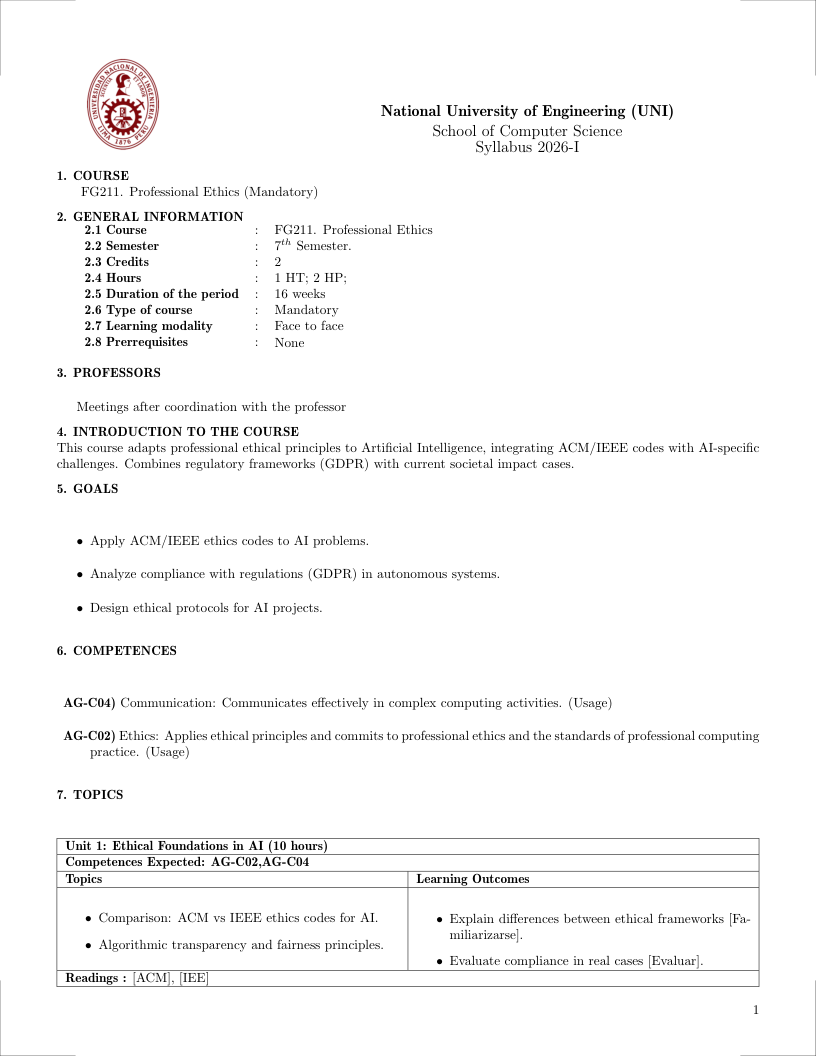 English
 - Prerrequisites: None
5.41.1. Justification ↑ Back to top
This course adapts professional ethical principles to Artificial Intelligence, integrating ACM/IEEE codes with AI-specific challenges. Combines regulatory frameworks (GDPR) with current societal impact cases.
5.41.2. Generales Goals ↑ Back to top
- Apply ACM/IEEE ethics codes to AI problems.
- Analyze compliance with regulations (GDPR) in autonomous systems.
- Design ethical protocols for AI projects.
5.41.3. Contribution to Outcomes ↑ Back to top
- AG-C04) Communication: Communicates effectively in complex computing activities. (Usage)
- AG-C02) Ethics: Applies ethical principles and commits to professional ethics and the standards of professional computing practice. (Usage)
5.41.4. Content ↑ Back to top
5.41.4.1. Ethical Foundations in AI (10 hours) [Skills AG-C02,AG-C04] ↑ Back to top
Bibliography: (ACM, 2018; IEEE, 2020)
Topics
- Comparison: ACM vs IEEE ethics codes for AI.
- Algorithmic transparency and fairness principles.
Learning Outcomes
- Explain differences between ethical frameworks [Familiarity].
- Evaluate compliance in real cases [Assessment].
5.41.4.2. Privacy and Regulations (14 hours) [Skills AG-C02,AG-C04] ↑ Back to top
Bibliography: (Voigt and von dem Bussche, 2018; Müller, 2021)
Topics
- GDPR applied to ML: right to explanation.
- Ethical auditing of datasets (e.g., ImageNet).
Learning Outcomes
- Implement GDPR checklists for models [Usage].
- Identify violations in case studies [Assessment].
5.41.4.3. Bias and Fairness (18 hours) [Skills AG-C02,AG-C04] ↑ Back to top
Bibliography: (Force, 2020; Mehrabi et al., 2021)
Topics
- Fairness metrics (demographic parity, equality of opportunity).
- Tools: IBM Fairness 360, Google What-If.
Learning Outcomes
- Measure biases in models using Python [Usage].
- Propose mitigation strategies [Assessment].
5.41.4.4. Accountability in Autonomous Systems (18 hours) [Skills AG-C02,AG-C04] ↑ Back to top
Bibliography: (Bostrom, 2014; Committee, 2019)
Topics
- Legal attribution in AI failures (e.g., self-driving cars).
- ISO standards for trustworthy AI.
Learning Outcomes
- Draft liability clauses [Assessment].
- Analyze legal conflicts [Familiarity].
5.41.5. Bibliography ↑ Back to top
ACM (2018). Acm code of ethics and professional conduct. Technical report, ACM.
IEEE (2020). Ieee code of ethics. Technical report, IEEE.
Voigt, P. and von dem Bussche, A. (2018). The EU General Data Protection Regulation (GDPR): A Practical Guide. Springer.
Müller, V. C. (2021). Ethics of Artificial Intelligence and Robotics. Cambridge University Press.
Force, A. E. T. (2020). Case studies in computing and society. Technical report, ACM.
Mehrabi, N., Morstatter, F., Saxena, N., Lerman, K., and Galstyan, A. (2021). A survey on bias and fairness in machine learning. ACM Computing Surveys, 54(6).
Bostrom, N. (2014). Superintelligence: Paths, Dangers, Strategies. Oxford University Press.
Committee, I. E. (2019). Ethical dilemmas in engineering. Technical report, IEEE.