- ES Español (Latinoamérica)

- EN English

5.66. Evolutionary Computing (Mandatory)
- Semester: 10th Sem. Credits: 4
- Hour of this course: Theory: 2 hours; Practice: 2 hours; Laboratory: 2 hours;
- Syllabus:
- htmlonly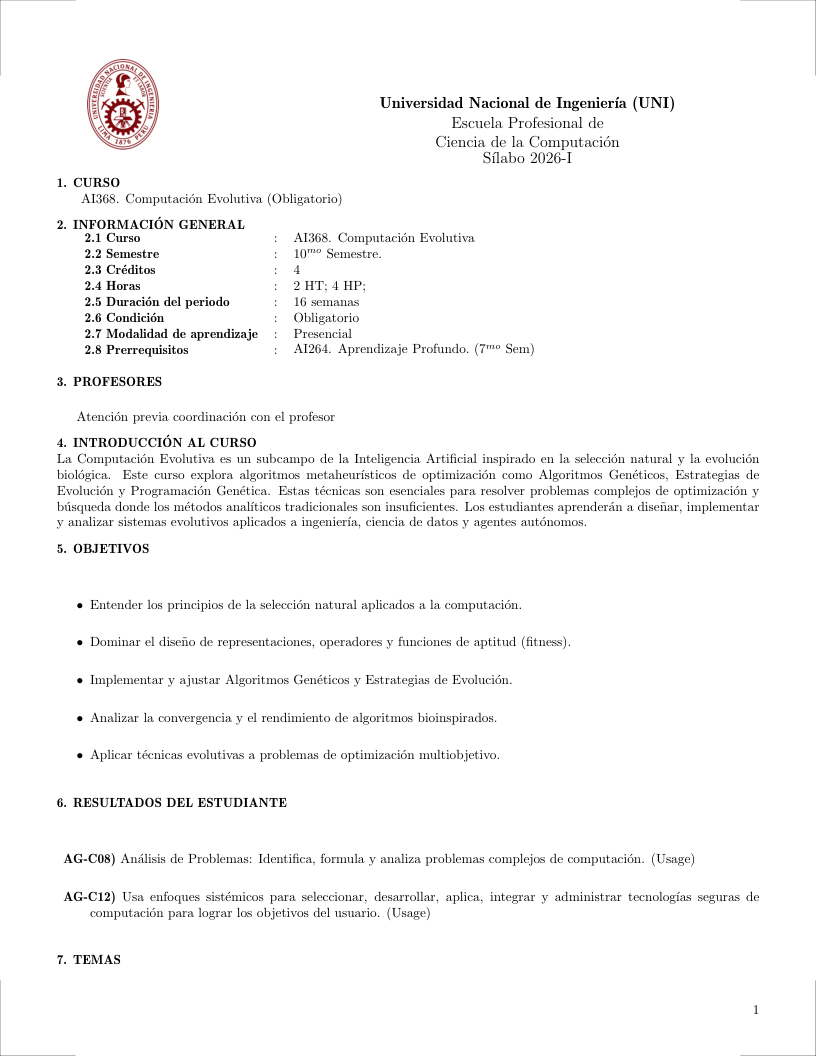
 Español (Latinoamérica)
 English
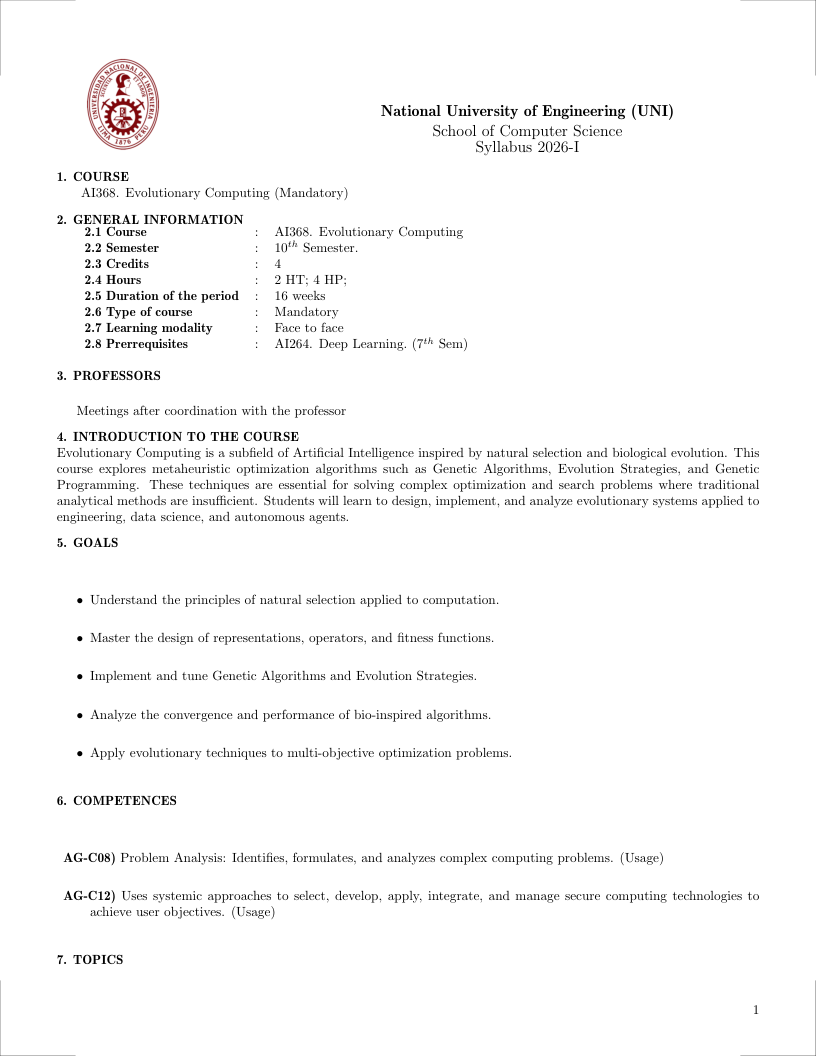
 - Prerrequisites:
- AI264 Deep Learning (7th Sem)
5.66.1. Justification ↑ Back to top
Evolutionary Computing is a subfield of Artificial Intelligence inspired by natural selection and biological evolution. This course explores metaheuristic optimization algorithms such as Genetic Algorithms, Evolution Strategies, and Genetic Programming. These techniques are essential for solving complex optimization and search problems where traditional analytical methods are insufficient. Students will learn to design, implement, and analyze evolutionary systems applied to engineering, data science, and autonomous agents.
5.66.2. Generales Goals ↑ Back to top
- Understand the principles of natural selection applied to computation.
- Master the design of representations, operators, and fitness functions.
- Implement and tune Genetic Algorithms and Evolution Strategies.
- Analyze the convergence and performance of bio-inspired algorithms.
- Apply evolutionary techniques to multi-objective optimization problems.
5.66.3. Contribution to Outcomes ↑ Back to top
- AG-C08) Problem Analysis: Identifies, formulates, and analyzes complex computing problems. (Usage)
- AG-C12) Applies computer science theory and software development fundamentals to produce computer-based solutions. (Usage)
5.66.4. Content ↑ Back to top
5.66.4.1. Foundations of Evolutionary Computation (12 hours) [Skills AG-C08,AG-C12] ↑ Back to top
Bibliography: (Eiben and Smith, 2015; Back, 1996)
Topics
- Introduction to Evolutionary Algorithms (EAs) and biological metaphors.
- The General Evolutionary Algorithm cycle: Initialization, Selection, Variation, Replacement.
- Components: Populations, chromosomes, genes, alleles.
- Fitness landscapes, genotype-phenotype mapping, and search spaces.
Learning Outcomes
- Explain the relationship between biological evolution and artificial search processes [Familiarity]
- Identify the components of a generic evolutionary algorithm and their roles [Usage]
- Describe the concept of fitness landscapes and their impact on EA performance [Familiarity]
5.66.4.2. Genetic Algorithms and Variants (16 hours) [Skills AG-C08,AG-C12] ↑ Back to top
Bibliography: (Eiben and Smith, 2015; Mitchell, 1998)
Topics
- Canonical Genetic Algorithms (CGA): binary representation, selection schemes (roulette, tournament).
- Genetic Operators: Crossover (single-point, uniform, arithmetic), Mutation (bit-flip, Gaussian).
- Schema Theorem and Building Block Hypothesis.
- Advanced GA variants: Real-coded GAs, Genetic Programming (GP) with tree representations.
Learning Outcomes
- Design appropriate representations and operators for specific optimization problems [Assessment]
- Implement a canonical Genetic Algorithm for function optimization [Usage]
- Apply Genetic Programming to symbolic regression or automatic programming tasks [Assessment]
5.66.4.3. Evolution Strategies and Evolutionary Programming (18 hours) [Skills AG-C08,AG-C12] ↑ Back to top
Bibliography: (Eiben and Smith, 2015; Deb, 2001)
Topics
- Evolution Strategies (ES): \((\mu, \lambda)\) and \((\mu + \lambda)\) selection mechanisms.
- Self-adaptation of strategy parameters (mutation step sizes).
- Covariance Matrix Adaptation (CMA-ES).
- Evolutionary Programming (EP) and its focus on behavioral evolution.
Learning Outcomes
- Implement Evolution Strategies with self-adaptive mutation for continuous optimization [Assessment]
- Compare the performance of GAs vs ES on benchmark problems [Usage]
- Explain the role of strategy parameter adaptation in convergence speed [Familiarity]
5.66.4.4. Multi-objective and Hybrid Evolutionary Algorithms (18 hours) [Skills AG-C08,AG-C12] ↑ Back to top
Bibliography: (Eiben and Smith, 2015; Deb, 2001)
Topics
- Multi-objective Optimization: Pareto optimality, dominance relations.
- Multi-objective EAs: NSGA-II, SPEA2, MOEA/D.
- Diversity preservation mechanisms and archiving strategies.
- Memetic Algorithms: Hybridization with local search.
- Constraint handling techniques in evolutionary search.
Learning Outcomes
- Solve multi-objective problems using Pareto-based selection methods [Assessment]
- Design a memetic algorithm combining global and local search [Assessment]
- Evaluate the trade-offs between convergence and diversity in MOEAs [Usage]
5.66.5. Bibliography ↑ Back to top
Eiben, A. E. and Smith, J. E. (2015). Introduction to Evolutionary Computing. Springer, 2nd edition.
Back, T. (1996). Evolutionary Algorithms in Theory and Practice. Oxford University Press.
Mitchell, M. (1998). An Introduction to Genetic Algorithms. MIT Press.
Deb, K. (2001). Multi-Objective Optimization using Evolutionary Algorithms. Wiley.