- ES Español (Latinoamérica)

- EN English

5.50. Information systems (Elective)
- Semester: 8th Sem. Credits: 3
- Hour of this course: Theory: 2 hours; Laboratory: 2 hours;
- Syllabus:
- htmlonly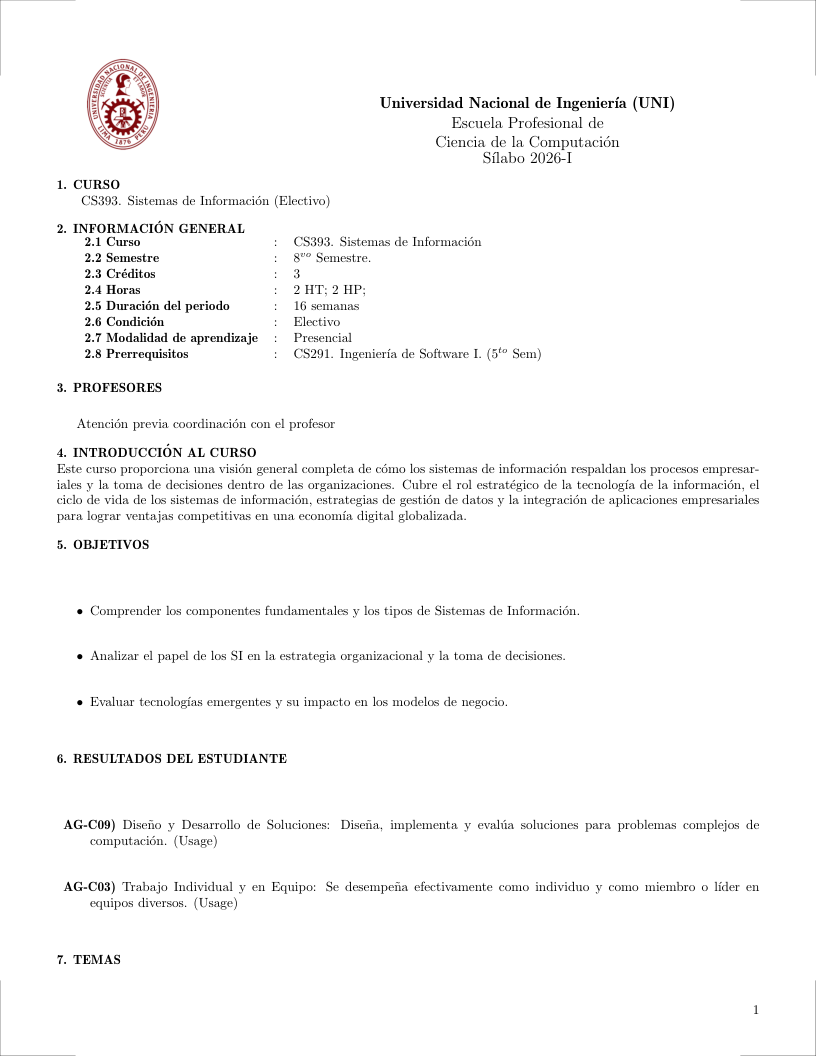
 Español (Latinoamérica)
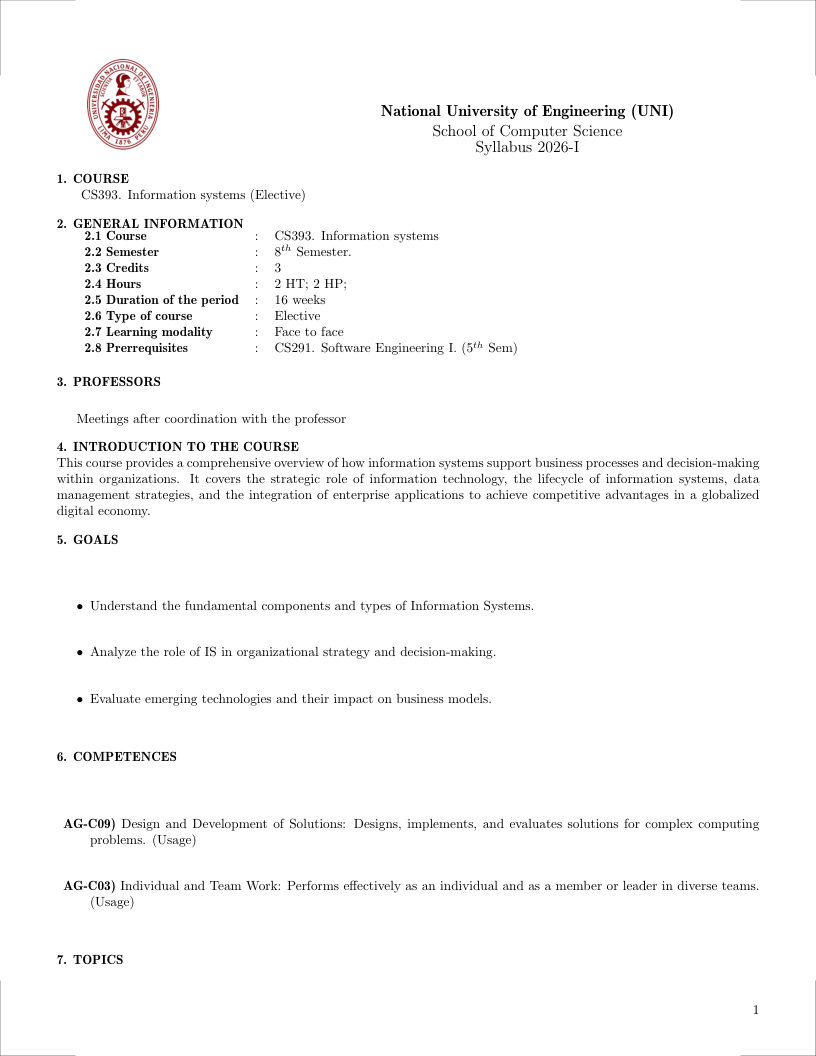 English
 - Prerrequisites:
- CS291 Software Engineering I (5th Sem)
5.50.1. Justification ↑ Back to top
This course provides a comprehensive overview of how information systems support business processes and decision-making within organizations. It covers the strategic role of information technology, the lifecycle of information systems, data management strategies, and the integration of enterprise applications to achieve competitive advantages in a globalized digital economy.
5.50.2. Generales Goals ↑ Back to top
- Understand the fundamental components and types of Information Systems.
- Analyze the role of IS in organizational strategy and decision-making.
- Evaluate emerging technologies and their impact on business models.
5.50.3. Contribution to Outcomes ↑ Back to top
- AG-C09) Design and Development of Solutions: Designs, implements, and evaluates solutions for complex computing problems. (Usage)
- AG-C03) Individual and Team Work: Performs effectively as an individual and as a member or leader in diverse teams. (Usage)
5.50.4. Content ↑ Back to top
5.50.4.1. Foundations of Information Systems (12 hours) [Skills AG-C03,AG-C09] ↑ Back to top
Bibliography: (Laudon and Laudon, 2021; Stair and Reynolds, 2017)
Topics
- Components of Information Systems: Hardware, Software, Data, Networks.
- Types of IS: TPS, MIS, DSS, and ESS.
- Competitive advantage through Information Technology.
- Business processes and Information Systems integration.
Learning Outcomes
- Identify the core components of an information system [Familiarity].
- Explain how IS supports various levels of organizational hierarchy [Usage].
- Analyze a business case to identify strategic uses of IT [Assessment].
5.50.4.2. Data Management and Business Intelligence (12 hours) [Skills AG-C03,AG-C09] ↑ Back to top
Bibliography: (Laudon and Laudon, 2021; Valacich and Schneider, 2021)
Topics
- Database management systems and data warehousing.
- Big Data analytics in a business context.
- Business Intelligence (BI) and Data Visualization tools.
- Knowledge Management Systems.
Learning Outcomes
- Design a basic data architecture for a business requirement [Usage].
- Evaluate the importance of data quality and governance [Assessment].
5.50.4.3. Enterprise Systems and E-Commerce (12 hours) [Skills AG-C03,AG-C09] ↑ Back to top
Bibliography: (Stair and Reynolds, 2017; Valacich and Schneider, 2021)
Topics
- Enterprise Resource Planning (ERP) systems.
- Supply Chain Management (SCM) and Customer Relationship Management (CRM).
- E-commerce models: B2B, B2C, and C2C.
- Mobile commerce and digital payment systems.
Learning Outcomes
- Describe the functional areas of an ERP system [Familiarity].
- Assess the impact of e-commerce on traditional business models [Assessment].
5.50.4.4. IS Development and Security (12 hours) [Skills AG-C03,AG-C09] ↑ Back to top
Bibliography: (Laudon and Laudon, 2021; Stair and Reynolds, 2017)
Topics
- Systems Development Life Cycle (SDLC) and Agile methodologies.
- Outsourcing and cloud-based IS services.
- Information security threats and risk management.
- Ethical and social issues in Information Systems.
Learning Outcomes
- Compare different system development methodologies [Usage].
- Formulate ethical guidelines for data privacy and security [Assessment].
5.50.5. Bibliography ↑ Back to top
Laudon, K. C. and Laudon, J. P. (2021). Management Information Systems: Managing the Digital Firm. Pearson, 17th edition.
Stair, R. and Reynolds, G. (2017). Principles of Information Systems. Cengage Learning, 13th edition.
Valacich, J. and Schneider, C. (2021). Information Systems Today: Managing in the Digital World. Pearson, 9th edition.