- ES Español (Latinoamérica)

- EN English

5.32. Algorithms for Complex Problems (Mandatory)
- Semester: 6th Sem. Credits: 3
- Hour of this course: Theory: 2 hours; Laboratory: 2 hours;
- Syllabus:
- htmlonly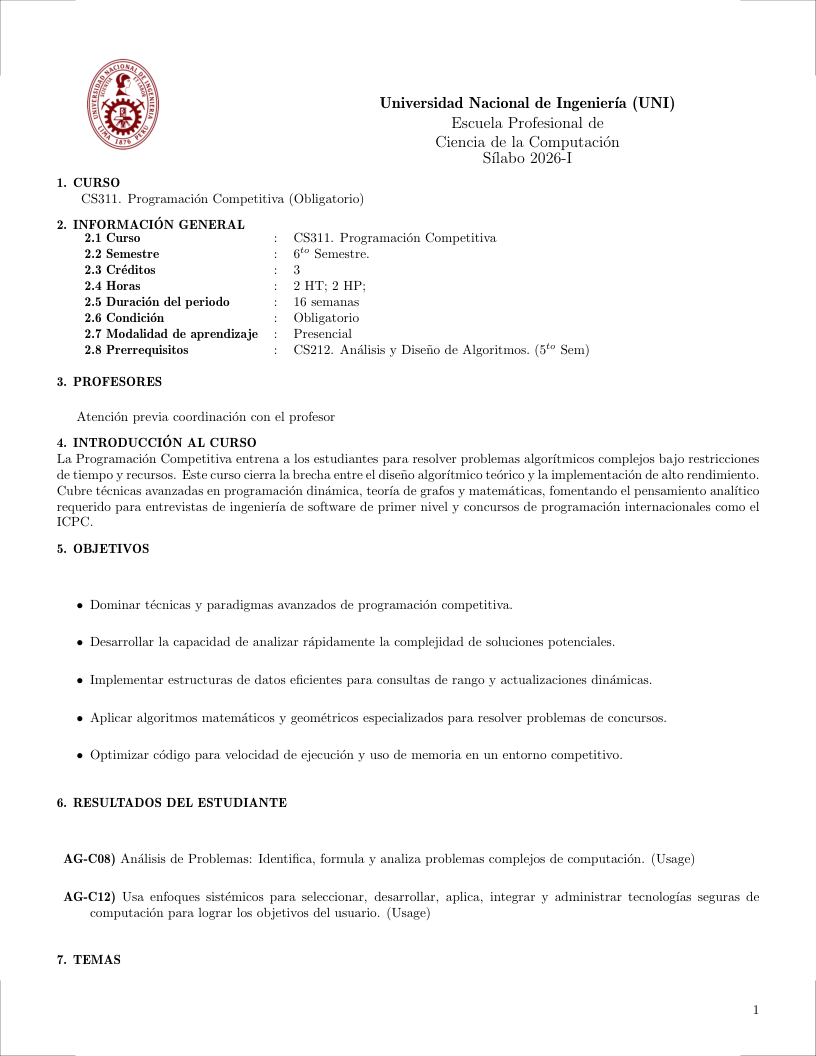
 Español (Latinoamérica)
 English
 - Prerrequisites:
- CS212 Analysis and Design of Algorithms (5th Sem)
5.32.1. Justification ↑ Back to top
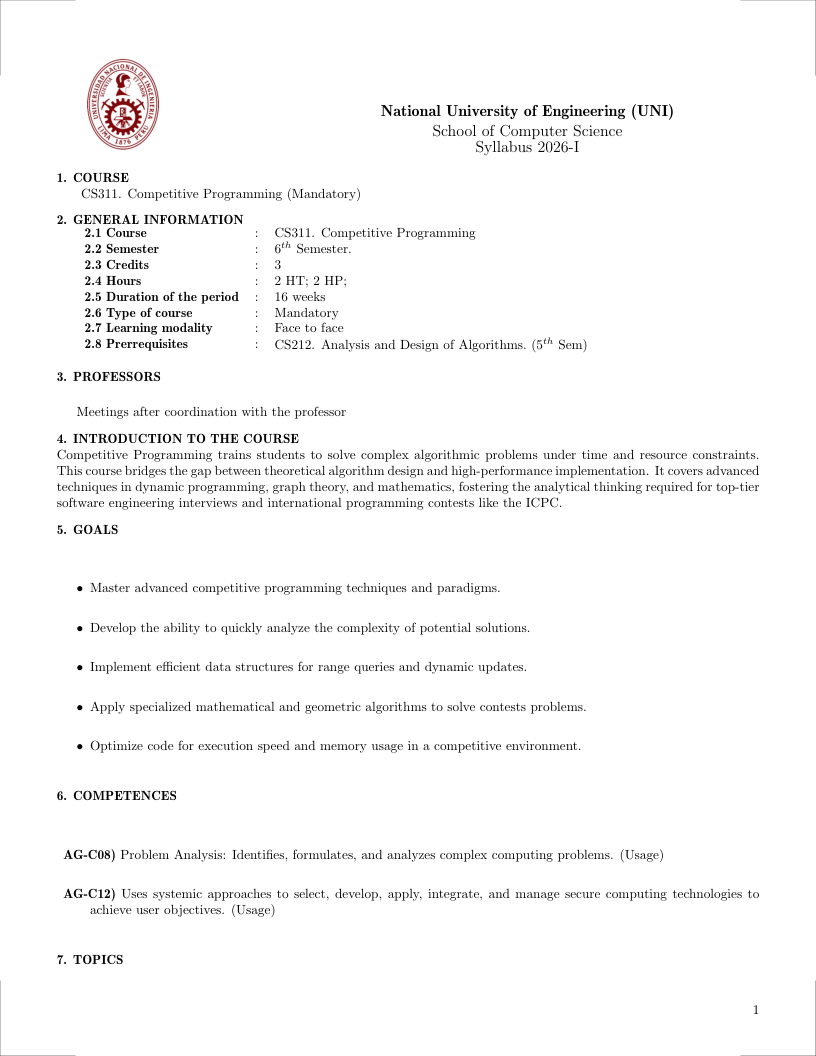
Competitive Programming trains students to solve complex algorithmic problems under time and resource constraints. This course bridges the gap between theoretical algorithm design and high-performance implementation. It covers advanced techniques in dynamic programming, graph theory, and mathematics, fostering the analytical thinking required for top-tier software engineering interviews and international programming contests like the ICPC.
5.32.2. Generales Goals ↑ Back to top
- Master advanced competitive programming techniques and paradigms.
- Develop the ability to quickly analyze the complexity of potential solutions.
- Implement efficient data structures for range queries and dynamic updates.
- Apply specialized mathematical and geometric algorithms to solve contests problems.
- Optimize code for execution speed and memory usage in a competitive environment.
5.32.3. Contribution to Outcomes ↑ Back to top
- AG-C08) Problem Analysis: Identifies, formulates, and analyzes complex computing problems. (Usage)
- AG-C12) Applies computer science theory and software development fundamentals to produce computer-based solutions. (Usage)
5.32.4. Content ↑ Back to top
5.32.4.1. Algorithmic Strategies (12 hours) [Skills AG-C08,AG-C12] ↑ Back to top
Bibliography: (Halim and Halim, 2020; Laaksonen, 2020)
Topics
- Complete Search: Recursive Backtracking and Bitmasking.
- Greedy Strategies: Choice property and optimal substructure.
- Divide and Conquer: Binary Search on the answer and Ternary Search.
- Dynamic Programming: State reduction, Digit DP, and DP on trees.
Learning Outcomes
- Apply search pruning techniques to solve NP-hard problems in small constraints [Usage]
- Identify the most efficient paradigm for a given problem statement [Assessment]
5.32.4.2. Foundational Algorithms (12 hours) [Skills AG-C08,AG-C12] ↑ Back to top
Bibliography: (Halim and Halim, 2020; Skiena, 2020)
Topics
- Fenwick Trees (Binary Indexed Trees).
- Segment Trees: Lazy Propagation and Persistent Segment Trees.
- Square Root Decomposition and Mo's Algorithm.
- Sparse Tables for RMQ.
Learning Outcomes
- Implement range query structures for real-time data updates [Assessment]
- Analyze the trade-offs between different range query data structures [Usage]
5.32.4.3. Foundational Algorithms (12 hours) [Skills AG-C08,AG-C12] ↑ Back to top
Bibliography: (Laaksonen, 2020; Halim and Halim, 2020)
Topics
- Network Flow: Max Flow Min Cut (Dinic's and Edmonds-Karp).
- Strongly Connected Components (Tarjan's and Kosaraju's).
- Bipartite Matching and Heavy-Light Decomposition.
- Centroid Decomposition on trees.
Learning Outcomes
- For each algorithm in this unit explain step-by-step how the algorithm operates [Explain]
- For each algorithmic approach (e.g., sorting) in this unit apply a prototypical example of the approach (e.g., merge sort) [Apply]
- Given requirements for a problem, develop multiple solutions using various data structures and algorithms. Subsequently, evaluate the suitability, strengths, and weaknesses selecting an approach that best satisfies the requirements [Create]
- Explain factors beyond computational efficiency that influence the choice of algorithms, such as programming time, maintainability, and the use of application-specific patterns in the input data [Explain]
- For each of the algorithms and algorithmic approaches in the KA Core topics:
- Explain a prototypical example of the algorithm, and
- Explain step-by-step how the algorithm operates.
5.32.4.4. Foundational Algorithms (12 hours) [Skills AG-C08,AG-C12] ↑ Back to top
Bibliography: (Skiena, 2020; Laaksonen, 2020)
Topics
- Number Theory: Sieve of Eratosthenes, Extended Euclidean, and Modular Inverse.
- Combinatorics: Inclusion-Exclusion and Burnside's Lemma.
- Computational Geometry: Cross product, Convex Hull (Monotone Chain), and Line intersection.
- Fast Fourier Transform (FFT) for polynomial multiplication.
Learning Outcomes
- Solve combinatorial problems using modular arithmetic [Usage]
- Implement geometric primitives for spatial relationship analysis [Assessment]
5.32.5. Bibliography ↑ Back to top
Halim, S. and Halim, F. (2020). Competitive Programming 4: The Lower Bound of Programming Contests. Lulu.
Laaksonen, A. (2020). Competitive Programmer's Handbook. Draft.
Skiena, S. S. (2020). The Algorithm Design Manual. Springer, 3rd edition.