- ES Español (Latinoamérica)

- EN English

1.1. Basic definitions
The most solid worldwide reference regarding the proposal of undergraduate computing programs is the one jointly proposed by the ACM, IEEE-CS, and the AIS. These three organizations proposed the Computing Curricula in the document entitled: Joint Task Force for Computing Curricula 2005, Computing Curricula 2005. Overview Report(Shakelford et al., 2005) whose most recent version is called Computing Curricula 2020(ACM/IEEE-CS, 2020).
The CC is a term of U.S. origin CS. This term is also known as informatics in the European context*.
According to the dictionary of the Royal Spanish Academy (http://www.rae.es), both terms are also synonyms.
At the international level, computing presents seven clearly defined profiles:
- Computer Science (ACM/IEEE-CS/AAAI Joint Task Force, 2023),
- Computer Engineering (Soldan et al., 2016),
- Information Systems (The Joint ACM/AIS IS2020 Task Force, 2020),
- Software Engineering (Díaz-Herrera and Hilburn, 2004),
- Information Technology (ACM and IEEE-CS, 2017),
- Data Science (ACM Data Science Task Force, 2021),
- Cybersecurity (ACM/IEEE-CS Joint Task Force on Cybersecurity Education, 2017).
Figure 1.1 is taken from the definition proposed in the Computing Curricula(Shakelford et al., 2005) in the area of CC
The CC covers most of the range between the upper and lower extremes, because the CC professional does not deal ``solely with the hardware'' that uses software or ``solely with the organization'' that makes use of the information that computing can provide.
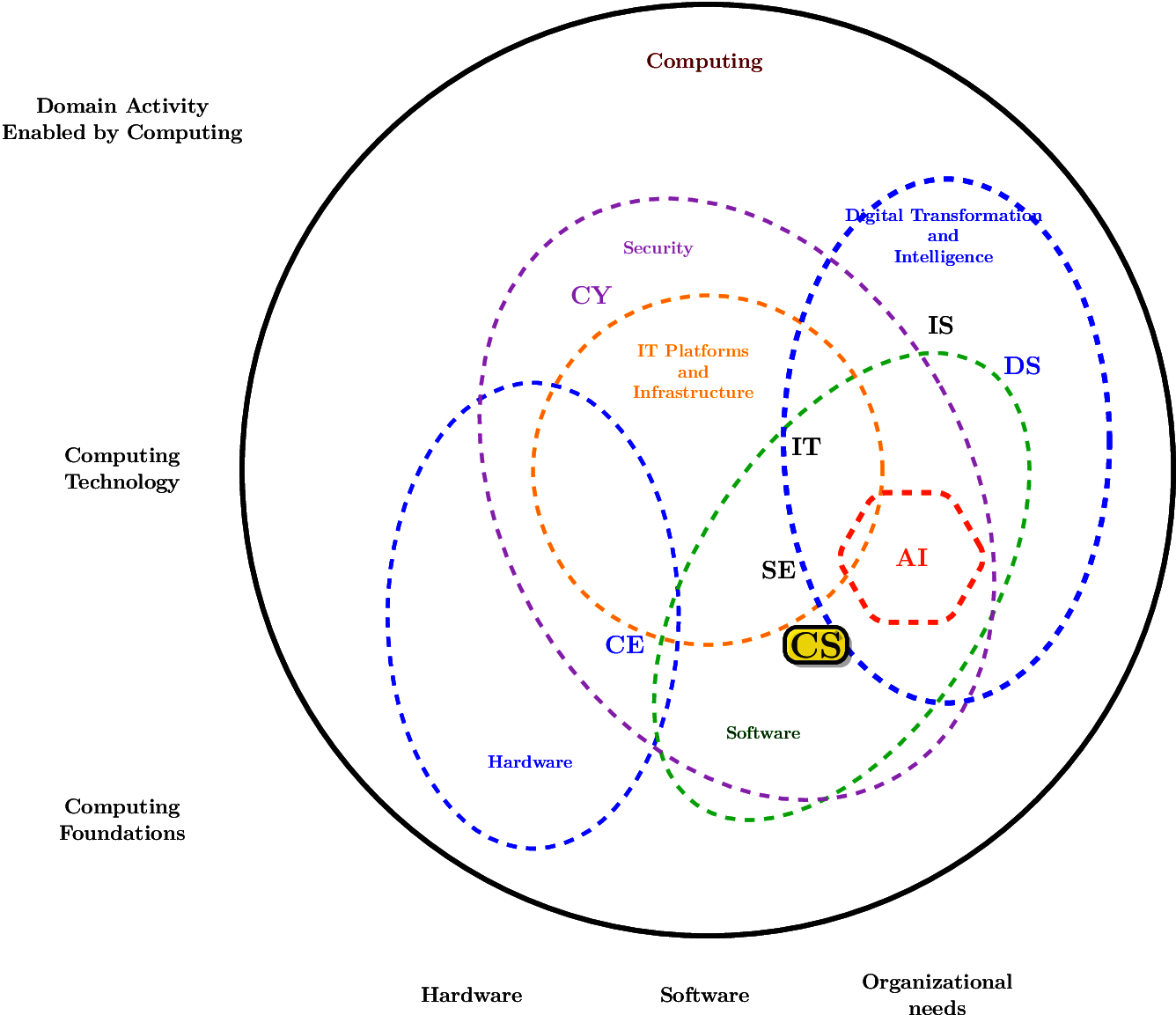
Computer Science covers a wide range, from its theoretical and algorithmic foundations to the latest developments in robotics, computer vision, Artificial Intelligence, bioinformatics, and other exciting areas. We can think of a computer scientist's work as belonging to the following three categories:
- Design and implementation of software. Computer scientists undertake challenging programming tasks. They also supervise other programmers, making them aware of new approaches.
- Devising new ways to use computers. The progress in the areas of computer science such as networks, databases, and human-computer interaction enabled the development of the WWW and currently work is being done on the development of Grid metasystems. Furthermore, researchers are now working on making robots practical helpers that demonstrate intelligence, using databases to create new knowledge, and using computers to decipher the secrets of our DNA.
- Developing effective ways to solve computing problems. For example, computer scientists develop the best possible ways to store information in databases, send data across networks, and display complex images. Their theoretical foundations allow them to determine the best possible performance, and their study of algorithms helps them develop new approaches to provide better performance.
Computer Science covers the entire range from theory to programming. While other disciplines may produce graduates better prepared for specific jobs, computer science offers a broad foundation that allows its graduates to adapt to new technologies and new ideas.
The CC professional is concerned with almost everything in between these areas. Towards hardware, this professional develops software that enables the operation of devices. Towards organizational aspects, the CC professional helps information systems operate correctly in organizations. He/she generates the technology that allows other areas such as information systems to develop adequately.
The CC professional designs and develops all kinds of software, from platform infrastructure (operating systems, communication programs, etc.) to technology application (web browsers, databases, search engines, etc.). This professional creates these capabilities, but is not focused on their use. Therefore, the shaded area (fig. 1.1) for CC narrows and ends as we move towards the application and configuration of products.