- ES Español (Latinoamérica)

- EN English

5.17. Technical and professional English III (Elective)
- Semester: 3rd Sem. Credits: 2
- Hour of this course: Practice: 4 hours;
- Syllabus:
- htmlonly
 Español (Latinoamérica)
 English
 - Prerrequisites:
- BEI102 Technical and professional English II (2nd Sem)
5.17.1. Justification ↑ Back to top
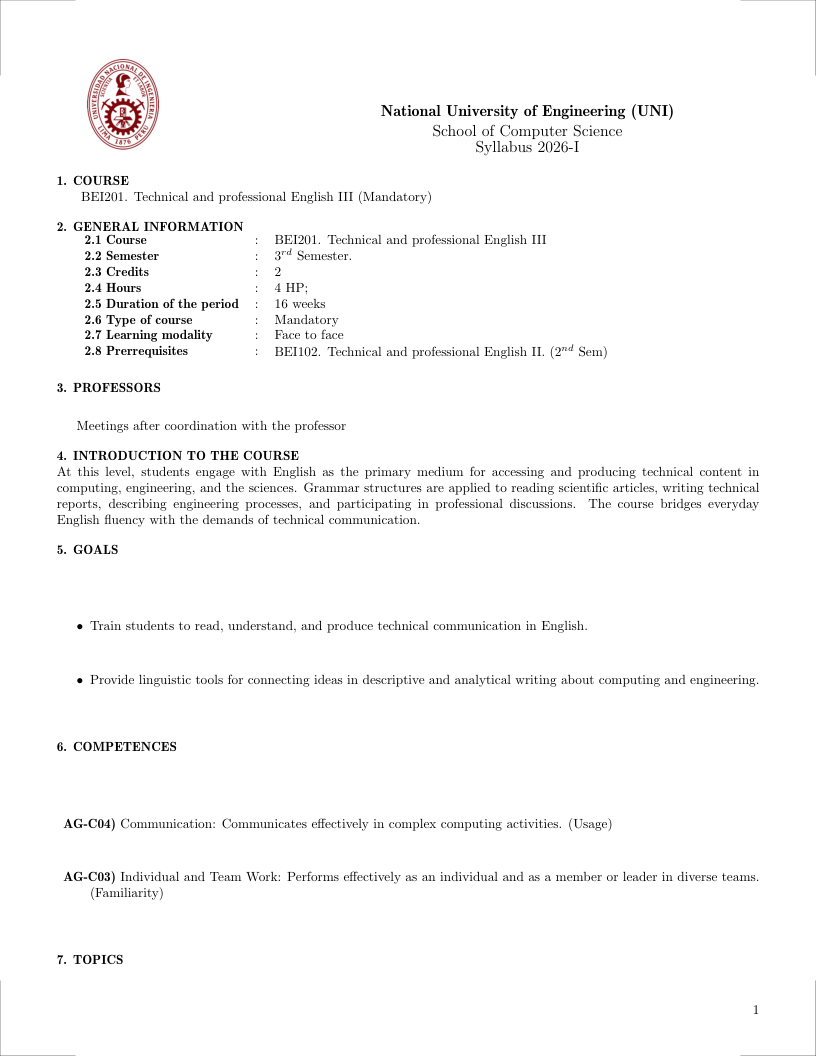
At this level, students engage with English as the primary medium for accessing and producing technical content in computing, engineering, and the sciences. Grammar structures are applied to reading scientific articles, writing technical reports, describing engineering processes, and participating in professional discussions. The course bridges everyday English fluency with the demands of technical communication.
5.17.2. Generales Goals ↑ Back to top
- Train students to read, understand, and produce technical communication in English.
- Provide linguistic tools for connecting ideas in descriptive and analytical writing about computing and engineering.
5.17.3. Contribution to Outcomes ↑ Back to top
- AG-C04) Communication: Communicates effectively in complex computing activities. (Usage)
- AG-C03) Individual and Team Work: Performs effectively as an individual and as a member or leader in diverse teams. (Familiarity)
5.17.4. Content ↑ Back to top
5.17.4.1. Technical Communication (12 hours) [Skills AG-C03,AG-C04] ↑ Back to top
Bibliography: (Soars and John, 2002b; Cambridge, 2006; MacGrew, 1999)
Topics
- Review of Tenses: Present, Past, and Future in technical documentation.
- Interrogative sentences with complex Wh- questions for system analysis.
- Words with more than one meaning in technical contexts (Polysemy).
- Expressions for describing professional activities and research interests.
Learning Outcomes
- By the end of the unit, students use various tenses to exchange detailed technical information and formulate precise questions about computing systems and engineering processes.
5.17.4.2. Comparing Architectures (12 hours) [Skills AG-C03,AG-C04] ↑ Back to top
Bibliography: (Soars and John, 2002b; Cambridge, 2006; MacGrew, 1999)
Topics
- Use of "What's it like?": Describing system characteristics and interfaces.
- Advanced comparative and superlative adjectives in benchmark analysis.
- Collocations in computing: high-performance, low-level, fault-tolerant.
- Reading: Architecture comparison reports (RISC vs. CISC, SQL vs. NoSQL).
Learning Outcomes
- Students analyze and describe differences between computing architectures, frameworks, and systems using varied comparative structures with technical precision.
5.17.4.3. Then and Now in Computing (12 hours) [Skills AG-C03,AG-C04] ↑ Back to top
Bibliography: (Soars and John, 2002b; Cambridge, 2006; MacGrew, 1999)
Topics
- Present Perfect vs. Simple Past: Contrasting historic events with current state.
- Time expressions: for, since, ever, never applied to technology evolution.
- Adverbs of time and manner in scientific narrative.
- Vocabulary: Generations of technology, legacy systems, current platforms.
Learning Outcomes
- Students differentiate and correctly apply the present perfect and the simple past to narrate the evolution of computing technologies and contrast historical achievements with the current state of the field.
5.17.4.4. Engineering Standards and Protocols (12 hours) [Skills AG-C03,AG-C04] ↑ Back to top
Bibliography: (Soars and John, 2002b; Cambridge, 2006; MacGrew, 1999)
Topics
- Modals of obligation and permission: Have to, Must, Can in professional norms.
- Giving technical recommendations: Should, Ought to — code reviews and design.
- Vocabulary: IEEE/ACM standards, coding conventions, security policies.
- Formal writing: Technical memos and engineering recommendations.
Learning Outcomes
- Students express engineering rules, standards, and professional recommendations using appropriate modal verbs in formal technical writing and peer discussion.
5.17.4.5. How Systems Are Built (12 hours) [Skills AG-C03,AG-C04] ↑ Back to top
Bibliography: (Soars and John, 2002b; Cambridge, 2006; MacGrew, 1999)
Topics
- Passive Voice: Present and Simple Past to describe engineering processes.
- Vocabulary: Manufacturing, deployment, integration, and testing.
- Expressions for giving technical opinions and discussing design trade-offs.
- Writing: Process description for a software or hardware system.
Learning Outcomes
- Students use the passive voice to describe how systems are designed, built, tested, and deployed, participating in technical discussions about engineering processes.
5.17.4.6. Debugging and Analysis (12 hours) [Skills AG-C03,AG-C04] ↑ Back to top
Bibliography: (Soars and John, 2002b; Cambridge, 2006; MacGrew, 1999)
Topics
- Past Continuous vs. Simple Past in incident and failure reports.
- Narrative and sequence connectors: while, when, suddenly, as a result.
- Vocabulary: Bugs, exceptions, crashes, logs, root cause analysis.
- Writing: Incident report for a software or network failure.
Learning Outcomes
- Students narrate debugging sessions, system failures, and experimental incidents using narrative tenses and technical sequencing connectors fluently.
5.17.4.7. Research and Innovation (12 hours) [Skills AG-C03,AG-C04] ↑ Back to top
Bibliography: (Soars and John, 2002b; Cambridge, 2006; MacGrew, 1999)
Topics
- Future Forms: Will, Going to, Present Continuous for research projection.
- Expressions of probability and certainty in scientific contexts.
- Vocabulary: Innovation cycles, research proposals, technology forecasting.
- Oral presentations: "The future of computing in my field".
Learning Outcomes
- Students project research goals and discuss future directions in computing and engineering using various future structures with appropriate degrees of certainty.
5.17.4.8. Technical English III (12 hours) [Skills AG-C03,AG-C04] ↑ Back to top
Bibliography: (Soars and John, 2002b; Cambridge, 2006; MacGrew, 1999)
Topics
- Programming and Web Development terminology: functions, APIs, frameworks.
- User Interface (UI/UX) descriptions and usability concepts.
- Basic project management vocabulary: sprints, milestones, deliverables.
- Writing: Simple technical specification or README document.
Learning Outcomes
- By the end of the course, students use specialized software development vocabulary to describe logical and functional components and produce basic technical documentation in English.
5.17.5. Bibliography ↑ Back to top
Soars, L. and John (2002b). American Headway N 2 Student Book. Editorial Oxford.
Cambridge (2006). Diccionario Inglés-Espanol Cambridge. Editorial Oxford.
MacGrew, J. (1999). Focus on Grammar Basic. Editorial Oxford.