- ES Español (Latinoamérica)

- EN English

5.64. Research Workshop (Mandatory)
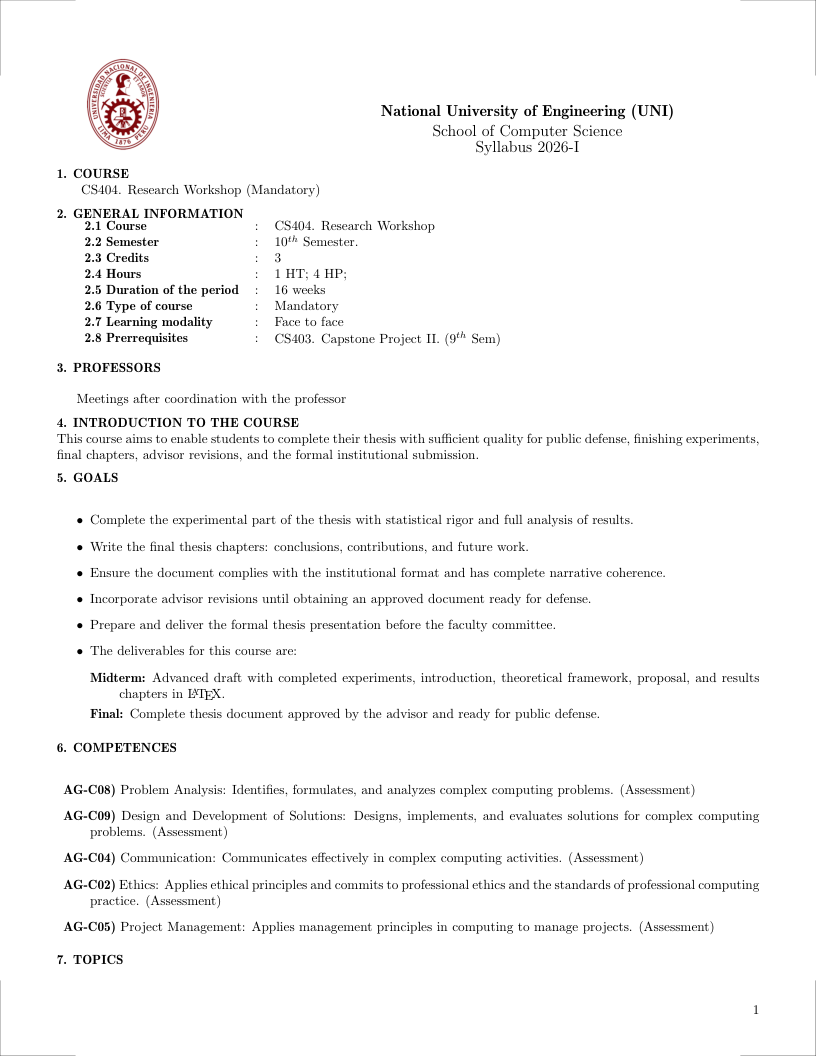
- Semester: 10th Sem. Credits: 3
- Hour of this course: Theory: 1 hours; Laboratory: 4 hours;
- Syllabus:
- htmlonly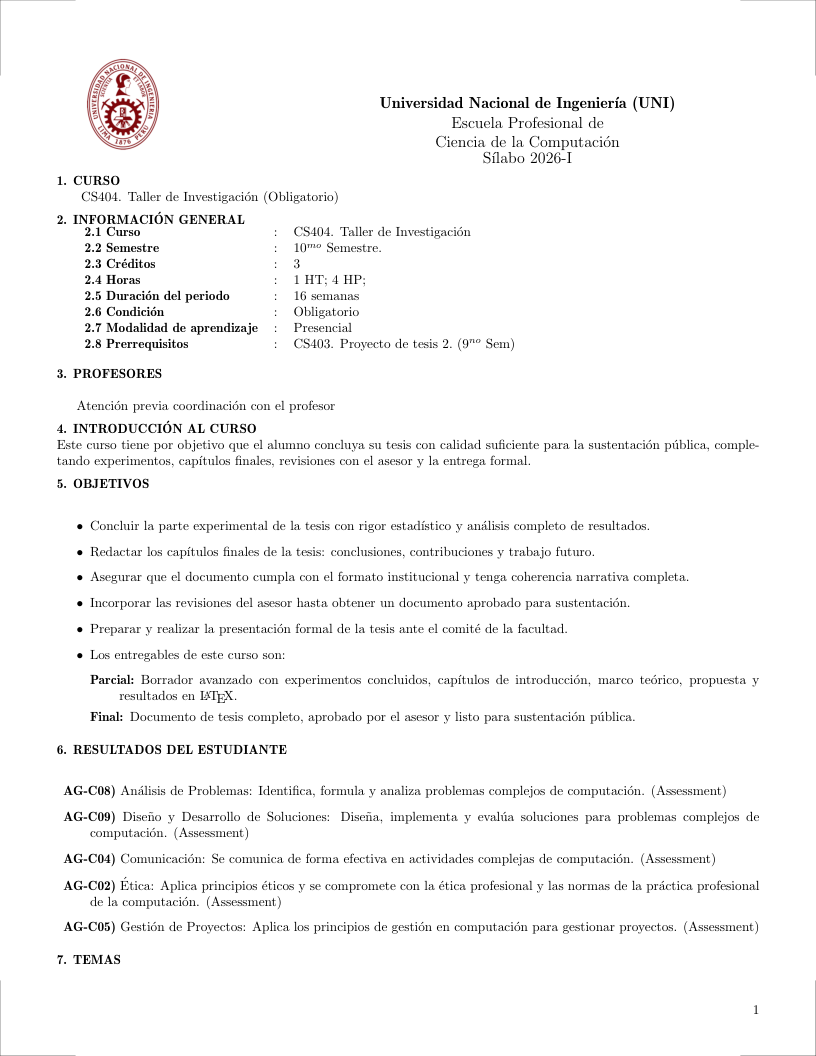
 Español (Latinoamérica)
 English
 - Prerrequisites:
- CS403 Capstone Project II (9th Sem)
5.64.1. Justification ↑ Back to top
This course aims to enable students to complete their thesis with sufficient quality for public defense, finishing experiments, final chapters, advisor revisions, and the formal institutional submission.
5.64.2. Generales Goals ↑ Back to top
- Complete the experimental part of the thesis with statistical rigor and full analysis of results.
- Write the final thesis chapters: conclusions, contributions, and future work.
- Ensure the document complies with the institutional format and has complete narrative coherence.
- Incorporate advisor revisions until obtaining an approved document ready for defense.
- Prepare and deliver the formal thesis presentation before the faculty committee.
- The deliverables for this course are:
- [Midterm:] Advanced draft with completed experiments, introduction, theoretical framework, proposal, and results chapters in LaTeX.
- [Final:] Complete thesis document approved by the advisor and ready for public defense.
5.64.3. Contribution to Outcomes ↑ Back to top
- AG-C08) Problem Analysis: Identifies, formulates, and analyzes complex computing problems. (Assessment)
- AG-C09) Design and Development of Solutions: Designs, implements, and evaluates solutions for complex computing problems. (Assessment)
- AG-C04) Communication: Communicates effectively in complex computing activities. (Assessment)
- AG-C02) Ethics: Applies ethical principles and commits to professional ethics and the standards of professional computing practice. (Assessment)
- AG-C05) Project Management: Applies management principles in computing to manage projects. (Assessment)
5.64.4. Content ↑ Back to top
5.64.4.1. Completion of Experiments and Results Analysis (12 hours) [Skills AG-C05,AG-C08,AG-C09] ↑ Back to top
Bibliography: (IEEE-Computer Society, 2008; ACM, 2008)
Topics
- Full execution of the experimental protocol defined in the thesis plan.
- Final statistical analysis: significance tests, confidence intervals, and effect size.
- Objective comparison with baselines and state-of-the-art using established metrics.
- Interpretation of results: findings, limitations, and threats to validity.
- Reproducible documentation: code, datasets, configurations, and results.
Learning Outcomes
- Complete the execution of the experimental protocol covering all defined cases. [Assessment]
- Analyze results with statistical rigor and interpret findings with respect to the hypothesis. [Assessment]
- Document experiments, configurations, and results in a reproducible manner. [Usage]
5.64.4.2. Writing the Final Thesis Chapters (12 hours) [Skills AG-C02,AG-C04,AG-C09] ↑ Back to top
Bibliography: (IEEE-Computer Society, 2008; ACM, 2008)
Topics
- Writing the results chapter: high-quality tables, figures, and comparative analysis.
- Writing the conclusions chapter: findings, original contributions, and limitations.
- Writing the future work chapter: extensions and open research problems.
- Writing the final introduction: motivation, problem statement, and contributions summary.
- Writing the executive abstract in both Spanish and English.
Learning Outcomes
- Write the results chapter with clear visualizations and comparative analysis. [Assessment]
- Formulate the conclusions and original contributions of the thesis with precision. [Assessment]
- Write the abstract and final introduction articulating the problem and the contributions. [Assessment]
5.64.4.3. Document Formatting, Integration, and Quality (10 hours) [Skills AG-C02,AG-C04,AG-C09] ↑ Back to top
Bibliography: (IEEE-Computer Society, 2008; ACM, 2008)
Topics
- Verification of compliance with the institutional thesis format in LaTeX.
- Quality review of figures, tables, and equations in the final document.
- Narrative and terminological consistency across all thesis chapters.
- Review and update of bibliography: coverage, BibTeX format, and correct citations.
- Generation of the final document: PDF, cover page, indices, and appendices.
Learning Outcomes
- Verify that the document fully complies with the institutional thesis format. [Assessment]
- Correct the narrative and terminological consistency across all chapters. [Assessment]
- Produce the final PDF document with cover page, indices, and complete bibliography. [Usage]
5.64.4.4. Advisor Review and Correction Cycles (10 hours) [Skills AG-C02,AG-C08,AG-C09] ↑ Back to top
Bibliography: (IEEE-Computer Society, 2008; ACM, 2008)
Topics
- Structured revision dynamic: submission, review, and response to the advisor.
- Incorporation of advisor feedback: prioritization and argued response.
- Review of proposal soundness and experimental validity according to the advisor.
- Handling academic disagreements with the advisor constructively and ethically.
- Advisor approval criteria for authorizing the thesis defense.
Learning Outcomes
- Systematically incorporate advisor observations with argued responses. [Assessment]
- Improve the scientific soundness of the document through revision cycles. [Assessment]
- Obtain formal advisor approval for the thesis defense authorization. [Assessment]
5.64.4.5. Defense Preparation and Rehearsal (8 hours) [Skills AG-C02,AG-C04,AG-C05] ↑ Back to top
Bibliography: (IEEE-Computer Society, 2008; ACM, 2008)
Topics
- Design of the oral presentation: structure, narrative, and time management.
- Preparation of technical slides: figures, results, and key comparisons.
- Defense techniques for jury questions: argumentation and objection handling.
- Defense rehearsal with the advisor and/or academic peers.
- Stress management and effective communication in academic evaluation contexts.
Learning Outcomes
- Design and deliver a clear and structured oral presentation of the thesis work. [Assessment]
- Defend methodology and results before critical questions from the jury. [Assessment]
- Demonstrate full command of the topic through prior defense rehearsals. [Usage]
5.64.4.6. Formal Submission and Pre-Defense (8 hours) [Skills AG-C02,AG-C04,AG-C05] ↑ Back to top
Bibliography: (IEEE-Computer Society, 2008; ACM, 2008)
Topics
- Institutional thesis submission process: documentation and regulatory deadlines.
- Pre-defense before faculty authorities: evaluation of the final draft.
- Incorporation of pre-defense committee corrections into the document.
- Administrative procedures: jury designation and defense scheduling.
- Ethics in dissemination: open access, institutional repository, and authorship rights.
Learning Outcomes
- Submit the complete thesis document meeting all institutional requirements. [Assessment]
- Present the final draft before the pre-defense committee and incorporate their corrections. [Assessment]
- Complete the administrative procedures for scheduling the public defense. [Usage]
5.64.5. Bibliography ↑ Back to top
IEEE-Computer Society (2008). Digital Libray. IEEE-Computer Society. http://www.computer.org/publications/dlib.
ACM (2008). Digital Libray. Association for Computing Machinery. http://portal.acm.org/dl.cfm.