- ES Español (Latinoamérica)

- EN English

5.62. Internet of Things (Elective)
- Semester: 9th Sem. Credits: 3
- Hour of this course: Theory: 1 hours; Laboratory: 4 hours;
- Syllabus:
- htmlonly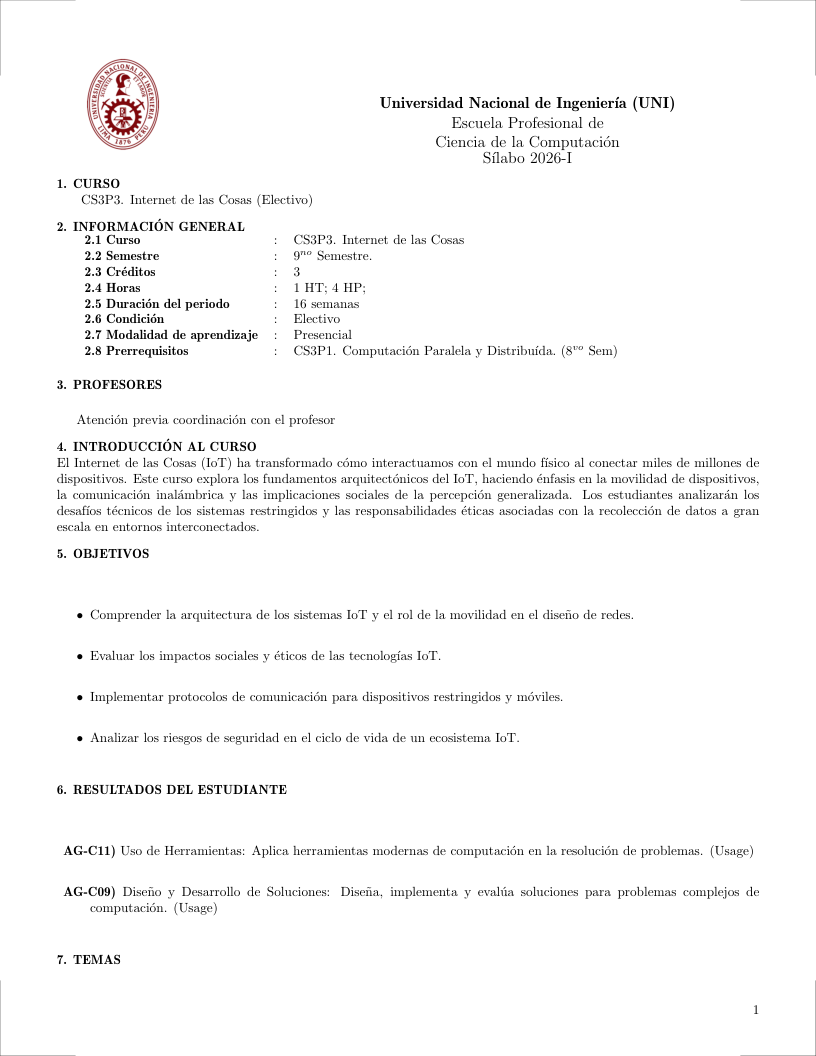
 Español (Latinoamérica)
 English
 - Prerrequisites:
- CS3P1 Parallel and Distributed Computing (8th Sem)
5.62.1. Justification ↑ Back to top
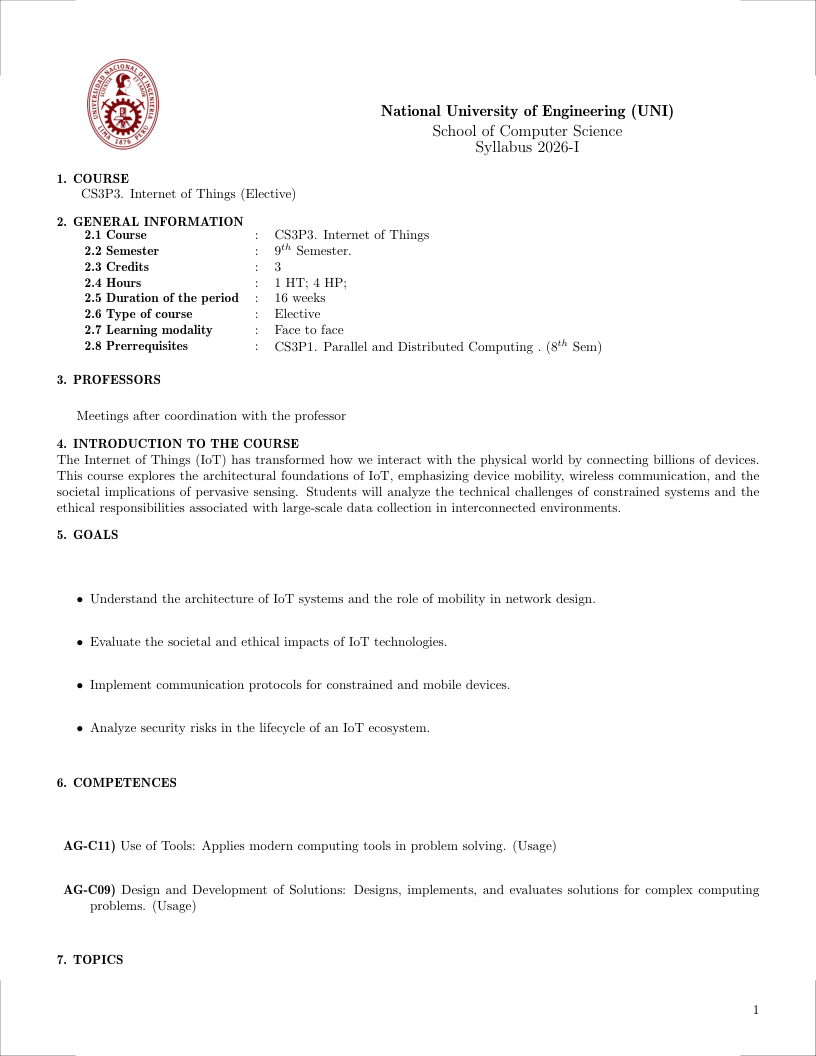
The Internet of Things (IoT) has transformed how we interact with the physical world by connecting billions of devices. This course explores the architectural foundations of IoT, emphasizing device mobility, wireless communication, and the societal implications of pervasive sensing. Students will analyze the technical challenges of constrained systems and the ethical responsibilities associated with large-scale data collection in interconnected environments.
5.62.2. Generales Goals ↑ Back to top
- Understand the architecture of IoT systems and the role of mobility in network design.
- Evaluate the societal and ethical impacts of IoT technologies.
- Implement communication protocols for constrained and mobile devices.
- Analyze security risks in the lifecycle of an IoT ecosystem.
5.62.3. Contribution to Outcomes ↑ Back to top
- AG-C11) Use of Tools: Applies modern computing tools in problem solving. (Usage)
- AG-C09) Design and Development of Solutions: Designs, implements, and evaluates solutions for complex computing problems. (Usage)
5.62.4. Content ↑ Back to top
5.62.4.1. Mobility Support (12 hours) [Skills AG-C09,AG-C11] ↑ Back to top
Bibliography: (Hanes et al., 2017; Buyya and Dastjerdi, 2016)
Topics
- Principles of cellular communication (e.g., 4G, 5G)
- Principles of Wireless LANs (mainly 802.11)
- Device to device communication (e.g., IoT communication)
- Multi-hop wireless networks (e.g., ad hoc networks, opportunistic, delay tolerant)
Learning Outcomes
- Describe some aspects of cellular communication such as registration [Describe]
- Describe how 802.11 supports mobile users [Describe]
- Describe practical uses of device-to-device communication, as well as multihop [Describe]
- Describe one type of mobile network such as ad hoc [Describe]
5.62.4.2. Security Ethics, Law and Society (12 hours) [Skills AG-C09,AG-C11] ↑ Back to top
Bibliography: (Hanes et al., 2017)
Topics
- Societal impacts of Internet of Things (IoT) devices and other emerging technologies on security and privacy Civil Liberties and Expression , Data, Surveillance and Privacy Technology , Privacy Philosophical Foundations and Legislation , Computer Crimes and Attacks , Security Laws, Policies and Responsibility .
- Privacy by design and privacy engineering Civil Liberties and Expression , Data, Surveillance and Privacy Technology , Privacy Philosophical Foundations and Legislation , Computer Crimes and Attacks , Security Laws, Policies and Responsibility .
Learning Outcomes
- Analyze the societal impacts of pervasive IoT surveillance [Assessment].
- Apply privacy-by-design principles to IoT data architectures [Usage].
5.62.4.3. Networked Applications (24 hours) [Skills AG-C09,AG-C11] ↑ Back to top
Bibliography: (Hanes et al., 2017)
Topics
- Distributed application paradigms (e.g., client/server, peer-to-peer, cloud, edge, and fog). See also: Communication , Coordination
- Protocols for constrained networks (CoAP, MQTT, LoRaWAN).
Learning Outcomes
- Define the principles of naming, addressing, resource location [Define]
- Analyze the needs of specific networked application demands [Analyze]
- Describe the details of one application layer protocol [Describe]
- Implement a simple client-server socket-based application [Implement]
5.62.5. Bibliography ↑ Back to top
Hanes, D., Salgueiro, G., and Grossetete, P. (2017). IoT Fundamentals: Networking Technologies, Protocols, and Use Cases for the Internet of Things. Cisco Press.
Buyya, R. and Dastjerdi, A. V. (2016). Internet of Things: Principles and Paradigms. Morgan Kaufmann.