- ES Español (Latinoamérica)

- EN English

5.31. Networking and Communication (Mandatory)
- Semester: 6th Sem. Credits: 3
- Hour of this course: Theory: 1 hours; Practice: 2 hours; Laboratory: 2 hours;
- Syllabus:
- htmlonly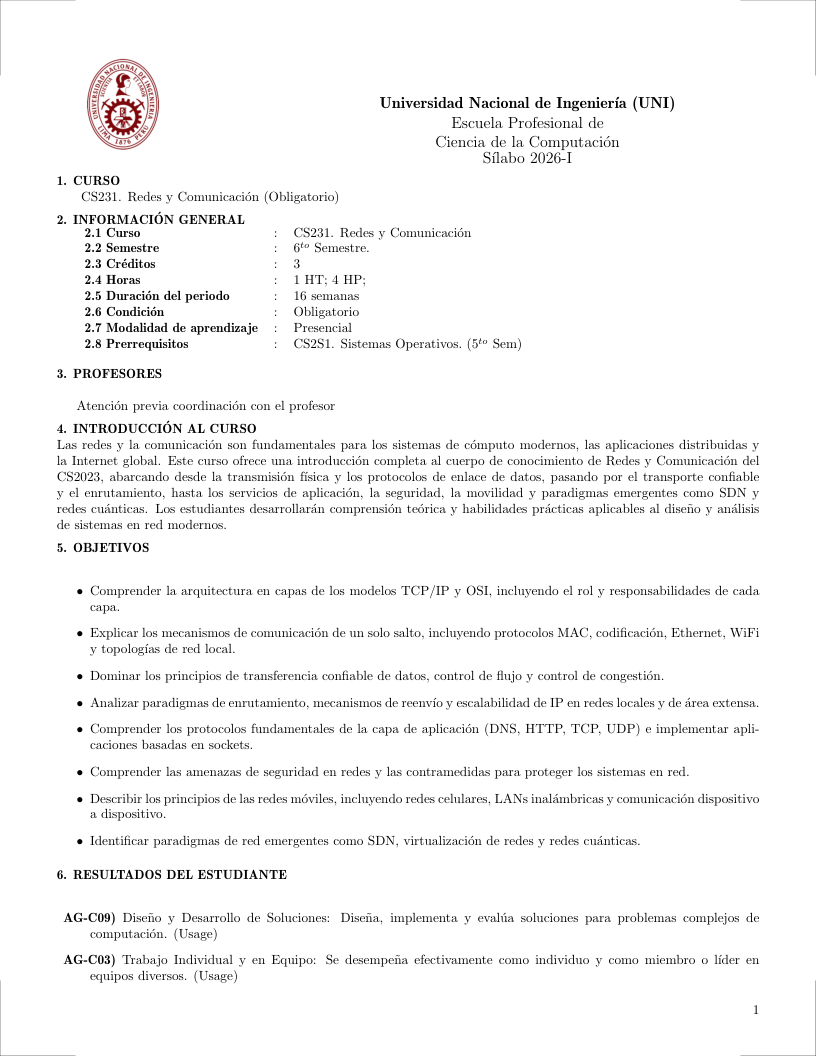
 Español (Latinoamérica)
 English
 - Prerrequisites:
- CS2S1 Operating systems (5th Sem)
5.31.1. Justification ↑ Back to top
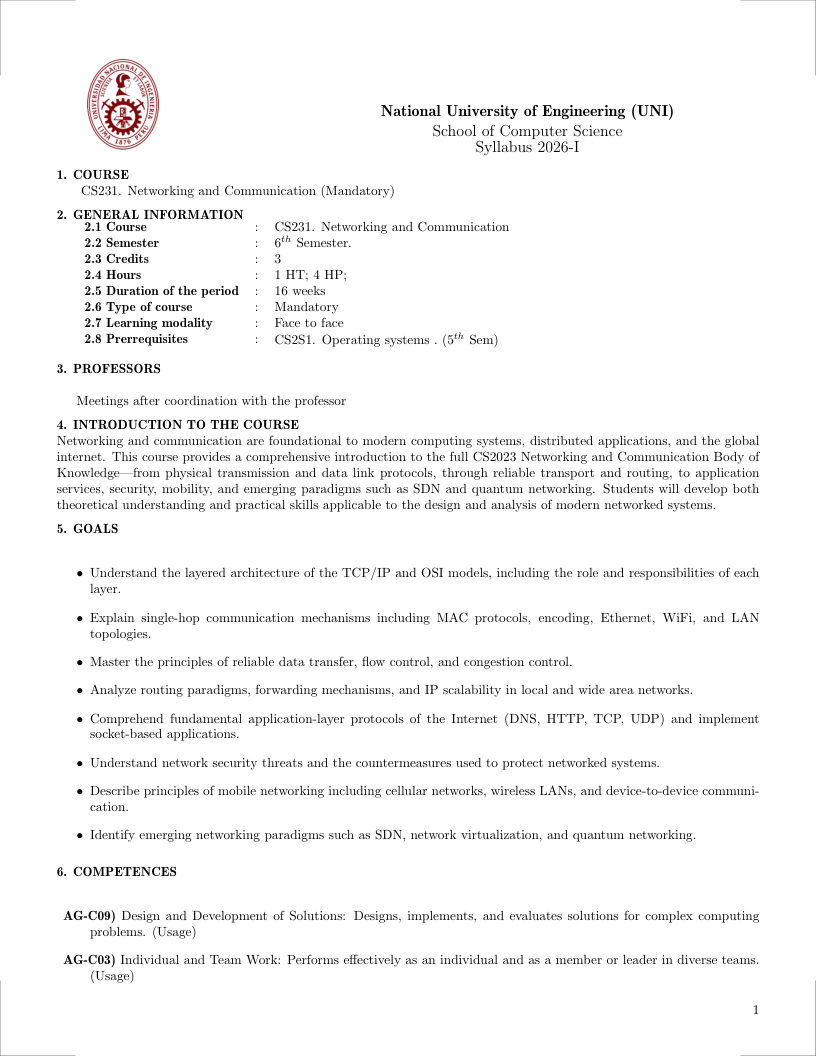
Networking and communication are foundational to modern computing systems, distributed applications, and the global internet. This course provides a comprehensive introduction to the full CS2023 Networking and Communication Body of Knowledge—from physical transmission and data link protocols, through reliable transport and routing, to application services, security, mobility, and emerging paradigms such as SDN and quantum networking. Students will develop both theoretical understanding and practical skills applicable to the design and analysis of modern networked systems.
5.31.2. Generales Goals ↑ Back to top
- Understand the layered architecture of the TCP/IP and OSI models, including the role and responsibilities of each layer.
- Explain single-hop communication mechanisms including MAC protocols, encoding, Ethernet, WiFi, and LAN topologies.
- Master the principles of reliable data transfer, flow control, and congestion control.
- Analyze routing paradigms, forwarding mechanisms, and IP scalability in local and wide area networks.
- Comprehend fundamental application-layer protocols of the Internet (DNS, HTTP, TCP, UDP) and implement socket-based applications.
- Understand network security threats and the countermeasures used to protect networked systems.
- Describe principles of mobile networking including cellular networks, wireless LANs, and device-to-device communication.
- Identify emerging networking paradigms such as SDN, network virtualization, and quantum networking.
5.31.3. Contribution to Outcomes ↑ Back to top
- AG-C09) Design and Development of Solutions: Designs, implements, and evaluates solutions for complex computing problems. (Usage)
- AG-C03) Individual and Team Work: Performs effectively as an individual and as a member or leader in diverse teams. (Usage)
5.31.4. Content ↑ Back to top
5.31.4.1. Fundamentals of Networks and Communications (6 hours) [Skills AG-C03,AG-C09] ↑ Back to top
Bibliography: (Kurose and Ross, 2021; Tanenbaum et al., 2021; Peterson and Davie, 2022)
Topics
- Importance of networking in contemporary computing, and associated challenges. See also: Digital Equity and Accessibility , Social Impact and AI , Civil Liberties and Expression , Data, Surveillance and Privacy Technology , Privacy Philosophical Foundations and Legislation
- Organization of the internet (e.g., users, Internet Service Providers, autonomous systems, content providers, content delivery networks)
- Switching techniques (e.g., circuit and packet)
- Layers and their roles (application, transport, network, datalink, and physical)
- Layering principles (e.g., encapsulation and hourglass model). See also: Digital Systems and Logic , Sequential and Parallel Processing , State Machines
- Network elements (e.g., routers, switches, hubs, access points, and hosts)
- Basic queueing concepts (e.g., relationship with latency, congestion, service levels, etc.)
Learning Outcomes
- Articulate the organization of the internet [Articulate]
- List and define the appropriate network terminology [List]
- Describe the layered structure of a typical networked architecture [Describe]
- Identify the different types of complexity in a network (edges, core, etc.) [Analyze]
5.31.4.2. Single Hop Communication (6 hours) [Skills AG-C03,AG-C09] ↑ Back to top
Bibliography: (Tanenbaum et al., 2021; Peterson and Davie, 2022)
Topics
- Introduction to modulation, bandwidth, and communication media
- Encoding and Framing
- Medium Access Control (MAC) (e.g., random access and scheduled access)
- Ethernet and WiFi
- Switching (e.g., spanning trees, VLANS).
- Local Area Network Topologies (e.g., data center, campus networks).
Learning Outcomes
- Describe some basic aspects of modulation, bandwidth, and communication media [Describe]
- Describe in detail a MAC protocol [Describe]
- Demonstrate understanding of encoding and framing solution tradeoffs [Demonstrate]
- Describe details of the implementation of Ethernet [Describe]
- Describe how switching works [Describe]
- Describe one kind of a LAN topology [Describe]
5.31.4.3. Networked Applications (6 hours) [Skills AG-C03,AG-C09] ↑ Back to top
Bibliography: (Kurose and Ross, 2021; Peterson and Davie, 2022)
Topics
- Naming and address schemes (e.g., DNS, and Uniform Resource Identifiers)
- Distributed application paradigms (e.g., client/server, peer-to-peer, cloud, edge, and fog). See also: Communication , Coordination
- Diversity of networked application demands (e.g., latency, bandwidth, and loss tolerance). See also: Communication , Sustainable Design and Pervasive Computing , Environmental Footprint of Computing Systems , Systemic Effects and Social Context , Digital Equity and Accessibility , Social Impact and AI
- Coverage of application-layer protocols (e.g., HTTP)
- Interactions with TCP, UDP, and Socket APIs. See also: Programs: Distribution , Programs: Execution Properties , GPU Programming , Programs: Implementation Mappings , Programs: Declarative Parallelism , Programs: Starting Activities
Learning Outcomes
- Define the principles of naming, addressing, resource location [Define]
- Analyze the needs of specific networked application demands [Analyze]
- Describe the details of one application layer protocol [Describe]
- Implement a simple client-server socket-based application [Implement]
5.31.4.4. Reliability Support (6 hours) [Skills AG-C03,AG-C09] ↑ Back to top
Bibliography: (Kurose and Ross, 2021; Tanenbaum et al., 2021)
Topics
- Unreliable delivery (e.g., UDP)
- Principles of reliability (e.g., delivery without loss, duplication, or out of order). See also: System Reliability
- Error control (e.g., retransmission, error correction)
- Flow control (e.g., stop and wait, window based)
- Congestion control (e.g., implicit and explicit congestion notification)
- TCP and performance issues (e.g., Tahoe, Reno, Vegas, Cubic)
Learning Outcomes
- Describe the operation of reliable delivery protocols [Describe]
- List the factors that affect the performance of reliable delivery protocols [List]
- Describe some TCP reliability design issues [Describe]
- Design and implement a simple reliable protocol [Design]
5.31.4.5. Routing and Forwarding (6 hours) [Skills AG-C03,AG-C09] ↑ Back to top
Bibliography: (Kurose and Ross, 2021; Tanenbaum et al., 2021; Peterson and Davie, 2022)
Topics
- Routing paradigms and hierarchy (e.g., intra/inter domain, centralized and decentralized, source routing, virtual circuits, QoS)
- Forwarding methods (e.g., forwarding tables and matching algorithms)
- IP and Scalability issues (e.g., NAT, CIDR, BGP, different versions of IP)
Learning Outcomes
- Describe various routing paradigms and hierarchies [Describe]
- Describe how packets are forwarded in an IP network [Describe]
- Describe how the Internet tackles scalability challenges [Describe]
5.31.4.6. Network Security (6 hours) [Skills AG-C03,AG-C09] ↑ Back to top
Bibliography: (Stallings, 2022; Kurose and Ross, 2021)
Topics
- General intro about security (Threats, vulnerabilities, and countermeasures). See also: Computer Crimes and Attacks , Security Laws, Policies and Responsibility , AI and Hardware Security , Access Control and Applications , Security Mindset and Principles , Security Design and Controls Engineering , Threat Analysis and Security Engineering , Trusted Computing and Privacy Engineering
- Network specific threats and attack types (e.g., denial of service, spoofing, sniffing and traffic redirection, attacker-in-the-middle, message integrity attacks, routing attacks, ransomware, and traffic analysis). See also: AI and Hardware Security , Access Control and Applications , Security Mindset and Principles , Security Design and Controls Engineering , Threat Analysis and Security Engineering , Trusted Computing and Privacy Engineering
- Countermeasures:
- Cryptography (e.g. SSL, TLS, symmetric/asymmetric)
- Architectures for secure networks (e.g., secure channels, secure routing protocols, secure DNS, VPNs, DMZ, Zero Trust Network Access, hyper network security, anonymous communication protocols, isolation)
- Network monitoring, intrusion detection, firewalls, spoofing and DoS protection, honeypots, tracebacks, BGP Sec, RPKI
Learning Outcomes
- Describe some of the threat models of network security [Describe]
- Describe specific network-based countermeasures [Describe]
- Analyze various aspects of network security from a case study [Analyze]
5.31.4.7. Mobility Support (6 hours) [Skills AG-C03,AG-C09] ↑ Back to top
Bibliography: (Tanenbaum et al., 2021; Peterson and Davie, 2022)
Topics
- Principles of cellular communication (e.g., 4G, 5G)
- Principles of Wireless LANs (mainly 802.11)
- Device to device communication (e.g., IoT communication)
- Multi-hop wireless networks (e.g., ad hoc networks, opportunistic, delay tolerant)
Learning Outcomes
- Describe some aspects of cellular communication such as registration [Describe]
- Describe how 802.11 supports mobile users [Describe]
- Describe practical uses of device-to-device communication, as well as multihop [Describe]
- Describe one type of mobile network such as ad hoc [Describe]
5.31.4.8. Emerging Topics (6 hours) [Skills AG-C03,AG-C09] ↑ Back to top
Bibliography: (Peterson and Davie, 2022; Tanenbaum et al., 2021)
Topics
- Middleboxes (e.g., advances in usage of AI, intent-based networking, filtering, deep packet inspection, load balancing, NAT, CDN)
- Network Virtualization (e.g., SDN, Data Center Networks)
- Quantum Networking (e.g., Intro to the domain, teleportation, security, Quantum Internet)
- Satellite, mmWave, Visible Light
Learning Outcomes
- Describe the value of advances in middleboxes in networks [Describe]
- Describe the importance of Software Defined Networks [Describe]
- Describe some of the added value achieved by using Quantum Networking [Describe]
5.31.5. Bibliography ↑ Back to top
Kurose, J. and Ross, K. (2021). Computer Networking: A Top-Down Approach. Pearson, 8th edition.
Tanenbaum, A. S., Feamster, N., and Wetherall, D. J. (2021). Computer Networks. Pearson, 6th edition.
Peterson, L. L. and Davie, B. S. (2022). Computer Networks: A Systems Approach. Morgan Kaufmann, 6th edition.
Stallings, W. (2022). Cryptography and Network Security: Principles and Practice. Pearson, 8th edition.