- ES Español (Latinoamérica)

- EN English

5.4. Chemistry I (Mandatory)
- Semester: 1st Sem. Credits: 5
- Hour of this course: Theory: 4 hours; Laboratory: 2 hours;
- Syllabus:
- htmlonly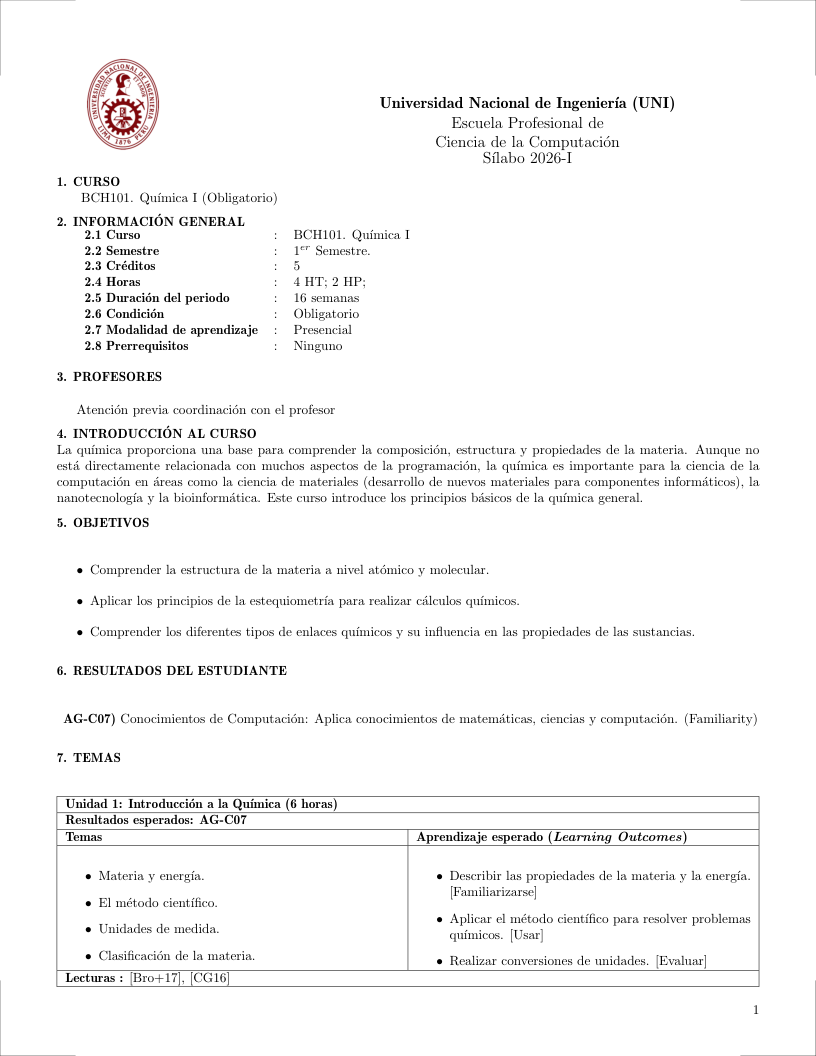
 Español (Latinoamérica)
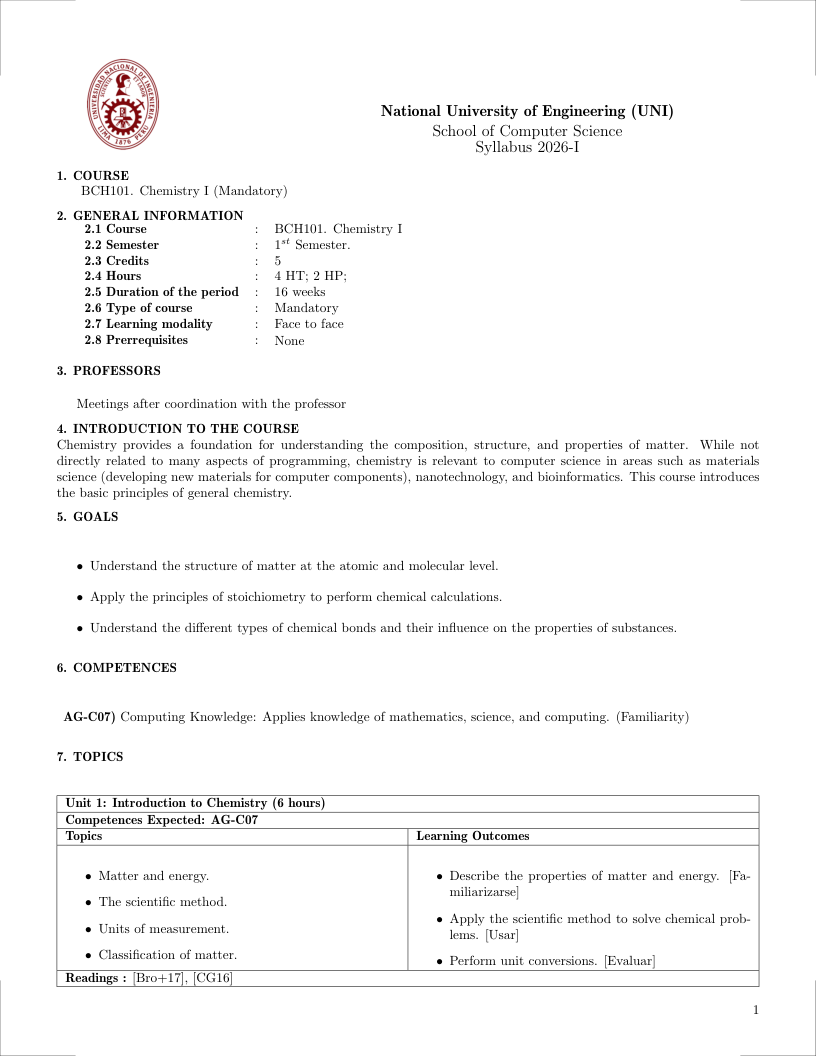 English
 - Prerrequisites: None
5.4.1. Justification ↑ Back to top
Chemistry provides the foundation for understanding the composition, structure, and properties of matter – knowledge required across computing, and engineering programs alike as part of a rigorous grounding in the natural sciences. This course introduces the basic principles of general chemistry and extends them to chemical equilibrium and electrochemistry, together with the applied chemistry of water, polymers, and cement, topics that recur in materials science, environmental analysis, and engineering practice.
5.4.2. Generales Goals ↑ Back to top
- Understand the structure of matter at the atomic and molecular level.
- Apply the principles of stoichiometry to perform chemical calculations.
- Understand the different types of chemical bonds and their influence on the properties of substances.
- Apply chemical equilibrium, including acid-base and solubility equilibria, to predict the behavior of aqueous systems.
- Apply electrochemical principles to analyze corrosion of metals and reinforced concrete.
- Relate the composition and properties of water, polymers, and cement to their applications in materials science and civil engineering.
5.4.3. Contribution to Outcomes ↑ Back to top
- AG-C07) Computing Knowledge: Applies knowledge of mathematics, science, and computing. (Familiarity)
5.4.4. Content ↑ Back to top
5.4.4.1. Matter and Energy (8 hours) [Skills AG-C07] ↑ Back to top
Bibliography: (Brown et al., 2017; Chang and Goldsby, 2016)
Topics
- Classification of matter: elements, compounds, homogeneous and heterogeneous mixtures
- Physical and chemical properties, and physical and chemical changes of matter
- International System of units, significant figures, and dimensional analysis
- Forms of energy, heat and temperature; the law of conservation of mass and energy
- The scientific method applied to chemistry: observation, hypothesis, and experimentation
Learning Outcomes
- Classify a sample of matter as an element, compound, or mixture, and distinguish homogeneous from heterogeneous mixtures [Familiarity]
- Apply dimensional analysis and significant-figure rules in calculations involving chemical measurements [Usage]
- Relate observed energy changes to specific physical and chemical processes, applying the law of conservation of energy [Assessment]
5.4.4.2. Atomic Structure (10 hours) [Skills AG-C07] ↑ Back to top
Bibliography: (Brown et al., 2017; Chang and Goldsby, 2016)
Topics
- Historical evolution of the atomic model: Dalton, Thomson, Rutherford, and Bohr
- Subatomic particles, atomic number, mass number, and isotopes
- Electron configuration, quantum numbers, and the Aufbau principle
- Organization of the periodic table: groups, periods, and blocks
- Periodic trends: atomic radius, ionization energy, electron affinity, and electronegativity
Learning Outcomes
- Describe the historical evolution of the atomic model and each model's contribution to the current understanding of the atom [Familiarity]
- Determine the electron configuration of an atom or ion from its position in the periodic table [Usage]
- Predict periodic trends (atomic radius, ionization energy) to compare two or more elements [Assessment]
5.4.4.3. Chemical Bonding (10 hours) [Skills AG-C07] ↑ Back to top
Bibliography: (Brown et al., 2017; Chang and Goldsby, 2016)
Topics
- Ionic bonding: formation, lattice energy, and properties of ionic compounds
- Covalent bonding, Lewis structures, and the concept of resonance
- Molecular geometry via Valence Shell Electron Pair Repulsion (VSEPR) theory
- Electronegativity, bond polarity, and molecular polarity
- Intermolecular forces: dipole-dipole, hydrogen bonding, and London dispersion forces
Learning Outcomes
- Draw correct Lewis structures, including resonance cases, for molecules and polyatomic ions [Usage]
- Predict the molecular geometry and polarity of a molecule by applying VSEPR theory [Usage]
- Relate the type of intermolecular force present in a substance to its observed physical properties (boiling point, solubility) [Assessment]
5.4.4.4. Stoichiometry (10 hours) [Skills AG-C07] ↑ Back to top
Bibliography: (Brown et al., 2017; Chang and Goldsby, 2016)
Topics
- Chemical formulas, molar mass, and the mole concept
- Balancing chemical equations and their quantitative interpretation
- Mole-to-mole, mass-to-mass, and mass-to-mole stoichiometric calculations
- Limiting reagent, excess reagent, and percent yield
- Molarity, solution preparation, and solution stoichiometry
Learning Outcomes
- Balance chemical equations by inspection, verifying conservation of mass [Familiarity]
- Calculate the amounts of reactants and products in a chemical reaction using mole ratios [Usage]
- Determine the limiting reagent and percent yield of a reaction from experimental data [Assessment]
5.4.4.5. States of Matter (10 hours) [Skills AG-C07] ↑ Back to top
Bibliography: (Brown et al., 2017; Chang and Goldsby, 2016)
Topics
- Gas laws: Boyle's, Charles's, Avogadro's, and the ideal gas equation
- Kinetic-molecular theory of gases and its applications
- Phase changes, heating curves, and phase diagrams
- Crystalline and amorphous solids; types of crystalline solids
- Colligative properties of solutions: vapor pressure lowering, boiling point elevation, freezing point depression, and osmotic pressure
Learning Outcomes
- Apply the ideal gas equation and the gas laws to solve problems involving pressure, volume, and temperature [Usage]
- Interpret a phase diagram to identify the states and transitions of a substance under different conditions [Familiarity]
- Calculate the colligative properties of a solution (vapor pressure, boiling point, freezing point) from its concentration [Assessment]
5.4.4.6. Environmental and Water Chemistry (4 hours) [Skills AG-C07] ↑ Back to top
Bibliography: (Brown et al., 2017; Chang and Goldsby, 2016)
Topics
- Chemical composition of natural water and quality parameters (pH, hardness, dissolved oxygen, BOD)
- Fundamentals of water treatment: coagulation, flocculation, and disinfection
- Major air and water pollutants and their sources
- Biogeochemical cycles of carbon, nitrogen, and phosphorus
- Atmospheric chemistry and the greenhouse effect
Learning Outcomes
- Interpret water quality parameters to assess fitness for use [Usage]
- Describe the basic processes of drinking water and wastewater treatment [Familiarity]
- Identify the main sources and effects of air and water pollutants [Familiarity]
- Explain the chemical mechanism of the greenhouse effect [Usage]
5.4.4.7. Polymers and Geosynthetics (4 hours) [Skills AG-C07] ↑ Back to top
Bibliography: (Chang and Goldsby, 2016; Mamlouk and Zaniewski, 2017)
Topics
- Classification of polymers: thermoplastics, thermosets, and elastomers
- Polymerization reactions: addition and condensation
- Mechanical and chemical properties of polymers relevant to engineering
- Geosynthetics: geotextiles, geomembranes, and geogrids, and their applications
- Degradation and durability of polymers under environmental conditions
Learning Outcomes
- Classify a polymer by its structure and thermal behavior [Usage]
- Identify whether a polymerization reaction is addition or condensation [Familiarity]
- Select the appropriate geosynthetic type for a given civil engineering application [Usage]
- Assess the durability of a polymer under environmental exposure [Assessment]
5.4.4.8. Chemical Equilibrium (4 hours) [Skills AG-C07] ↑ Back to top
Bibliography: (Brown et al., 2017; Chang and Goldsby, 2016)
Topics
- The equilibrium constant \(K_c\) and \(K_p\), and its relation to reaction stoichiometry
- The reaction quotient \(Q\) and predicting the direction of a reaction
- Le Chatelier's principle: effect of concentration, pressure, and temperature
- ICE tables for calculating equilibrium concentrations
Learning Outcomes
- Write the equilibrium constant expression for a given reaction [Usage]
- Calculate equilibrium concentrations using ICE tables [Usage]
- Predict the shift of an equilibrium upon changes in concentration, pressure, or temperature using Le Chatelier's principle [Assessment]
5.4.4.9. Ionic Equilibrium and Salt Hydrolysis (12 hours) [Skills AG-C07] ↑ Back to top
Bibliography: (Brown et al., 2017; Chang and Goldsby, 2016)
Topics
- Arrhenius, Brønsted-Lowry, and Lewis acid-base theories
- Calculating pH and pOH for strong acids and bases
- Equilibrium of weak acids and bases: \(K_a\), \(K_b\), and degree of dissociation
- Salt hydrolysis and predicting the acidic, basic, or neutral character of a solution
- Buffer solutions and the Henderson-Hasselbalch equation
Learning Outcomes
- Calculate the pH of solutions of strong and weak acids and bases [Usage]
- Predict the acid-base character of a salt solution from the hydrolysis of its ions [Assessment]
- Calculate the pH of a buffer solution using the Henderson-Hasselbalch equation [Usage]
5.4.4.10. Salts, Solubility, and Precipitation Equilibria (6 hours) [Skills AG-C07] ↑ Back to top
Bibliography: (Brown et al., 2017; Chang and Goldsby, 2016)
Topics
- The solubility product \(K_{sp}\) and its relation to molar solubility
- Predicting precipitation by comparing the ion product with \(K_{sp}\)
- Common ion effect on solubility
Learning Outcomes
- Calculate \(K_{sp}\) from the molar solubility of a salt, and vice versa [Usage]
- Predict whether a precipitate will form when mixing two solutions given their concentrations and the corresponding \(K_{sp}\) [Assessment]
5.4.4.11. Electrochemistry and Electrolysis (8 hours) [Skills AG-C07] ↑ Back to top
Bibliography: (Brown et al., 2017; Chang and Goldsby, 2016)
Topics
- Oxidation-reduction reactions and balancing by the ion-electron method
- Galvanic cells, standard electrode potentials, and the Nernst equation
- Electrolytic cells and electrolysis; Faraday's laws
- Electrochemical corrosion of metals and protection methods
- Corrosion of reinforcing steel in reinforced concrete
Learning Outcomes
- Balance redox equations by the ion-electron method in acidic or basic medium [Usage]
- Calculate the potential of a galvanic cell and predict the spontaneity of a redox reaction [Usage]
- Apply Faraday's laws to calculate the mass deposited or the time in an electrolysis process [Usage]
- Analyze the conditions that favor the corrosion of a metal or of reinforcing steel in concrete, and propose protection methods [Assessment]
5.4.4.12. Cement Chemistry (4 hours) [Skills AG-C07] ↑ Back to top
Bibliography: (Mamlouk and Zaniewski, 2017; Chang and Goldsby, 2016)
Topics
- Chemical composition of Portland cement: calcium silicates, aluminates, and ferroaluminates
- Cement hydration reactions and strength development
- Role of each compound (\(C_3S\), \(C_2S\), \(C_3A\), \(C_4AF\)) in cement properties
- Supplementary cementitious materials: pozzolans, slag, and fly ash
Learning Outcomes
- Describe the chemical composition of Portland cement and its main compounds [Familiarity]
- Explain the cement hydration process and its relation to strength development [Usage]
- Evaluate the effect of supplementary cementitious materials on concrete properties [Assessment]
5.4.5. Bibliography ↑ Back to top
Brown, T. L., Jr., H. E. L., Bursten, B. E., Murphy, C. J., and Woodward, P. M. (2017). Chemistry: The Central Science. Pearson.
Chang, R. and Goldsby, K. A. (2016). Chemistry. McGraw-Hill Education.
Mamlouk, M. S. and Zaniewski, J. P. (2017). Materials for Civil and Construction Engineers. Pearson, 4th edition.