- ES Español

- EN English

5.3. Differential Calculus (Mandatory)
- Semester: 1st Sem. Credits: 5
- Hour of this course: Theory: 4 hours; Practice: 2 hours;
- Syllabus:
- htmlonly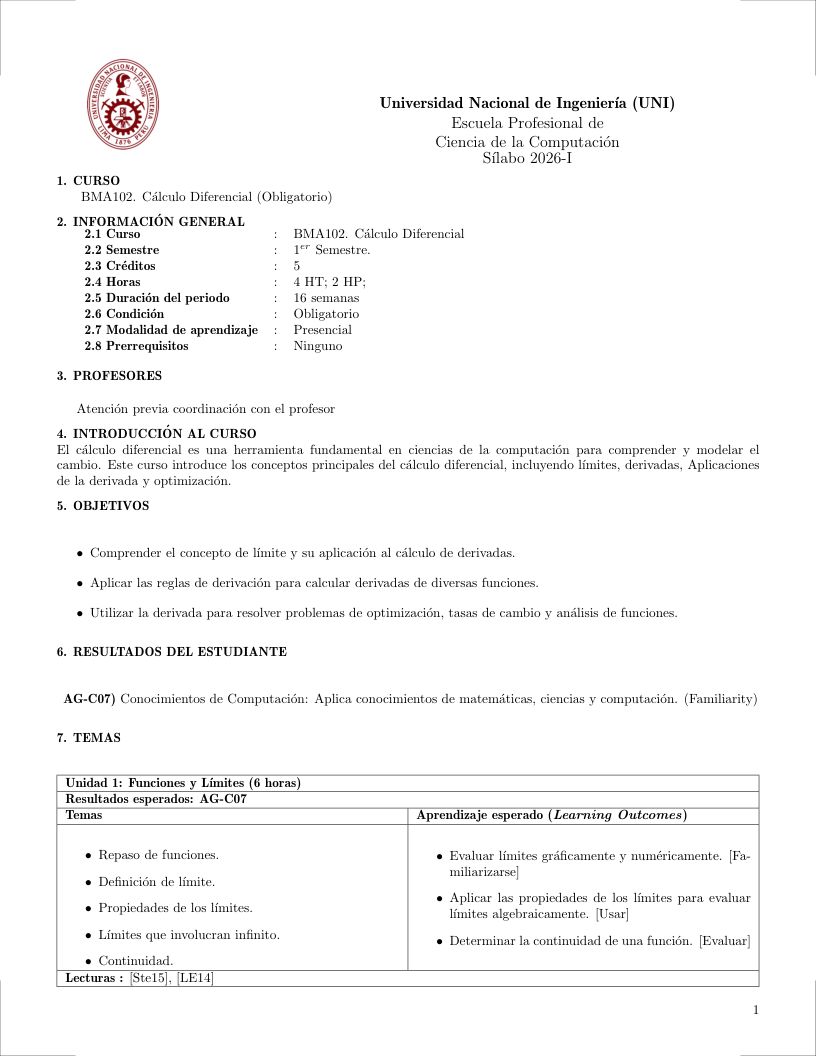
 Español
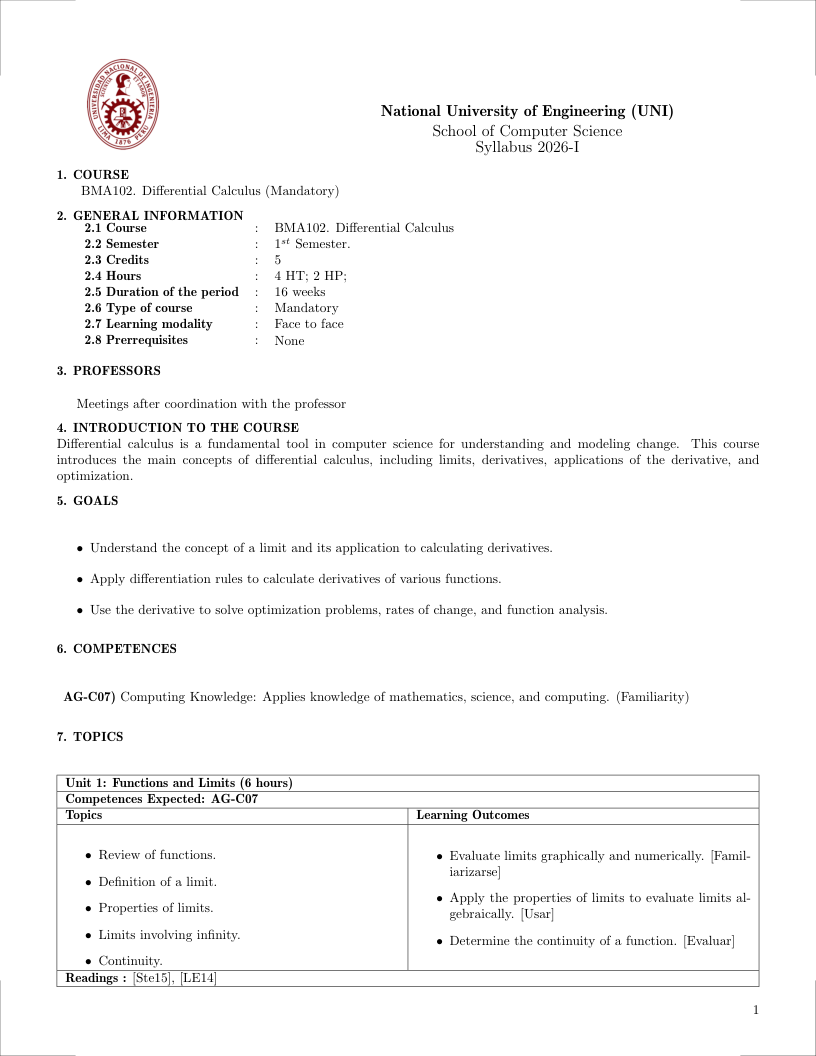 English
 - Prerrequisites: None
5.3.1. Justification ↑ Back to top
Differential calculus is a fundamental mathematical tool shared by computer science and engineering disciplines, providing the foundations for the rigorous study of change, the analysis of rates of change, the optimization of systems and functions, and the modeling of continuous phenomena. This course provides a solid foundation in the concepts and techniques of differential calculus of one variable, with emphasis on its application in scientific and engineering contexts.
5.3.2. Generales Goals ↑ Back to top
- Rigorously understand the concepts of limit, continuity, and derivative of functions of one variable.
- Apply differentiation rules to compute derivatives of algebraic, composite, and implicit functions arising from scientific and engineering contexts.
- Use differential calculus to solve optimization problems, related rates problems, and function behavior analysis.
5.3.3. Contribution to Outcomes ↑ Back to top
- AG-C07) Computing Knowledge: Applies knowledge of mathematics, science, and computing. (Familiarity)
5.3.4. Content ↑ Back to top
5.3.4.1. Limits and Continuity (12 hours) [Skills AG-C07] ↑ Back to top
Bibliography: (Stewart, 2015; Larson and Edwards, 2014)
Topics
- Epsilon-delta definition of a limit and formal proof techniques
- Limit laws, one-sided limits, and limits at infinity
- Continuity: types, properties, and the Intermediate Value Theorem
- L'Hôpital's rule and indeterminate forms
- Limits of sequences: convergence, Squeeze Theorem, and Bolzano-Weierstrass
Learning Outcomes
- State the epsilon-delta definition of a limit and explain its geometric meaning [Familiarity]
- Evaluate limits using limit laws, L'Hôpital's rule, and asymptotic analysis [Usage]
- Prove continuity or discontinuity of a function and apply the Intermediate Value Theorem [Assessment]
5.3.4.2. Differential Calculus (36 hours) [Skills AG-C07] ↑ Back to top
Bibliography: (Stewart, 2015; Larson and Edwards, 2014)
Topics
- Derivative as a limit; geometric and physical interpretations; differentiability
- Product, quotient, and chain rules; implicit differentiation; related rates
- Rolle's theorem, Mean Value Theorem, and monotonicity criteria
- Higher-order derivatives, Taylor polynomials, and remainder estimation
- Extrema: first and second derivative tests, curve sketching, and applied optimization
Learning Outcomes
- Interpret the derivative as a rate of change and as the slope of the tangent line [Familiarity]
- Apply differentiation rules and implicit differentiation to compute derivatives of composite and implicit functions [Usage]
- Solve optimization problems and sketch curves using the Mean Value Theorem and derivative tests [Assessment]
5.3.4.3. (6 hours) [Skills AG-C07] ↑ Back to top
Bibliography: (Stewart, 2016; Thomas et al., 2014)
5.3.5. Bibliography ↑ Back to top
Stewart, J. (2015). Calculus: Early Transcendentals. Cengage Learning.
Larson, R. and Edwards, B. H. (2014). Calculus. Cengage Learning.
Stewart, J. (2016). Cálculo de una variable: Trascendentes tempranas. Cengage Learning, 8th edition.
Thomas, G. B., Weir, M. D., and Hass, J. (2014). Cálculo de una variable. Pearson, 13th edition.