- ES Español (Latinoamérica)

- EN English

5.24. Technical and professional English IV (Elective)
- Semester: 4th Sem. Credits: 2
- Hour of this course: Practice: 4 hours;
- Syllabus:
- htmlonly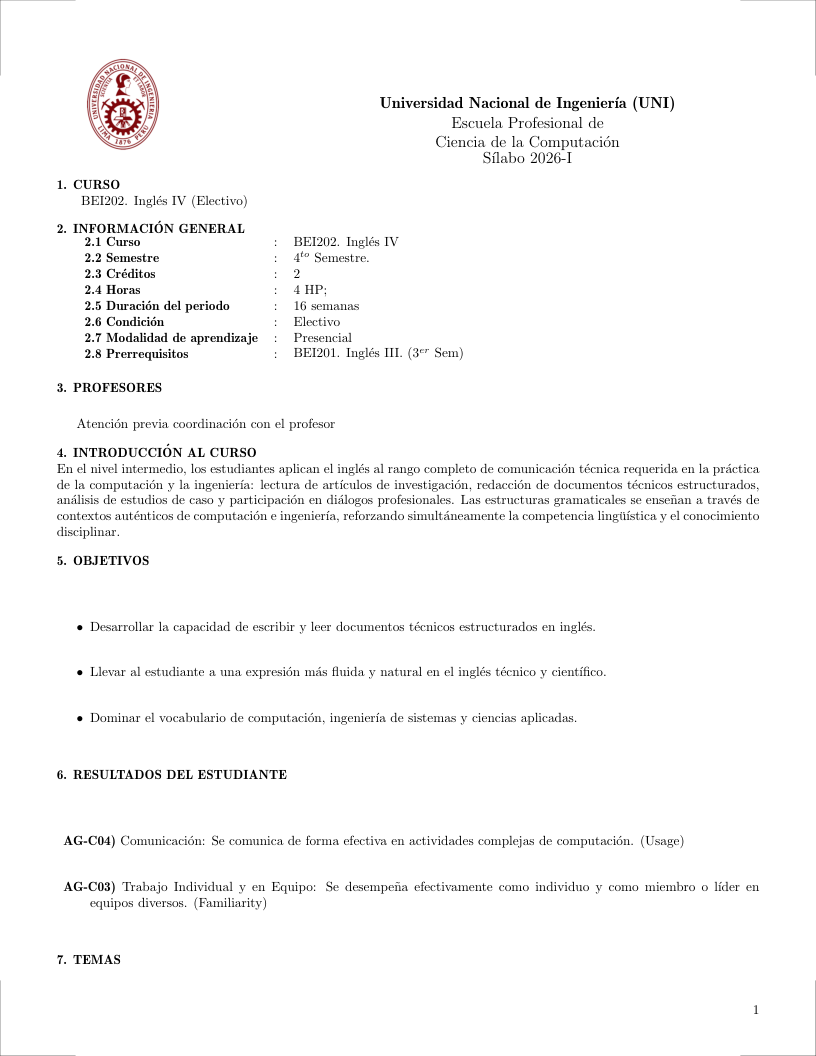
 Español (Latinoamérica)
 English
 - Prerrequisites:
- BEI201 Technical and professional English III (3rd Sem)
5.24.1. Justification ↑ Back to top
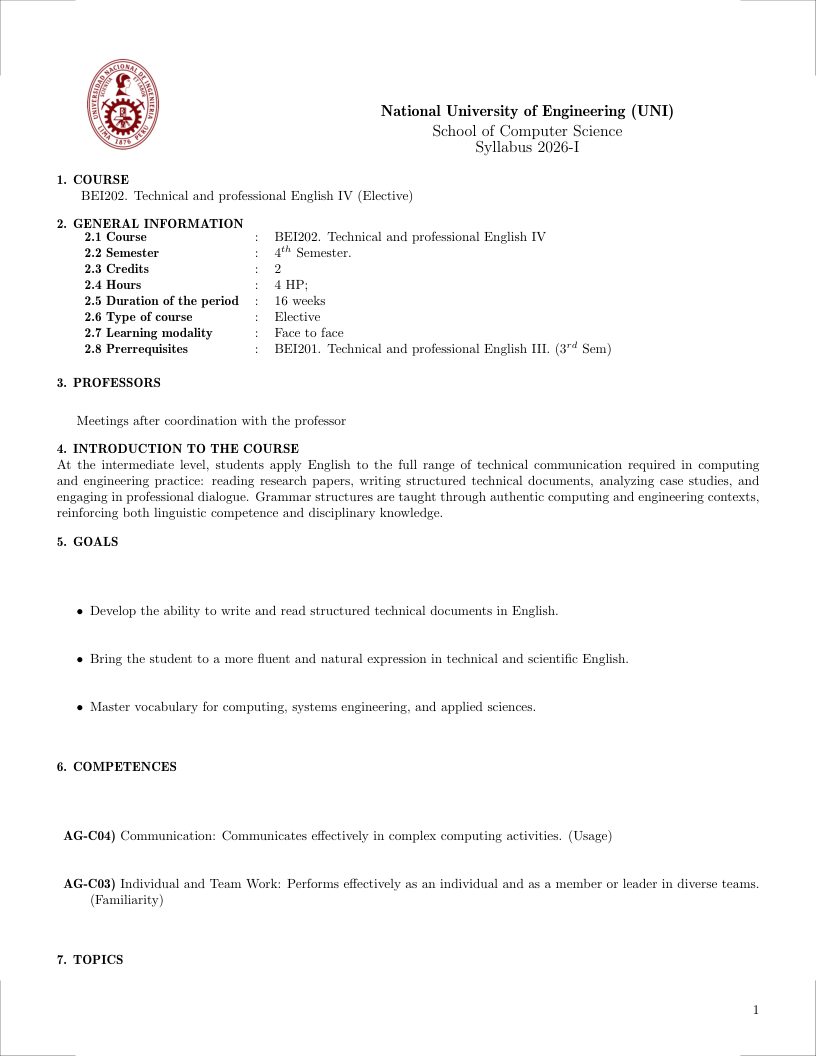
At the intermediate level, students apply English to the full range of technical communication required in computing and engineering practice: reading research papers, writing structured technical documents, analyzing case studies, and engaging in professional dialogue. Grammar structures are taught through authentic computing and engineering contexts, reinforcing both linguistic competence and disciplinary knowledge.
5.24.2. Generales Goals ↑ Back to top
- Develop the ability to write and read structured technical documents in English.
- Bring the student to a more fluent and natural expression in technical and scientific English.
- Master vocabulary for computing, systems engineering, and applied sciences.
5.24.3. Contribution to Outcomes ↑ Back to top
- AG-C04) Communication: Communicates effectively in complex computing activities. (Usage)
- AG-C03) Individual and Team Work: Performs effectively as an individual and as a member or leader in diverse teams. (Familiarity)
5.24.4. Content ↑ Back to top
5.24.4.1. Best Practices and Ethics (12 hours) [Skills AG-C03,AG-C04] ↑ Back to top
Bibliography: (Soars and John, 2002b; Cambridge, 2006; MacGrew, 1999)
Topics
- Modals of obligation and advice: Should, Must, Have to in engineering codes.
- Prohibition and absence of obligation in software licensing and data privacy.
- Vocabulary: Professional ethics, intellectual property, responsible AI.
- Writing: Formal technical recommendation and policy documents.
Learning Outcomes
- By the end of the unit, students correctly use modal auxiliaries to express engineering standards, ethical obligations, and professional recommendations in formal technical environments.
5.24.4.2. Failures and Root Causes (12 hours) [Skills AG-C03,AG-C04] ↑ Back to top
Bibliography: (Soars and John, 2002b; Cambridge, 2006; MacGrew, 1999)
Topics
- Past Perfect: Structure and use in root cause analysis and post-mortems.
- Contrast between Simple Past, Continuous, and Perfect in failure timelines.
- Vocabulary: System outages, security breaches, cascading failures.
- Expressions for reporting information: reported speech in incident briefings.
Learning Outcomes
- Students reconstruct complex failure timelines and root cause analyses by establishing clear chronological sequences through the use of past tense contrasts.
5.24.4.3. If-Then Logic (12 hours) [Skills AG-C03,AG-C04] ↑ Back to top
Bibliography: (Soars and John, 2002b; Cambridge, 2006; MacGrew, 1999)
Topics
- Conditionals Type 0, 1, and 2 applied to computing logic and engineering decisions.
- Sentences with "If" and "Unless" for system constraints and requirements.
- Vocabulary: Hypothetical scenarios, risk analysis, and optimization trade-offs.
- Expressions of what-if design thinking: "If we used X, the system would..."
Learning Outcomes
- Students pose real and hypothetical technical scenarios and their consequences, using conditional structures to reason about design choices and engineering decisions.
5.24.4.4. Ongoing Research (12 hours) [Skills AG-C03,AG-C04] ↑ Back to top
Bibliography: (Soars and John, 2002b; Cambridge, 2006; MacGrew, 1999)
Topics
- Present Perfect Continuous for describing research in progress.
- Contrast between Simple and Continuous Present Perfect in scientific writing.
- Vocabulary: Continuous integration, agile development, iterative research.
- Word formation: Prefixes and suffixes in scientific and technical terminology.
Learning Outcomes
- Students describe research activities and development processes that began in the past and continue into the present, emphasizing duration and iterative progress.
5.24.4.5. Manufacturing and Deployment (12 hours) [Skills AG-C03,AG-C04] ↑ Back to top
Bibliography: (Soars and John, 2002b; Cambridge, 2006; MacGrew, 1999)
Topics
- Passive Voice in all basic tenses for technical process descriptions.
- Verbs with two objects in passive: data is sent to the server by the client.
- Vocabulary: Hardware manufacturing, cloud deployment, CI/CD pipelines.
- Writing: Technical description of a deployment or production process.
Learning Outcomes
- Students use the passive voice across multiple tenses to describe technical processes where the action, system, or result is the focus rather than the agent.
5.24.4.6. Tech Roadmaps (12 hours) [Skills AG-C03,AG-C04] ↑ Back to top
Bibliography: (Soars and John, 2002b; Cambridge, 2006; MacGrew, 1999)
Topics
- Future Continuous and Future Perfect for project timelines and milestones.
- Adverbs of probability: perhaps, probably, definitely — in tech forecasting.
- Vocabulary: Product roadmaps, release planning, emerging research areas.
- Oral presentations: "The state of AI / quantum computing in 5 years".
Learning Outcomes
- Students project technical states, completed future milestones, and research outcomes, discussing computing and engineering roadmaps with advanced vocabulary.
5.24.4.7. Technical Teams (12 hours) [Skills AG-C03,AG-C04] ↑ Back to top
Bibliography: (Soars and John, 2002b; Cambridge, 2006; MacGrew, 1999)
Topics
- Indirect questions and Tag questions in technical interviews and peer reviews.
- Common Phrasal Verbs in engineering and research environments.
- Vocabulary: Collaboration tools, code review practices, team roles.
- Writing: Short technical blog posts and engineering team updates.
Learning Outcomes
- Students use polite inquiry forms and confirmation strategies in technical interviews and team discussions, improving their fluency and naturalness in professional engineering contexts.
5.24.4.8. Technical English IV: Networks and Security (12 hours) [Skills AG-C03,AG-C04] ↑ Back to top
Bibliography: (Soars and John, 2002b; Cambridge, 2006; MacGrew, 1999)
Topics
- Networking terminology: protocols, topologies, OSI model, routing.
- Cybersecurity vocabulary: vulnerabilities, threats, encryption, authentication.
- Reading and writing network incident and security audit reports.
- Project: Security assessment plan for a computing infrastructure.
Learning Outcomes
- By the end of the course, students command networking and cybersecurity technical terminology to read specialized documentation and communicate effectively with IT and security professionals in English.
5.24.5. Bibliography ↑ Back to top
Soars, L. and John (2002b). American Headway N 2 Student Book. Editorial Oxford.
Cambridge (2006). Diccionario Inglés-Espanol Cambridge. Editorial Oxford.
MacGrew, J. (1999). Focus on Grammar Basic. Editorial Oxford.