- ES Español (Latinoamérica)

- EN English

5.39. User Experience (UX) (Mandatory)
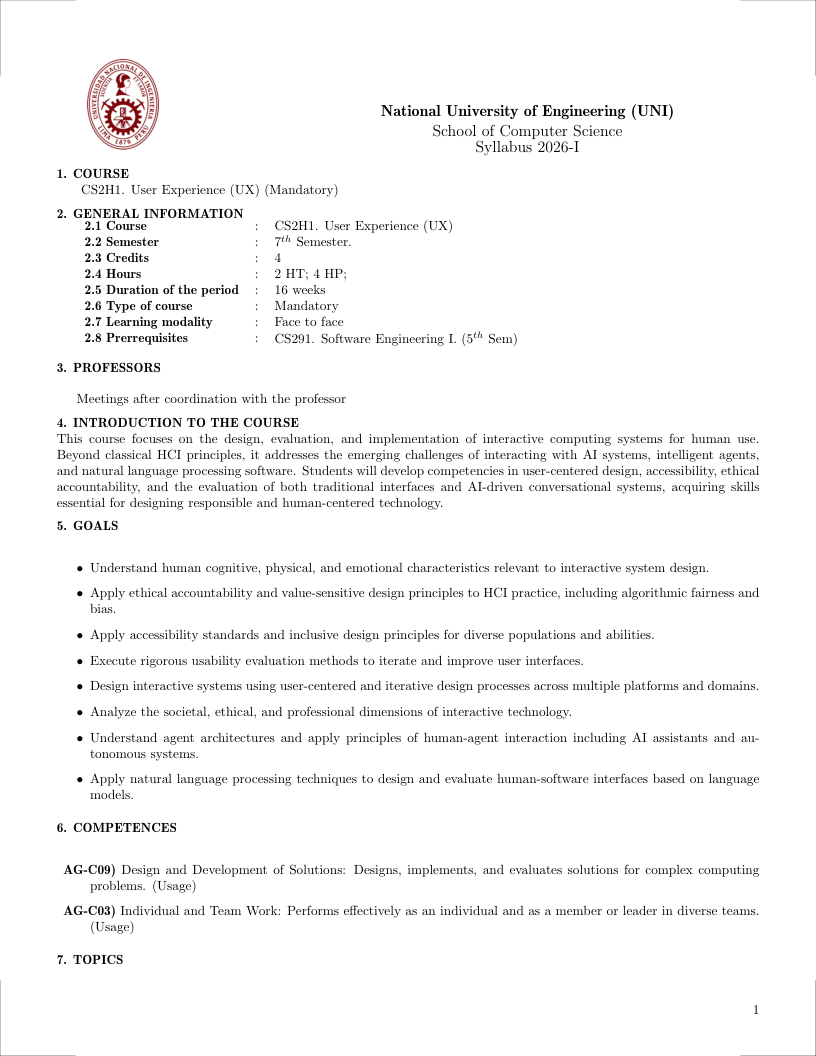
- Semester: 7th Sem. Credits: 4
- Hour of this course: Theory: 2 hours; Laboratory: 4 hours;
- Syllabus:
- htmlonly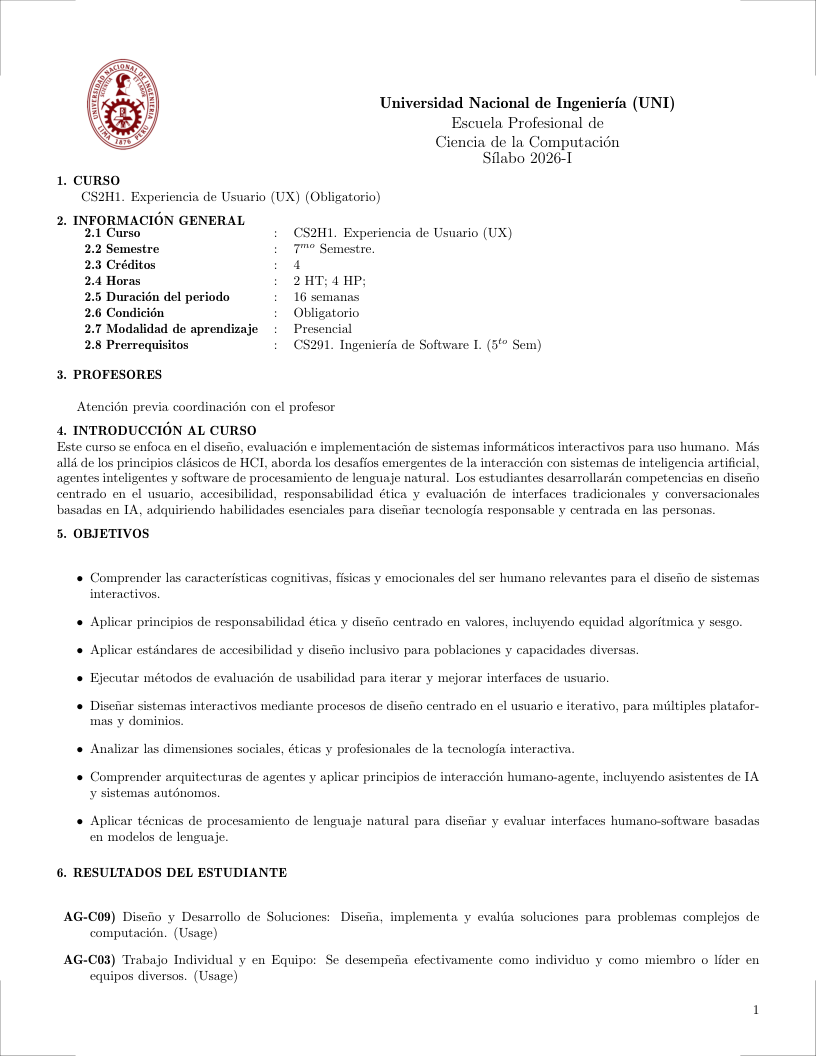
 Español (Latinoamérica)
 English
 - Prerrequisites:
- CS291 Software Engineering I (5th Sem)
5.39.1. Justification ↑ Back to top
This course focuses on the design, evaluation, and implementation of interactive computing systems for human use. Beyond classical HCI principles, it addresses the emerging challenges of interacting with AI systems, intelligent agents, and natural language processing software. Students will develop competencies in user-centered design, accessibility, ethical accountability, and the evaluation of both traditional interfaces and AI-driven conversational systems, acquiring skills essential for designing responsible and human-centered technology.
5.39.2. Generales Goals ↑ Back to top
- Understand human cognitive, physical, and emotional characteristics relevant to interactive system design.
- Apply ethical accountability and value-sensitive design principles to HCI practice, including algorithmic fairness and bias.
- Apply accessibility standards and inclusive design principles for diverse populations and abilities.
- Execute rigorous usability evaluation methods to iterate and improve user interfaces.
- Design interactive systems using user-centered and iterative design processes across multiple platforms and domains.
- Analyze the societal, ethical, and professional dimensions of interactive technology.
- Understand agent architectures and apply principles of human-agent interaction including AI assistants and autonomous systems.
- Apply natural language processing techniques to design and evaluate human-software interfaces based on language models.
5.39.3. Contribution to Outcomes ↑ Back to top
- AG-C09) Design and Development of Solutions: Designs, implements, and evaluates solutions for complex computing problems. (Usage)
- AG-C03) Individual and Team Work: Performs effectively as an individual and as a member or leader in diverse teams. (Usage)
5.39.4. Content ↑ Back to top
5.39.4.1. Understanding the User: Individual goals and interactions with others (8 hours) [Skills AG-C03,AG-C09] ↑ Back to top
Bibliography: (Norman, 2013; Johnson, 2020)
Topics
- Human capabilities and limitations: perception, cognition, motor skills
- User characteristics: demographics, expertise, cultural background
- User goals, tasks, and contexts of use
- Social and organizational aspects of interaction
- Cognitive models and theories relevant to HCI
- Emotional and affective aspects of interaction
- User research methods: interviews, surveys, observations
Learning Outcomes
- Describe human capabilities and limitations that affect interaction design [Describe]
- Analyze how user characteristics influence interaction with computing systems [Analyze]
- Identify user goals and tasks in specific contexts of use [Analyze]
- Explain social and organizational factors that impact technology adoption and use [Explain]
- Apply cognitive models to predict and explain user behavior [Apply]
- Consider emotional and affective factors in interaction design [Analyze]
- Conduct user research using appropriate methods such as interviews or observations [Evaluate]
5.39.4.2. Accountability and Responsibility in Design (8 hours) [Skills AG-C03,AG-C09] ↑ Back to top
Bibliography: (Shneiderman, 2022; Norman, 2013)
Topics
- Ethical considerations in HCI: fairness, transparency, accountability
- Design for values and value-sensitive design
- Responsible innovation and design ethics
- Algorithmic accountability and bias in interactive systems
- Professional responsibility in HCI practice
- Legal and regulatory considerations for interactive systems
Learning Outcomes
- Identify ethical issues in HCI design and implementation [Analyze]
- Apply value-sensitive design approaches to technology development [Apply]
- Discuss responsible innovation practices in HCI [Debate]
- Analyze algorithmic accountability and bias in interactive systems [Analyze]
- Describe professional responsibilities in HCI practice [Describe]
- Explain legal and regulatory considerations relevant to interactive systems [Explain]
5.39.4.3. Accessibility and Inclusive Design (8 hours) [Skills AG-C03,AG-C09] ↑ Back to top
Bibliography: (Johnson, 2020)
Topics
- Accessibility principles and guidelines
- Disabilities and assistive technologies
- Inclusive design and universal design principles
- Evaluation methods for accessibility
- Designing for diverse abilities and contexts
- Accessibility standards and compliance
Learning Outcomes
- Apply accessibility principles to interactive system design [Apply]
- Describe how different disabilities affect interaction with technology [Describe]
- Design inclusive systems using universal design principles [Design]
- Conduct accessibility evaluations of interactive systems [Evaluate]
- Create designs that accommodate diverse abilities and usage contexts [Create]
- Ensure compliance with accessibility standards and regulations [Evaluate]
5.39.4.4. Evaluating the Design (8 hours) [Skills AG-C03,AG-C09] ↑ Back to top
Bibliography: (Norman, 2013; Johnson, 2020)
Topics
- Usability principles and heuristics
- Evaluation methods: heuristic evaluation, cognitive walkthrough
- User testing: planning, conducting, analyzing
- Advanced evaluation methods: controlled experiments, field studies
- UX metrics and measurement
- Analytical evaluation methods: modeling and simulation
Learning Outcomes
- Apply usability principles and heuristics to evaluate designs [Apply]
- Conduct heuristic evaluations and cognitive walkthroughs [Evaluate]
- Plan, conduct, and analyze user testing sessions [Plan]
- Design and conduct controlled experiments for HCI research [Design]
- Measure user experience using appropriate metrics [Evaluate]
- Use analytical methods to model and predict user performance [Use]
5.39.4.5. System Design (8 hours) [Skills AG-C03,AG-C09] ↑ Back to top
Bibliography: (Johnson, 2020; Norman, 2013)
Topics
- Design process: user-centered design, iterative design
- Interaction design: concepts, principles, patterns
- Prototyping techniques: low-fidelity, high-fidelity, interactive
- Information architecture and navigation design
- Advanced interaction techniques: gesture, voice, multimodal
- Design for specific domains: mobile, web, ubiquitous computing
- Collaborative and social computing systems
Learning Outcomes
- Apply user-centered design processes to develop interactive systems [Apply]
- Design interactions using established principles and patterns [Design]
- Create prototypes at different fidelity levels for design exploration [Create]
- Structure information and navigation for effective user interaction [Structure]
- Implement advanced interaction techniques such as gesture or voice interfaces [Implement]
- Design interactive systems for specific domains and platforms [Design]
- Design collaborative systems that support group interaction [Design]
5.39.4.6. Society, Ethics, and the Profession (8 hours) [Skills AG-C03,AG-C09] ↑ Back to top
Bibliography: (Shneiderman, 2022; Norman, 2013)
Topics
- Social impact of interactive technologies
- Ethical issues in HCI research and practice
- Professional practice in HCI
- Cultural and cross-cultural considerations in HCI
- Sustainability and HCI
- Future trends and challenges in HCI
Learning Outcomes
- Analyze the social impact of interactive technologies on individuals and society [Analyze]
- Address ethical issues in HCI research and design projects [Evaluate]
- Describe professional practices and career paths in HCI [Describe]
- Design systems that account for cultural differences and contexts [Design]
- Incorporate sustainability considerations into HCI design [Integrate]
- Discuss emerging trends and future challenges in HCI [Debate]
5.39.4.7. Agents and Cognitive Systems (8 hours) [Skills AG-C03,AG-C09] ↑ Back to top
Bibliography: (Russell and Norvig, 2021; Shneiderman, 2022)
Topics
- Agent architectures (e.g., reactive, layered, cognitive)
- Agent theory (including mathematical formalisms)
- Rationality, Game Theory:
- Decision-theoretic agents
- Markov decision processes (MDP)
- Bandit algorithms
- Software agents, personal assistants, and information access:
- Collaborative agents
- Information-gathering agents
- Believable agents (synthetic characters, modeling emotions in agents)
- Learning agents
- Cognitive systems:
- Cognitive architectures (e.g., ACT-R, SOAR, ICARUS, FORR)
- Capabilities (e.g., perception, decision making, prediction, knowledge maintenance)
- Knowledge representation, organization, utilization, acquisition, and refinement
- Applications and evaluation of cognitive systems
- Multi-agent systems:
- Collaborating agents
- Agent teams
- Competitive agents (e.g., auctions, voting)
- Swarm systems and biologically inspired models
- Multi-agent learning
- Human-agent interaction:
- Communication methodologies (verbal and non-verbal)
- Practical issues
- Applications:
- Trading agents, supply chain management
- Ethical issues of AI interactions with humans
- Regulation and legal requirements of AI systems for interacting with humans
Learning Outcomes
- Characterize and contrast the standard agent architectures [Evaluate]
- Describe the applications of agent theory to domains such as software agents, personal assistants, and believable agents, and discuss associated ethical implications [Describe]
- Describe the primary paradigms used by learning agents [Describe]
- Demonstrate using appropriate examples how multi-agent systems support agent interaction [Demonstrate]
- Construct an intelligent agent using a well-established cognitive architecture (ACT-R, SOAR) for solving a specific problem [Apply]
5.39.4.8. Natural Language Processing (8 hours) [Skills AG-C03,AG-C09] ↑ Back to top
Bibliography: (Jurafsky and Martin, 2024; Russell and Norvig, 2021)
Topics
- Deterministic and stochastic grammars
- Parsing algorithms:
- CFGs and chart parsers (e.g., CYK)
- Probabilistic CFGs and weighted CYK
- Representing meaning/Semantics:
- Logic-based knowledge representations
- Semantic roles
- Temporal representations
- Beliefs, desires, and intentions
- Corpus-based methods
- N-grams and HMMs
- Smoothing and backoff
- Examples of use: POS tagging and morphology
- Information retrieval:
- Vector space model:
- TF & IDF
- Precision and recall
- Vector space model:
- Information extraction
- Language translation
- Text classification, categorization:
- Bag of words model
- Deep learning for NLP:
- RNNs
- Transformers
- Multi-modal embeddings (e.g., images + text)
- Generative language models
Learning Outcomes
- Define and contrast deterministic and stochastic grammars, providing examples to show the adequacy of each [Define]
- Simulate, apply, or implement classic and stochastic algorithms for parsing natural language [Apply]
- Identify the challenges of representing meaning [Analyze]
- List the advantages of using standard corpora. Identify examples of current corpora for a variety of NLP tasks [List]
- Identify techniques for information retrieval, language translation, and text classification [Analyze]
- Implement a TF/IDF transform, use it to extract features from a corpus, and train an off-the-shelf machine learning algorithm using those features to do text classification [Apply]
5.39.5. Bibliography ↑ Back to top
Norman, D. (2013). The Design of Everyday Things: Revised and Expanded Edition. Basic Books, 2nd edition.
Johnson, J. (2020). Designing with the Mind in Mind: Simple Guide to Understanding User Interface Design Guidelines. Morgan Kaufmann, 3rd edition.
Shneiderman, B. (2022). Human-Centered AI. Oxford University Press, 1st edition.
Russell, S. and Norvig, P. (2021). Artificial Intelligence: A Modern Approach. Pearson, 4th edition.
Jurafsky, D. and Martin, J. H. (2024). Speech and Language Processing. Prentice Hall, 3rd edition.