- ES Español (Latinoamérica)

- EN English

7.33. Materials Technology (Mandatory)
- Semester: 7th Sem. Credits: 4
- Hour of this course: Theory: 3 hours; Laboratory: 2 hours;
- Syllabus:
- htmlonly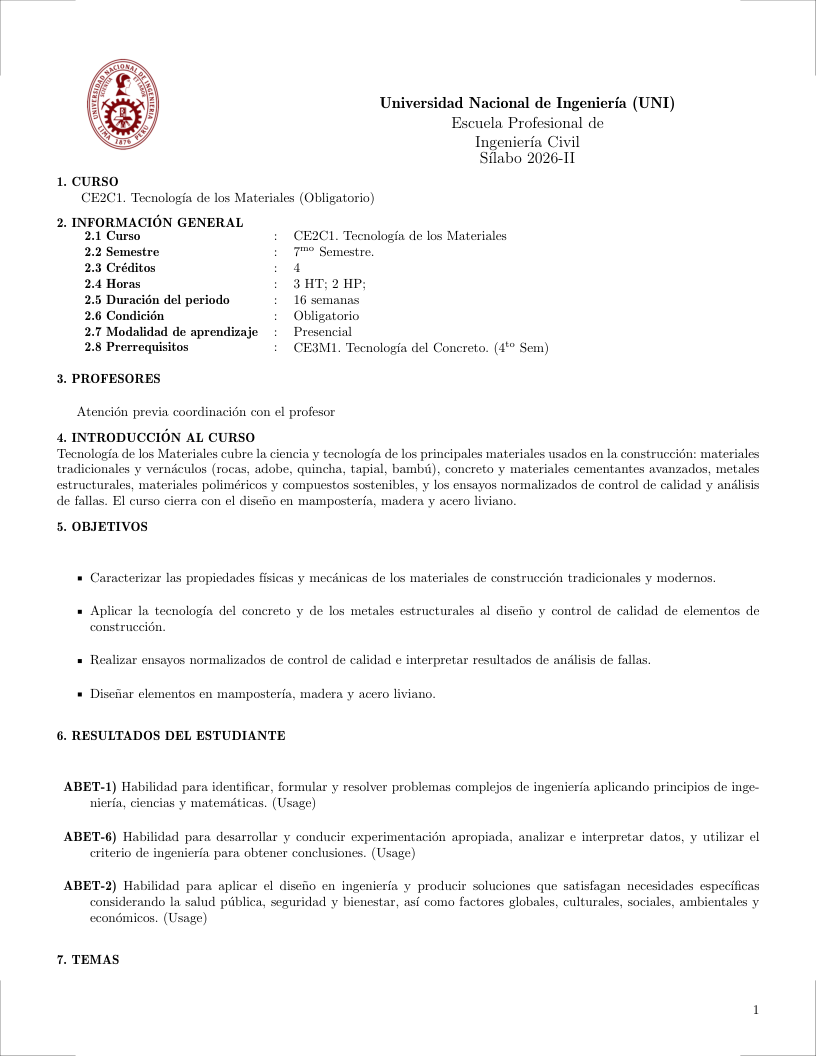
 Español (Latinoamérica)
 English
 - Prerrequisites:
- CE3M1 Concrete Technology (4th Sem)
7.33.1. Justification ↑ Back to top
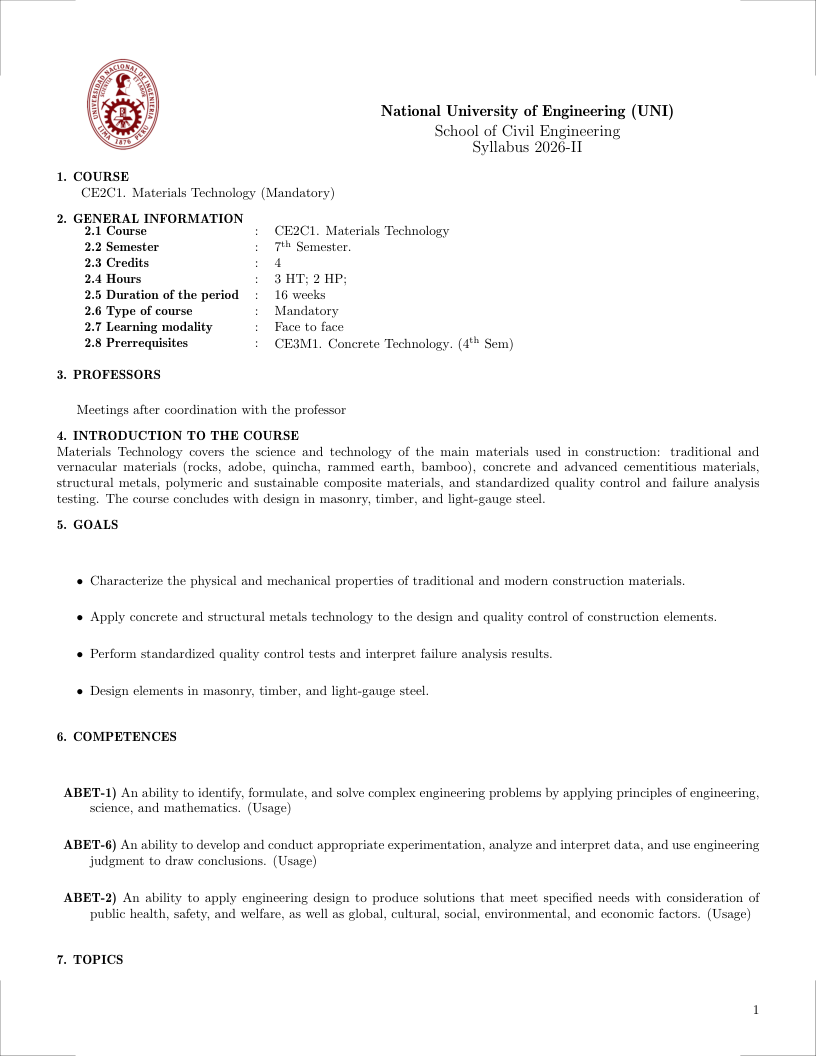
Materials Technology covers the science and technology of the main materials used in construction: traditional and vernacular materials (rocks, adobe, quincha, rammed earth, bamboo), concrete and advanced cementitious materials, structural metals, polymeric and sustainable composite materials, and standardized quality control and failure analysis testing. The course concludes with design in masonry, timber, and light-gauge steel.
7.33.2. Generales Goals ↑ Back to top
- Characterize the physical and mechanical properties of traditional and modern construction materials.
- Apply concrete and structural metals technology to the design and quality control of construction elements.
- Perform standardized quality control tests and interpret failure analysis results.
- Design elements in masonry, timber, and light-gauge steel.
7.33.3. Contribution to Outcomes ↑ Back to top
- ABET-1) An ability to identify, formulate, and solve complex engineering problems by applying principles of engineering, science, and mathematics. (Usage)
- ABET-6) An ability to develop and conduct appropriate experimentation, analyze and interpret data, and use engineering judgment to draw conclusions. (Usage)
- ABET-2) An ability to apply engineering design to produce solutions that meet specified needs with consideration of public health, safety, and welfare, as well as global, cultural, social, environmental, and economic factors. (Usage)
7.33.4. Content ↑ Back to top
7.33.4.1. Construction Materials Science (10 hours) [Skills ABET-1] ↑ Back to top
Bibliography: (Neville, 2011)
Topics
- Physical and mechanical properties of construction materials including density, porosity, strength, and elasticity
- Microstructure and phase composition of construction materials
- Durability mechanisms including weathering, chemical attack, and environmental degradation
- Thermal and moisture properties of construction materials
- Crystalline and amorphous structures in construction materials
- Material selection criteria based on performance requirements
- Degradation mechanisms and service life prediction
Learning Outcomes
- Describe the fundamental physical and mechanical properties of major construction materials [Familiarity]
- Analyze the relationship between microstructure and macroscopic properties of materials [Assessment]
- Evaluate the durability performance of materials under specific environmental conditions [Usage]
- Explain the effects of thermal and moisture variations on material behavior [Familiarity]
- Select appropriate construction materials based on design specifications and performance criteria [Assessment]
- Predict service life and degradation patterns of materials in various environments [Usage]
7.33.4.2. Traditional and Vernacular Construction Materials (18 hours) [Skills ABET-1] ↑ Back to top
Bibliography: (Blondet et al., 2003)
Topics
- Construction stone: classification and properties
- Adobe as a construction material: fabrication and properties
- Quincha as a construction system: materials and technique
- Tapial (rammed earth) as a construction material: fabrication and properties
- Bamboo as a construction material: properties and structural applications
- Quality control testing for vernacular construction materials
Learning Outcomes
- Classify construction stone by its properties and applications [Familiarity]
- Characterize the physical and mechanical properties of adobe, quincha, and tapial [Usage]
- Evaluate the suitability of bamboo as a structural material in construction [Assessment]
- Perform quality control tests on vernacular construction materials [Usage]
- Recommend the use of an appropriate vernacular material based on a project's conditions [Assessment]
7.33.4.3. Concrete Technology and Advanced Cementitious Materials (14 hours) [Skills ABET-1] ↑ Back to top
Bibliography: (Neville, 2011)
Topics
- Portland cement chemistry and hydration process
- Aggregates properties and grading requirements
- Mix design methodology for normal strength concrete
- Fresh concrete properties including workability, slump, and setting time
- Hardened concrete properties including strength, modulus, and shrinkage
- Chemical and mineral admixtures for concrete
- High-performance and high-strength concrete design
- Self-consolidating concrete and fiber-reinforced concrete
- Durability aspects including alkali-silica reaction, sulfate attack, and freeze-thaw
- Sustainable and low-carbon concrete technologies including supplementary cementitious materials such as fly ash, slag, and silica fume
Learning Outcomes
- Describe the chemistry of portland cement and the hydration process [Familiarity]
- Evaluate aggregate quality and suitability for concrete production [Assessment]
- Design concrete mixes for specified strength and workability requirements [Usage]
- Test and interpret fresh concrete properties using standard procedures [Assessment]
- Predict hardened concrete properties based on mix proportions and curing conditions [Usage]
- Explain the function and effects of various concrete admixtures [Familiarity]
- Formulate high-performance concrete mixes for demanding applications [Usage]
- Select appropriate special concretes for specific construction scenarios [Assessment]
- Incorporate supplementary cementitious materials to optimize concrete performance [Usage]
- Analyze durability risks and specify protective measures for concrete structures [Assessment]
- Compare environmental impacts and carbon footprints of different concrete formulations [Familiarity]
7.33.4.4. Structural Metals, Alloys, and Corrosion Engineering (5 hours) [Skills ABET-1] ↑ Back to top
Bibliography: (Callister and Rethwisch, 2020)
Topics
- Steel composition, classification, and grade designations
- Mechanical properties of structural steel including yield strength and ductility
- Heat treatment processes and their effects on steel properties
- Weldability and connection behavior of structural metals
- Corrosion mechanisms in metallic structures
- High-strength and weathering steel applications
- Aluminum alloys and their structural applications
- Fatigue behavior and fracture toughness of metals
- Corrosion protection methods including coatings and cathodic protection
- Material selection for corrosive and high-temperature environments
Learning Outcomes
- Identify different steel grades and their appropriate structural applications [Familiarity]
- Interpret stress-strain curves and determine mechanical properties of metals [Assessment]
- Explain how heat treatment affects the microstructure and properties of steel [Familiarity]
- Evaluate weldability of metals and specify appropriate welding procedures [Usage]
- Describe the electrochemical basis of metallic corrosion [Familiarity]
- Select high-strength or weathering steel for specific structural requirements [Usage]
- Compare aluminum alloys with steel for lightweight structural applications [Assessment]
- Analyze fatigue loading scenarios and predict service life of metal components [Assessment]
- Design corrosion protection systems for metallic structures in aggressive environments [Usage]
- Specify appropriate materials for structures exposed to extreme conditions [Assessment]
7.33.4.5. Polymeric, Composite, and Sustainable Construction Materials (4 hours) [Skills ABET-1] ↑ Back to top
Bibliography: (Callister and Rethwisch, 2020)
Topics
- Polymer chemistry and classification of construction polymers
- Mechanical and thermal behavior of polymeric materials
- Fiber-reinforced polymer composites and their structural applications
- Adhesives, sealants, and waterproofing materials
- Composite material mechanics and laminate theory
- FRP strengthening and rehabilitation of concrete and masonry structures
- Bio-based and recycled materials for sustainable construction
- Geopolymers and alternative binder systems
- Environmental degradation and long-term performance of polymers and composites
Learning Outcomes
- Classify polymers used in construction and describe their basic properties [Familiarity]
- Characterize the mechanical and thermal behavior of polymeric materials [Assessment]
- Apply fiber-reinforced polymers in structural design and retrofitting applications [Usage]
- Select appropriate adhesives and sealants for specific construction applications [Familiarity]
- Analyze composite laminates using classical lamination theory [Usage]
- Design FRP strengthening systems for existing concrete or masonry structures [Assessment]
- Evaluate the sustainability and life-cycle performance of bio-based construction materials [Assessment]
- Compare geopolymer binders with traditional portland cement systems [Familiarity]
- Predict long-term degradation of polymers and composites under environmental exposure [Usage]
7.33.4.6. Standardized Testing, Quality Control, and Failure Analysis (5 hours) [Skills ABET-6] ↑ Back to top
Bibliography: (Neville, 2011)
Topics
- Standard test methods for material characterization and acceptance testing
- Sampling procedures and representative sample selection
- Quality control and quality assurance protocols in construction
- Statistical analysis of test data and acceptance criteria
- Non-destructive testing methods for materials and structures
- Advanced material characterization techniques including microscopy and spectroscopy
- Failure analysis methodology and root cause investigation
- Forensic engineering and distress evaluation
- Performance-based testing and specification approaches
- Certification, compliance, and third-party testing requirements
Learning Outcomes
- Perform standard material tests according to ASTM or equivalent specifications [Usage]
- Develop appropriate sampling plans for construction material acceptance [Assessment]
- Implement quality control procedures for construction materials and processes [Usage]
- Analyze test data using statistical methods and establish acceptance criteria [Assessment]
- Apply non-destructive testing techniques for in-situ material evaluation [Familiarity]
- Utilize advanced characterization techniques to investigate material microstructure [Usage]
- Conduct systematic failure analysis to determine root causes of material distress [Assessment]
- Investigate structural failures using forensic engineering methodologies [Assessment]
- Design performance-based test protocols for innovative materials [Usage]
- Interpret certification requirements and coordinate third-party testing programs [Familiarity]
7.33.4.7. Masonry Structural Design (4 hours) [Skills ABET-2] ↑ Back to top
Bibliography: (Drysdale and Hamid, 2008)
Topics
- Masonry materials, units, and mortar properties
- Unreinforced masonry wall design for compression and flexure
- Reinforced masonry design and detailing
- Seismic design of masonry and timber structures
Learning Outcomes
- Identify masonry unit types and specify appropriate mortar for applications [Familiarity]
- Design unreinforced masonry walls for gravity and lateral loads [Assessment]
- Proportion reinforced masonry elements and specify reinforcement details [Usage]
- Implement seismic design provisions for masonry and timber buildings [Usage]
7.33.4.8. Timber and Light-Gauge Steel Framing Design (6 hours) [Skills ABET-2] ↑ Back to top
Bibliography: (Drysdale and Hamid, 2008)
Topics
- Timber properties, grading, and design values
- Sawn lumber and glued-laminated timber design
- Timber connections including nails, bolts, and metal connectors
- Cold-formed steel members and sectional properties
- Light-gauge steel framing systems and design
- Engineered wood products including I-joists and structural composite lumber
Learning Outcomes
- Select timber species and grades based on structural requirements [Familiarity]
- Design timber beams, columns, and combined loading members [Assessment]
- Specify timber connections and calculate their capacity [Usage]
- Calculate effective section properties for cold-formed steel members [Assessment]
- Design light-gauge steel wall studs and floor joists [Usage]
- Apply engineered wood products in floor and roof systems [Assessment]
7.33.5. Bibliography ↑ Back to top
Neville, A. M. (2011). Properties of Concrete. Pearson, 5th edition.
Blondet, M., Garcia, G. V., and Brzev, S. (2003). Earthquake-resistant construction of adobe buildings: A tutorial. Technical report, EERI/IAEE World Housing Encyclopedia.
Callister, W. D. and Rethwisch, D. G. (2020). Materials Science and Engineering: An Introduction. Wiley, 10th edition.
Drysdale, R. G. and Hamid, A. A. (2008). Masonry Structures: Behavior and Design. Masonry Society, 3rd edition.