- ES Español (Latinoamérica)

- EN English

7.72. Irrigation Engineering (Mandatory)
- Semester: 10th Sem. Credits: 4
- Hour of this course: Theory: 2 hours; Practice: 4 hours;
- Syllabus:
- htmlonly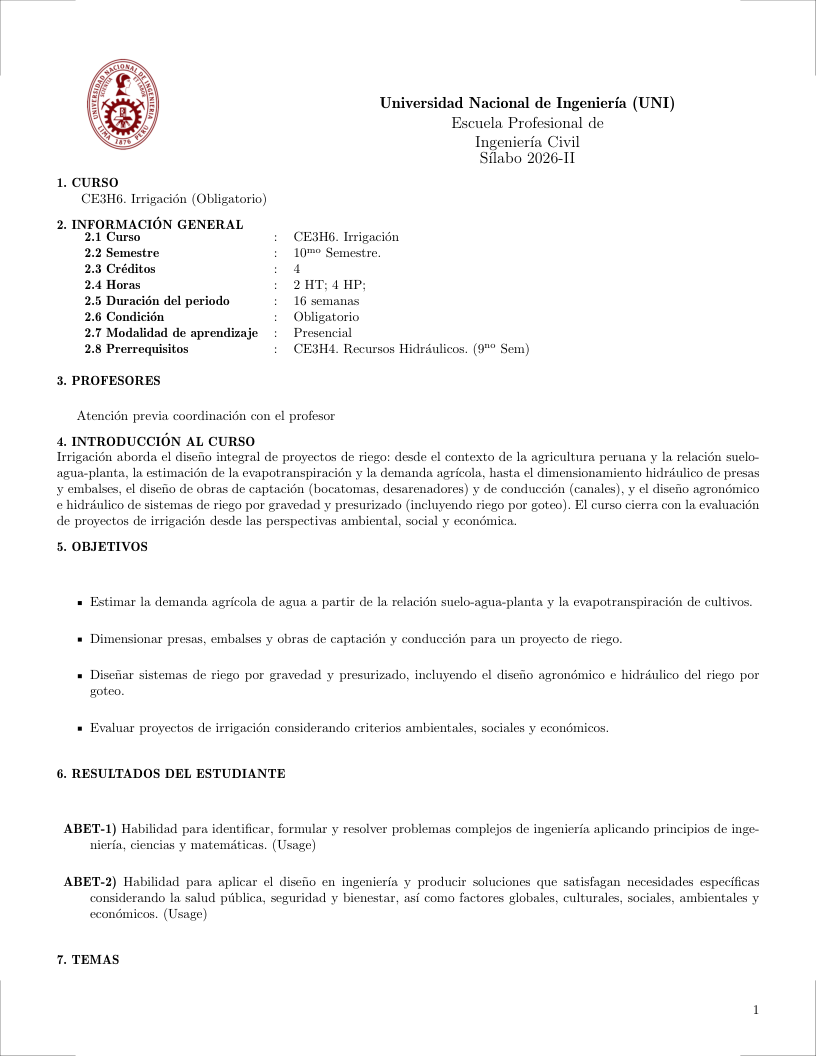
 Español (Latinoamérica)
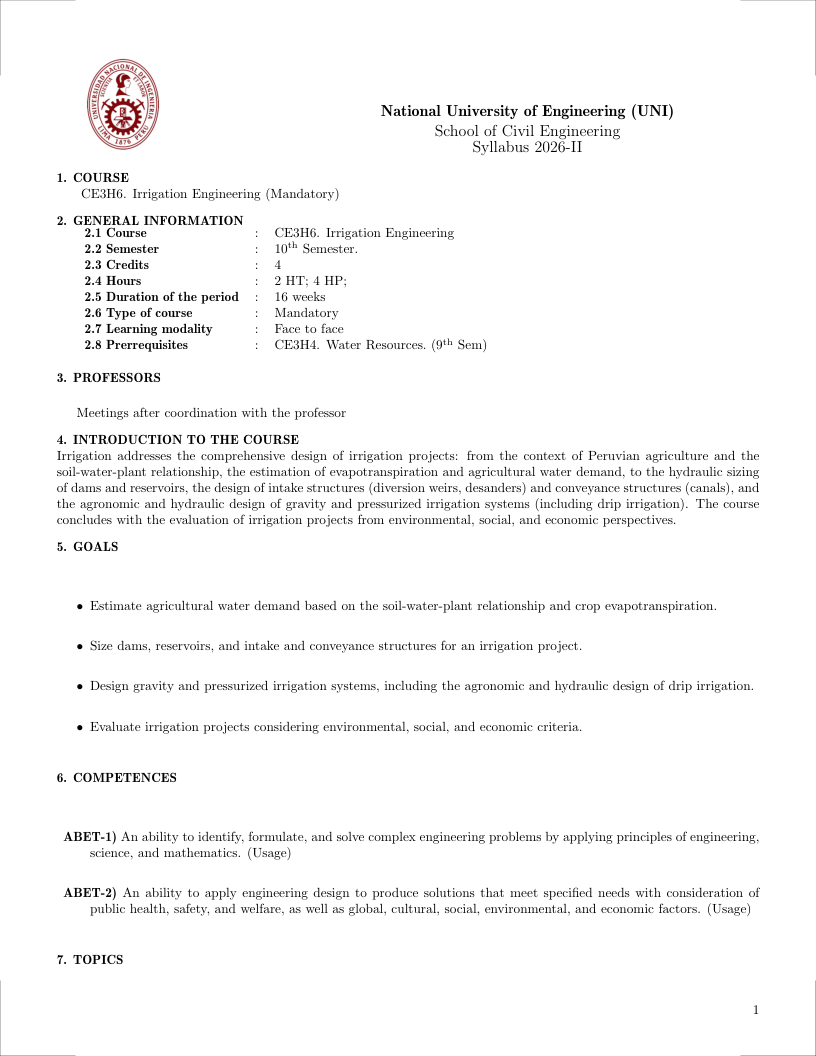 English
 - Prerrequisites:
- CE3H4 Water Resources (9th Sem)
7.72.1. Justification ↑ Back to top
Irrigation addresses the comprehensive design of irrigation projects: from the context of Peruvian agriculture and the soil-water-plant relationship, the estimation of evapotranspiration and agricultural water demand, to the hydraulic sizing of dams and reservoirs, the design of intake structures (diversion weirs, desanders) and conveyance structures (canals), and the agronomic and hydraulic design of gravity and pressurized irrigation systems (including drip irrigation). The course concludes with the evaluation of irrigation projects from environmental, social, and economic perspectives.
7.72.2. Generales Goals ↑ Back to top
- Estimate agricultural water demand based on the soil-water-plant relationship and crop evapotranspiration.
- Size dams, reservoirs, and intake and conveyance structures for an irrigation project.
- Design gravity and pressurized irrigation systems, including the agronomic and hydraulic design of drip irrigation.
- Evaluate irrigation projects considering environmental, social, and economic criteria.
7.72.3. Contribution to Outcomes ↑ Back to top
- ABET-1) An ability to identify, formulate, and solve complex engineering problems by applying principles of engineering, science, and mathematics. (Usage)
- ABET-2) An ability to apply engineering design to produce solutions that meet specified needs with consideration of public health, safety, and welfare, as well as global, cultural, social, environmental, and economic factors. (Usage)
7.72.4. Content ↑ Back to top
7.72.4.1. Agriculture in Peru and Description of an Irrigation Project (6 hours) [Skills ABET-1] ↑ Back to top
Bibliography: (Chambouleyron, 2005)
Topics
- Context and current status of irrigated agriculture in Peru.
- Components and general description of an irrigation project.
Learning Outcomes
- Describe the context of irrigated agriculture in Peru and its main challenges [Familiarity].
- Identify the main components of an irrigation project [Familiarity].
7.72.4.2. Agricultural Water Demand (12 hours) [Skills ABET-1] ↑ Back to top
Bibliography: (Allen et al., 1998; Chambouleyron, 2005)
Topics
- Soil-water-plant relationships and soil water availability
- Estimation of reference and crop evapotranspiration
- Crop water requirement and crop coefficients
- Water supply-and-demand balance for an irrigation project
- Irrigation scheduling and cropping calendars
- Irrigation efficiency at the field, conveyance, and system level
Learning Outcomes
- Explain the soil-water-plant relationship and its effect on water availability for crops [Familiarity]
- Calculate reference and crop evapotranspiration using standard methods [Usage]
- Estimate a crop's water requirement throughout its growth cycle [Assessment]
- Develop the water supply-and-demand balance for an irrigation project [Usage]
- Design an irrigation schedule accounting for the cropping calendar [Assessment]
- Evaluate the irrigation efficiency of a system and propose improvements [Usage]
7.72.4.3. Design of Hydraulic Structures (12 hours) [Skills ABET-2] ↑ Back to top
Bibliography: (Novak et al., 2007)
Topics
- Dam types and selection criteria
- Spillway hydraulics and design
- Weir and gate flow equations
- Energy dissipation and stilling basin design
- Culvert hydraulics and design
- Dam safety analysis and risk assessment
- Outlet works and control structures
- Fish passage facilities and environmental hydraulics
- Cavitation analysis and prevention
- Physical hydraulic modeling and scale effects
Learning Outcomes
- Classify dam types and select appropriate configurations for site conditions [Familiarity]
- Design spillways for flood discharge capacity [Assessment]
- Calculate discharge over weirs and through gates [Usage]
- Proportion energy dissipation structures and stilling basins [Assessment]
- Analyze culvert hydraulics for inlet and outlet control [Usage]
- Perform dam safety evaluations and hazard classification [Assessment]
- Design outlet works including intake structures and conduits [Usage]
- Incorporate fish passage requirements in hydraulic structure design [Assessment]
- Evaluate cavitation potential and design preventive measures [Usage]
- Interpret physical model results and apply scale corrections [Assessment]
7.72.4.4. Open Channel Flow and River Mechanics (9 hours) [Skills ABET-2] ↑ Back to top
Bibliography: (Chow, 1959)
Topics
- Channel flow classification and hydraulic elements
- Energy and momentum principles in open channels
- Uniform flow and Manning's equation
- Critical flow and specific energy concepts
- Gradually varied flow profiles
- Hydraulic jump and rapidly varied flow
- Channel design for stable conveyance
- Sediment transport in open channels
- River morphology and channel stability
- Scour analysis and protection measures
Learning Outcomes
- Classify open channel flow regimes and calculate hydraulic elements [Familiarity]
- Apply energy and momentum equations to solve channel flow problems [Assessment]
- Calculate normal depth and discharge using Manning's equation [Usage]
- Determine critical depth and analyze specific energy relationships [Assessment]
- Compute gradually varied flow profiles using standard methods [Usage]
- Analyze hydraulic jumps and calculate energy dissipation [Assessment]
- Design stable channels with appropriate cross-sections and linings [Usage]
- Estimate sediment transport rates in alluvial channels [Assessment]
- Evaluate river channel stability and bank erosion potential [Familiarity]
- Predict scour depths at hydraulic structures and design protection [Assessment]
7.72.4.5. Irrigation Systems Design (33 hours) [Skills ABET-2] ↑ Back to top
Bibliography: (Chambouleyron, 2005; Karmeli and Keller, 1975)
Topics
- Types of irrigation intake works
- Headworks design
- Desander design
- Other structures of the irrigation conveyance and distribution system
- Design of gravity irrigation systems
- Design of pressurized (technified) irrigation systems
- Agronomic design of drip irrigation
- Hydraulic design of drip irrigation: laterals, distribution lines, and emitters
Learning Outcomes
- Select the appropriate intake work type for the conditions of an irrigation project [Usage]
- Design a headworks structure and its associated desander [Assessment]
- Design a gravity irrigation system for a given field [Usage]
- Compare pressurized irrigation alternatives against gravity irrigation [Assessment]
- Perform the agronomic design of a drip irrigation system [Usage]
- Hydraulically design the lateral and distribution lines of a drip irrigation system [Assessment]
7.72.4.6. Economic, Financial and Social Evaluation of Water Resources Projects (9 hours) [Skills ABET-1] ↑ Back to top
Bibliography: (Blank and Tarquin, 2017)
Topics
- Economic evaluation indicators: Net Present Value (NPV), Internal Rate of Return (IRR), and Benefit-Cost ratio
- Selecting among project alternatives by comparing economic indicators
- Sensitivity analysis to variations in costs, benefits, and discount rate
- Funding sources and financial structuring of water projects
- User payment capacity and tariff schemes
- Cost allocation among beneficiaries in multipurpose projects
- Social evaluation of projects: exchange theory and shadow prices
- Distributional impacts and equity in project social evaluation
Learning Outcomes
- Calculate NPV, IRR, and Benefit-Cost ratio for a water resources project [Usage]
- Select among project alternatives based on compared economic indicators [Assessment]
- Perform a sensitivity analysis of project profitability to changes in key variables [Usage]
- Evaluate funding sources and tariff schemes based on user payment capacity [Assessment]
- Allocate costs among beneficiaries in a multipurpose project [Usage]
- Apply social evaluation principles to estimate a project's net benefit to society [Assessment]
7.72.4.7. Environmental Impact Assessment and Sustainability Metrics (3 hours) [Skills ABET-2] ↑ Back to top
Bibliography: (Glasson and Therivel, 2019)
Topics
- EIA process: screening, scoping, impact analysis, mitigation, and public participation
- Impact prediction methods for air, water, soil, noise, and ecological systems
- Mitigation hierarchy and design of environmental management plans
- Legal and institutional frameworks for EIA
- Sustainability concepts and the triple bottom line (environment, economy, society)
- Cumulative impact assessment and strategic environmental assessment (SEA)
- Social impact assessment and stakeholder engagement methods
- Sustainability metrics and indicator frameworks (e.g., SDGs, Envision)
- Decision-support tools and multi-criteria analysis for sustainable design
Learning Outcomes
- Outline the key stages of a standardized Environmental Impact Assessment (EIA) process [Familiarity]
- Predict primary environmental impacts of a proposed infrastructure project on local air and water quality [Usage]
- Develop mitigation measures for identified significant environmental impacts [Assessment]
- Explain the legal requirements and purpose of EIA in the project approval process [Familiarity]
- Apply the triple bottom line framework to evaluate a simple engineering project [Assessment]
- Conduct a scoping exercise to define the boundaries and key issues for a cumulative impact assessment [Assessment]
- Design a stakeholder engagement plan for a controversial development project [Usage]
- Select appropriate sustainability metrics to track the performance of a green infrastructure project [Assessment]
- Use a simple multi-criteria decision analysis (MCDA) tool to compare alternative project designs [Usage]
7.72.5. Bibliography ↑ Back to top
Chambouleyron, J. (2005). Riego y Drenaje: Técnicas para el Desarrollo de una Agricultura Regada en el Contexto de un Uso Multiple del Agua. Universidad Nacional de Cuyo.
Allen, R. G., Pereira, L. S., Raes, D., and Smith, M. (1998). Crop evapotranspiration: Guidelines for computing crop water requirements. Technical report, FAO Irrigation and Drainage Paper 56.
Novak, P., Moffat, A. I. B., Nalluri, C., and Narayanan, R. (2007). Hydraulic Structures. Taylor & Francis, 4th edition.
Chow, V. T. (1959). Open-Channel Hydraulics. McGraw-Hill.
Karmeli, D. and Keller, G. (1975). Trickle Irrigation Design. Rain Bird Sprinkler Manufacturing Corporation.
Blank, L. and Tarquin, A. (2017). Engineering Economy. McGraw-Hill, 8th edition.
Glasson, J. and Therivel, R. (2019). Introduction to Environmental Impact Assessment. Routledge, 5th edition.