- ES Español (Latinoamérica)

- EN English

7.38. Fluid Mechanics I (Mandatory)
- Semester: 7th Sem. Credits: 5
- Hour of this course: Theory: 4 hours; Practice: 2 hours;
- Syllabus:
- htmlonly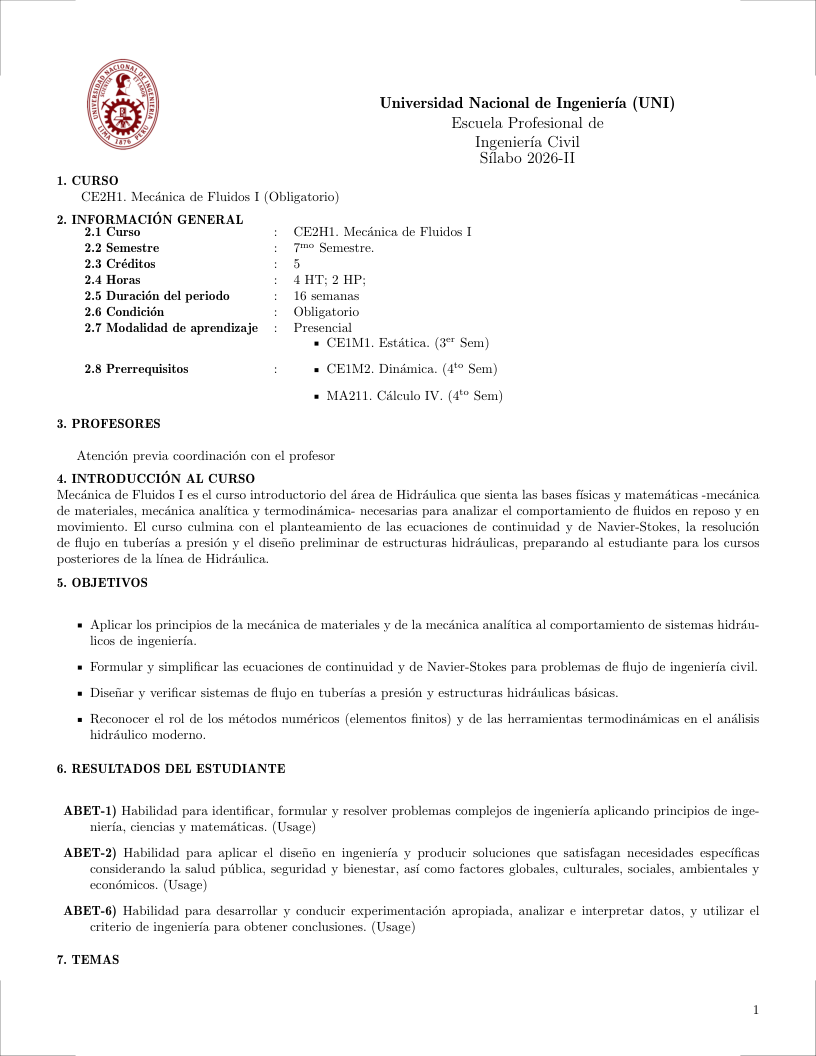
 Español (Latinoamérica)
 English
 - Prerrequisites:
7.38.1. Justification ↑ Back to top
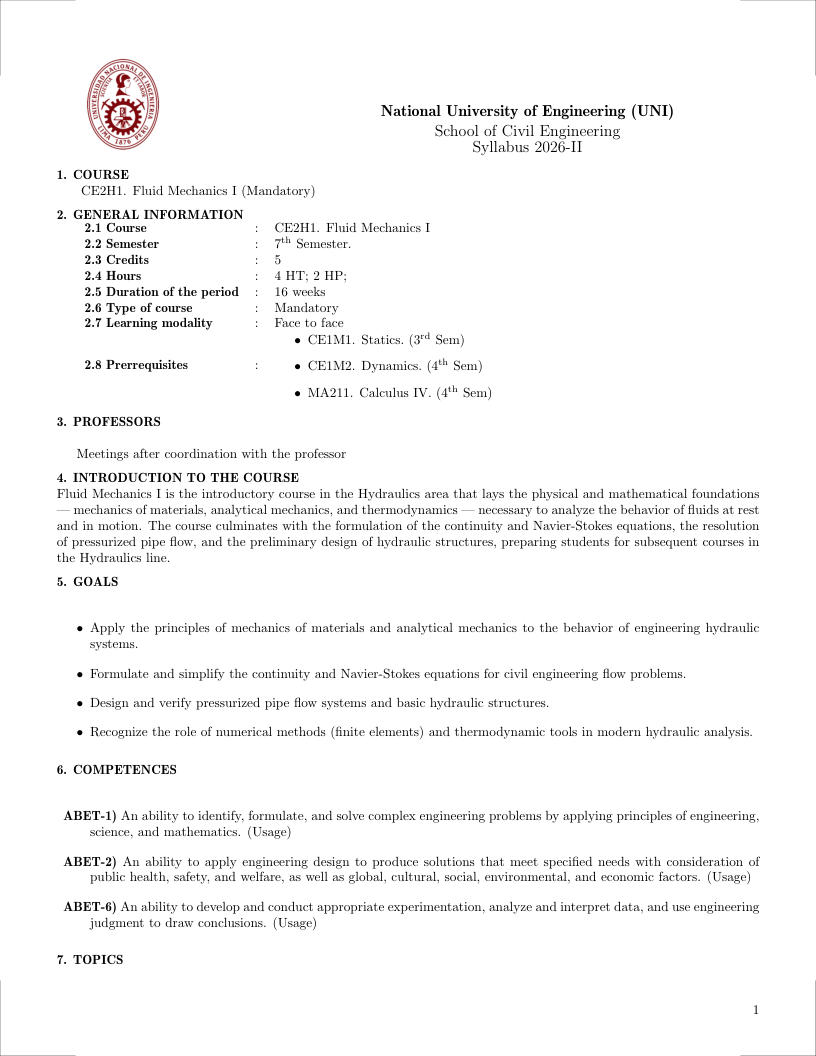
Fluid Mechanics I is the introductory course in the Hydraulics area that lays the physical and mathematical foundations — mechanics of materials, analytical mechanics, and thermodynamics — necessary to analyze the behavior of fluids at rest and in motion. The course culminates with the formulation of the continuity and Navier-Stokes equations, the resolution of pressurized pipe flow, and the preliminary design of hydraulic structures, preparing students for subsequent courses in the Hydraulics line.
7.38.2. Generales Goals ↑ Back to top
- Apply the principles of mechanics of materials and analytical mechanics to the behavior of engineering hydraulic systems.
- Formulate and simplify the continuity and Navier-Stokes equations for civil engineering flow problems.
- Design and verify pressurized pipe flow systems and basic hydraulic structures.
- Recognize the role of numerical methods (finite elements) and thermodynamic tools in modern hydraulic analysis.
7.38.3. Contribution to Outcomes ↑ Back to top
- ABET-1) An ability to identify, formulate, and solve complex engineering problems by applying principles of engineering, science, and mathematics. (Usage)
- ABET-2) An ability to apply engineering design to produce solutions that meet specified needs with consideration of public health, safety, and welfare, as well as global, cultural, social, environmental, and economic factors. (Usage)
- ABET-6) An ability to develop and conduct appropriate experimentation, analyze and interpret data, and use engineering judgment to draw conclusions. (Usage)
7.38.4. Content ↑ Back to top
7.38.4.1. Mechanics of Materials and Structural Behavior (13 hours) [Skills ABET-1,ABET-6] ↑ Back to top
Bibliography: (Hibbeler, 2017b)
Topics
- Stress and strain concepts including normal, shear, and principal stresses
- Axial loading and deformation of members
- Torsion of circular and non-circular sections
- Bending stress and deflection in beams
- Shear stress distribution in beams
- Combined loading and stress transformation
- Buckling of columns and stability analysis
- Fatigue and fracture mechanics
- Elastic and plastic behavior of materials
- Energy methods for structural analysis
Learning Outcomes
- Define stress, strain, and their relationships through constitutive laws [Familiarity]
- Calculate stresses and deformations in members under axial loading [Usage]
- Determine torsional stresses and angles of twist in shafts [Usage]
- Analyze bending stress distribution and deflection in beams [Assessment]
- Compute shear stress distribution in beam cross-sections [Usage]
- Apply stress transformation equations for combined loading conditions [Assessment]
- Evaluate column stability and calculate critical buckling loads [Assessment]
- Explain fatigue failure mechanisms and predict fatigue life [Familiarity]
- Distinguish between elastic and plastic material behavior under loading [Usage]
- Use energy methods to solve deflection and indeterminate structural problems [Usage]
7.38.4.2. Kinematics and Dynamics of Particles (6 hours) [Skills ABET-1,ABET-6] ↑ Back to top
Bibliography: (Goldstein et al., 2002)
Topics
- Vector description of position, velocity, and acceleration in Cartesian, polar, and spherical coordinates
- Newton's three laws of motion and inertial reference frames
- Formulation and solution of equations of motion for constant and variable forces
- Static and kinetic friction forces, including angle of repose
- Numerical integration of equations of motion for engineering dynamics problems
Learning Outcomes
- Formulate the equations of motion for a particle in one, two, and three dimensions given a force law [Usage]
- Identify all forces acting on a particle and draw a correct free-body diagram [Familiarity]
- Calculate the terminal velocity of an object falling through a fluid with drag resistance [Assessment]
- Implement a numerical algorithm to simulate the dynamics of an engineering mechanical system [Usage]
- Construct and interpret phase space diagrams for simple engineering oscillatory systems [Assessment]
7.38.4.3. Non-Inertial Reference Frames and Fictitious Forces (21 hours) [Skills ABET-1,ABET-6] ↑ Back to top
Bibliography: (Goldstein et al., 2002)
Topics
- Transformations between inertial and accelerating reference frames
- Centrifugal force defined as \(F_{cent} = -m\vec{\omega} \times (\vec{\omega} \times \vec{r}')\)
- Coriolis force defined as \(F_{Cor} = -2m\vec{\omega} \times \vec{v}'\)
- Euler force for non-constant rotation: \(F_{Euler} = -m\frac{d\vec{\omega}}{dt} \times \vec{r}'\)
- Effective gravity on the rotating Earth: \(g_{eff} = g - \vec{\omega} \times (\vec{\omega} \times \vec{R})\)
- Foucault pendulum as a demonstration of the Earth's rotation
- Coriolis effect on global weather patterns and ocean currents
- Larmor precession in magnetic fields viewed as a rotating frame effect
- Tidal forces as differential gravitational effects in co-rotating frames
- Connection to General Relativity's equivalence principle
Learning Outcomes
- Transform Newton's second law to a uniformly rotating reference frame [Usage]
- Calculate centrifugal and Coriolis forces for given positions and velocities in a rotating frame [Usage]
- Predict the deflection direction of projectiles due to the Earth's rotation through the Coriolis effect [Assessment]
- Explain the precession of a Foucault pendulum in terms of the Earth's rotation [Familiarity]
- Compute effective gravitational acceleration at different latitudes on Earth [Usage]
- Analyze Larmor precession using the concept of rotating reference frames [Assessment]
- Compare tidal forces to centrifugal forces in co-rotating systems [Assessment]
7.38.4.4. Lagrangian and Hamiltonian Mechanics (21 hours) [Skills ABET-1,ABET-6] ↑ Back to top
Bibliography: (Goldstein et al., 2002)
Topics
- Principle of least action and Hamilton's principle of stationary action
- Lagrangian definition: \(L = T - V\) for conservative systems
- Euler-Lagrange equations of motion: \(\frac{d}{dt}\left(\frac{\partial L}{\partial \dot{q}_i}\right) = \frac{\partial L}{\partial q_i}\)
- Generalized coordinates and the treatment of holonomic constraints
- Cyclic coordinates and the associated conservation laws
- Legendre transform from the Lagrangian to the Hamiltonian: \(H = \sum p_i\dot{q}_i - L\)
- Hamilton's equations: \(\dot{q}_i = \frac{\partial H}{\partial p_i}\) and \(\dot{p}_i = -\frac{\partial H}{\partial q_i}\)
- Poisson brackets: \(\{f,g\} = \sum\left(\frac{\partial f}{\partial q_i}\frac{\partial g}{\partial p_i} - \frac{\partial f}{\partial p_i}\frac{\partial g}{\partial q_i}\right)\)
- Canonical transformations and their generating functions
- Action-angle variables for periodic Hamiltonian systems
Learning Outcomes
- Construct the Lagrangian for simple mechanical systems in appropriate generalized coordinates [Usage]
- Derive equations of motion from the Euler-Lagrange equations [Usage]
- Identify cyclic coordinates and their associated conserved quantities in a given Lagrangian [Assessment]
- Formulate the Hamiltonian from a given Lagrangian system [Usage]
- Solve Hamilton's equations for simple systems such as the harmonic oscillator [Usage]
- Compute Poisson brackets for pairs of dynamical variables [Usage]
- Apply canonical transformations to simplify the description of Hamiltonian systems [Usage]
7.38.4.5. Continuum Mechanics Foundations (8 hours) [Skills ABET-1,ABET-6] ↑ Back to top
Bibliography: (Mase et al., 2010)
Topics
- Continuum hypothesis and the definition of density fields
- Stress tensor \(\sigma_{ij}\) and the concept of force per unit area
- Strain tensor \(\epsilon_{ij}\) as a measure of local deformation
- Hooke's law for isotropic materials: \(\sigma_{ij} = \lambda\epsilon_{kk}\delta_{ij} + 2\mu\epsilon_{ij}\)
- Navier-Stokes equation for viscous fluids: \(\rho\left(\frac{\partial \vec{v}}{\partial t} + \vec{v}\cdot\nabla\vec{v}\right) = -\nabla p + \mu\nabla^2\vec{v} + \vec{f}\)
- Bernoulli's principle for inviscid and incompressible fluid flow
- Conservation of mass and the continuity equation: \(\frac{\partial\rho}{\partial t} + \nabla\cdot(\rho\vec{v}) = 0\)
- Conservation of momentum expressed in continuum mechanics form
- Wave propagation in elastic media including P-waves and S-waves
- Viscosity and the rheology of non-Newtonian fluids
Learning Outcomes
- Interpret the physical meaning of the components of the stress tensor [Familiarity]
- Calculate strain tensor components for simple deformations [Usage]
- Apply Hooke's law to relate stress and strain for isotropic elastic materials [Usage]
- Simplify the Navier-Stokes equation for special cases such as steady or inviscid flow [Usage]
- Apply Bernoulli's principle to calculate pressure variations in fluid flow [Usage]
- Derive the continuity equation from the principle of mass conservation [Usage]
- Analyze different wave propagation modes in elastic solids [Assessment]
7.38.4.6. Laws of Thermodynamics and State Functions (4 hours) [Skills ABET-1,ABET-6] ↑ Back to top
Bibliography: (Cengel and Boles, 2019)
Topics
- Zeroth Law of Thermodynamics and temperature equilibrium
- First Law of Thermodynamics: \(dU = dQ - dW\) for engineering systems
- Enthalpy \(H = U + PV\) and its role in flow processes and chemical reactions
- Heat capacities \(C_V\) and \(C_P\) and their engineering measurement and application
- Adiabatic processes and isentropic flow conditions in turbomachinery
Learning Outcomes
- Calculate work done by a gas during isothermal and adiabatic expansions in engineering cycles [Usage]
- Evaluate internal energy changes and apply the First Law to engineering thermodynamic processes [Assessment]
- Apply Mayer's relation to determine heat capacity ratios for engineering working fluids [Usage]
- Analyze isentropic flow conditions in engineering nozzles and turbines [Assessment]
7.38.4.7. Kinetic Theory of Gases (4 hours) [Skills ABET-1,ABET-6] ↑ Back to top
Bibliography: (Cengel and Boles, 2019)
Topics
- Derivation of macroscopic pressure from molecular momentum transfer
- Maxwell-Boltzmann speed distribution and its engineering implications
- Equipartition theorem and degrees of freedom for monatomic and polyatomic gases
- Mean free path and its relevance to gas flow and vacuum engineering
- Transport phenomena: viscosity, thermal conductivity, and diffusion in engineering gases
Learning Outcomes
- Compute the rms and average molecular velocities for engineering working gases [Usage]
- Interpret the Maxwell-Boltzmann distribution and its temperature dependence for engineering applications [Assessment]
- Calculate mean free path and relate it to viscosity in gas-dynamics engineering problems [Usage]
- Estimate thermal conductivity and viscosity of a gas from kinetic theory for engineering design [Assessment]
7.38.4.8. First-Order Ordinary Differential Equations (ODEs) (4 hours) [Skills ABET-1,ABET-6] ↑ Back to top
Bibliography: (Boyce et al., 2017)
Topics
- First-order equations: separable, linear, and exact forms
Learning Outcomes
- Solve linear first-order ODEs using integrating factors [Usage]
7.38.4.9. Mathematical Fluid Dynamics (6 hours) [Skills ABET-1,ABET-6] ↑ Back to top
Bibliography: (Chorin and Marsden, 1993)
Topics
- Continuum hypothesis, material derivative, and the Reynolds transport theorem
- Euler equations for inviscid flow: conservation form, vorticity, and potential flow
- Navier-Stokes equations: derivation, exact solutions, and dimensional analysis
- Boundary layer theory: Prandtl equations and the Blasius solution
- Turbulence: Reynolds averaging, the \(k\)-\(\varepsilon\) model, and direct numerical simulation
Learning Outcomes
- Derive the Navier-Stokes equations from conservation principles and identify each term's physical meaning [Familiarity]
- Analyze inviscid flows using the Euler equations and apply Bernoulli's principle [Usage]
- Apply boundary layer theory to estimate drag on a flat plate and compare with the Blasius solution [Assessment]
7.38.4.10. Pressurized Pipe Flow and Pump Systems (8 hours) [Skills ABET-1,ABET-6] ↑ Back to top
Bibliography: (White, 2016)
Topics
- Pipe flow fundamentals and Darcy-Weisbach equation
- Minor losses and pipe system analysis
- Pipe network analysis methods
- Pump characteristics and system curves
- Pump selection and installation requirements
- Water hammer and surge analysis
- Pipeline design and material selection
- Variable speed pumps and energy efficiency
- Network modeling and optimization
- Valve selection and hydraulic control systems
Learning Outcomes
- Calculate head losses in pipe systems using friction equations [Assessment]
- Determine total head loss including minor losses in complex piping [Usage]
- Analyze pipe networks using Hardy Cross or equivalent methods [Assessment]
- Construct pump characteristic curves and system head curves [Usage]
- Select appropriate pumps based on operating point and efficiency [Assessment]
- Evaluate water hammer effects and design surge protection [Usage]
- Design pipelines considering hydraulic, structural, and economic factors [Assessment]
- Apply variable speed drives for pump system optimization [Usage]
- Optimize water distribution networks using modeling software [Assessment]
- Specify valves and control systems for pipeline operations [Usage]
7.38.4.11. Design of Hydraulic Structures (6 hours) [Skills ABET-1,ABET-6] ↑ Back to top
Bibliography: (White, 2016)
Topics
- Dam types and selection criteria
- Spillway hydraulics and design
- Weir and gate flow equations
- Energy dissipation and stilling basin design
- Culvert hydraulics and design
- Dam safety analysis and risk assessment
- Outlet works and control structures
- Fish passage facilities and environmental hydraulics
- Cavitation analysis and prevention
- Physical hydraulic modeling and scale effects
Learning Outcomes
- Classify dam types and select appropriate configurations for site conditions [Familiarity]
- Design spillways for flood discharge capacity [Assessment]
- Calculate discharge over weirs and through gates [Usage]
- Proportion energy dissipation structures and stilling basins [Assessment]
- Analyze culvert hydraulics for inlet and outlet control [Usage]
- Perform dam safety evaluations and hazard classification [Assessment]
- Design outlet works including intake structures and conduits [Usage]
- Incorporate fish passage requirements in hydraulic structure design [Assessment]
- Evaluate cavitation potential and design preventive measures [Usage]
- Interpret physical model results and apply scale corrections [Assessment]
7.38.4.12. Numerical Methods for ODEs and PDEs (8 hours) [Skills ABET-1,ABET-6] ↑ Back to top
Bibliography: (Chapra and Canale, 2015b)
Topics
- Runge-Kutta methods and adaptive time-stepping for engineering ODE problems
- Stability analysis and stiffness in engineering ODE integrators
- Finite difference discretization of engineering PDEs (heat equation, Laplace equation)
- Finite element and shooting methods for engineering boundary value problems
Learning Outcomes
- Implement a fourth-order Runge-Kutta integrator for a mechanical vibration problem [Usage]
- Determine the region of absolute stability for an explicit time-stepping scheme [Assessment]
- Discretize the 2D heat equation using finite differences and set up the resulting linear system [Usage]
- Compare finite difference and finite element approaches for solving an engineering PDE [Assessment]
7.38.4.13. Finite Element Method (6 hours) [Skills ABET-1,ABET-6] ↑ Back to top
Bibliography: (Reddy, 2019b)
Topics
- Weak (variational) formulation of boundary value problems and Sobolev spaces
- Galerkin method: finite-dimensional approximation spaces and the stiffness matrix
- Triangular and quadrilateral finite element spaces: Lagrange elements and conformity
- A priori error estimates: Céa's lemma and interpolation error bounds
- A posteriori error estimates and adaptive mesh refinement
Learning Outcomes
- Derive the weak formulation of an elliptic BVP and show its equivalence to the strong form [Familiarity]
- Assemble the global stiffness matrix and load vector for a linear finite element discretization [Usage]
- Estimate the \(H^1\) error of a finite element solution using Céa's lemma and interpolation theory [Assessment]
7.38.5. Bibliography ↑ Back to top
Hibbeler, R. (2017b). Mechanics of Materials. Pearson, 10th edition.
Goldstein, H., Poole, C., and Safko, J. (2002). Classical Mechanics. Addison Wesley, 3rd edition.
Mase, G. T., Smelser, R. E., and Mase, G. E. (2010). Continuum Mechanics for Engineers. CRC Press, 3rd edition.
Cengel, Y. A. and Boles, M. A. (2019). Thermodynamics: An Engineering Approach. McGraw-Hill, 9th edition.
Boyce, W. E., DiPrima, R. C., and Meade, D. B. (2017). Ecuaciones Diferenciales y Problemas con Valores en la Frontera. Limusa Wiley, 11th edition.
Chorin, A. J. and Marsden, J. E. (1993). A Mathematical Introduction to Fluid Mechanics. Springer, 3rd edition.
White, F. M. (2016). Fluid Mechanics. McGraw-Hill, 8th edition.
Chapra, S. C. and Canale, R. P. (2015b). Numerical Methods for Engineers. McGraw-Hill, 7th edition.
Reddy, J. N. (2019b). An Introduction to the Finite Element Method. McGraw-Hill, 4th edition.