- ES Español (Latinoamérica)

- EN English

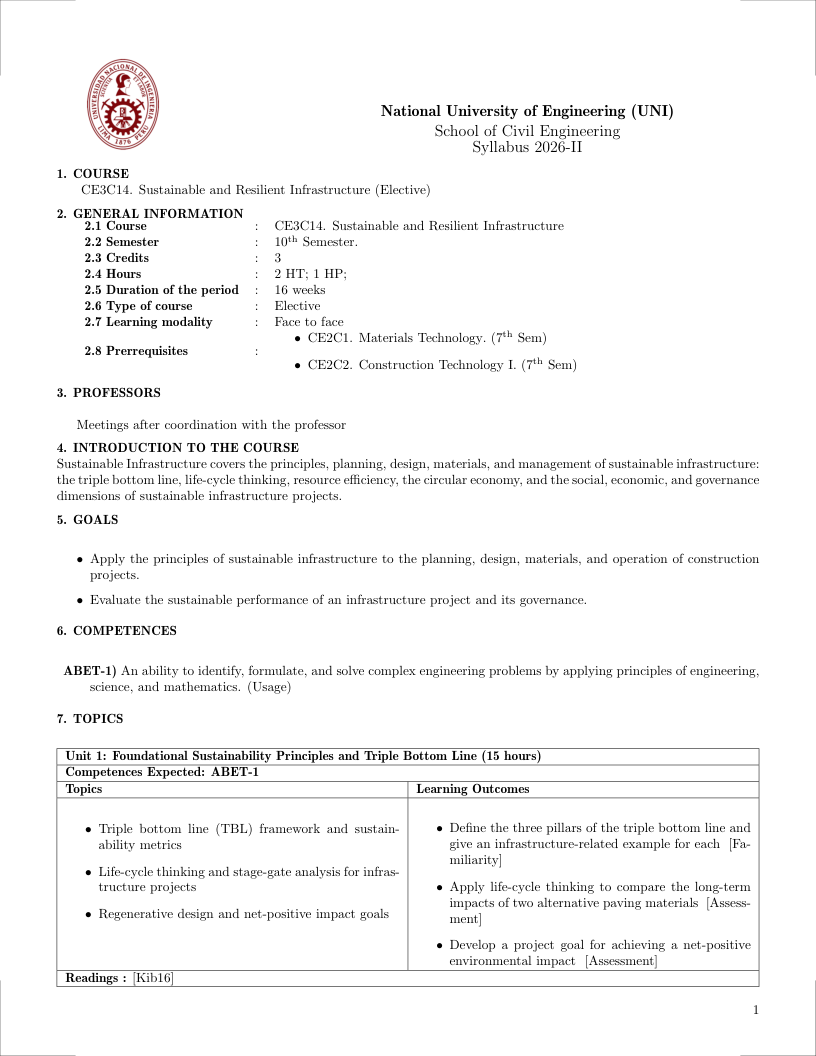
7.81. Sustainable and Resilient Infrastructure (Elective)
- Semester: 10th Sem. Credits: 3
- Hour of this course: Theory: 2 hours; Laboratory: 1 hours;
- Syllabus:
- htmlonly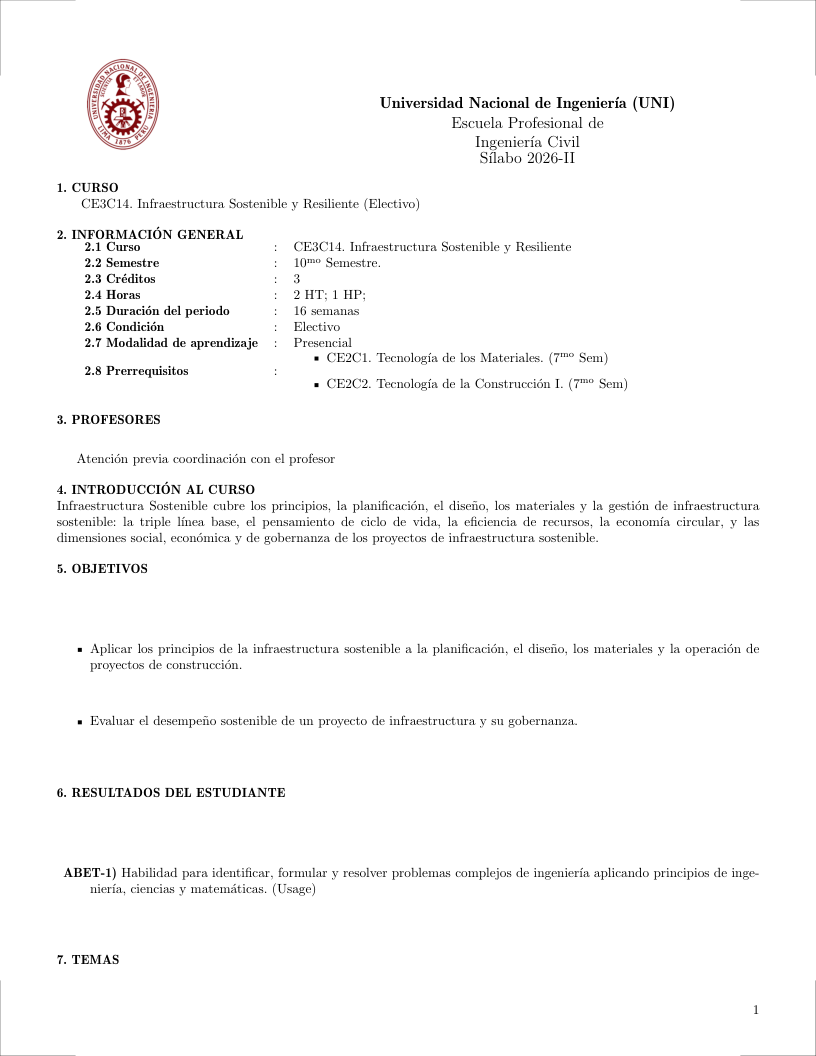
 Español (Latinoamérica)
 English
 - Prerrequisites:
- CE2C1 Materials Technology (7th Sem)
- CE2C2 Construction Technology I (7th Sem)
7.81.1. Justification ↑ Back to top
Sustainable Infrastructure covers the principles, planning, design, materials, and management of sustainable infrastructure: the triple bottom line, life-cycle thinking, resource efficiency, the circular economy, and the social, economic, and governance dimensions of sustainable infrastructure projects.
7.81.2. Generales Goals ↑ Back to top
- Apply the principles of sustainable infrastructure to the planning, design, materials, and operation of construction projects.
- Evaluate the sustainable performance of an infrastructure project and its governance.
7.81.3. Contribution to Outcomes ↑ Back to top
- ABET-1) An ability to identify, formulate, and solve complex engineering problems by applying principles of engineering, science, and mathematics. (Usage)
7.81.4. Content ↑ Back to top
7.81.4.1. Foundational Sustainability Principles and Triple Bottom Line (15 hours) [Skills ABET-1] ↑ Back to top
Bibliography: (Kibert, 2016)
Topics
- Triple bottom line (TBL) framework and sustainability metrics
- Life-cycle thinking and stage-gate analysis for infrastructure projects
- Regenerative design and net-positive impact goals
Learning Outcomes
- Define the three pillars of the triple bottom line and give an infrastructure-related example for each [Familiarity]
- Apply life-cycle thinking to compare the long-term impacts of two alternative paving materials [Assessment]
- Develop a project goal for achieving a net-positive environmental impact [Assessment]
7.81.4.2. Resource Efficiency and Circular Economy (15 hours) [Skills ABET-1] ↑ Back to top
Bibliography: (Kibert, 2016)
Topics
- Resource efficiency: energy, water, and material consumption minimization
- Circular economy principles: reduce, reuse, recycle, recover (R4)
- Sustainable procurement and supply chain management
Learning Outcomes
- Calculate the embodied energy or water footprint of a simple structural component [Usage]
- Explain how circular economy principles can be applied to construction and demolition waste [Familiarity]
7.81.4.3. Social, Economic, and Governance Dimensions of Sustainable Infrastructure (16 hours) [Skills ABET-1] ↑ Back to top
Bibliography: (Kibert, 2016)
Topics
- Social sustainability: equity, accessibility, and community well-being
- Economic sustainability: life-cycle costing and total cost of ownership
- Policy frameworks and green rating systems (e.g., Envision, LEED for Infrastructure)
Learning Outcomes
- Evaluate the social equity implications of a proposed transportation project [Assessment]
- Perform a life-cycle cost analysis to justify a higher initial investment in a durable material [Usage]
- Use a green infrastructure rating system checklist to assess a project's sustainability performance [Familiarity]
7.81.5. Bibliography ↑ Back to top
Kibert, C. J. (2016). Sustainable Construction: Green Building Design and Delivery. Wiley, 5th edition.