- ES Español (Latinoamérica)

- EN English

7.40. Reinforced Concrete Design I (Mandatory)
- Semester: 7th Sem. Credits: 5
- Hour of this course: Theory: 4 hours; Practice: 2 hours;
- Syllabus:
- htmlonly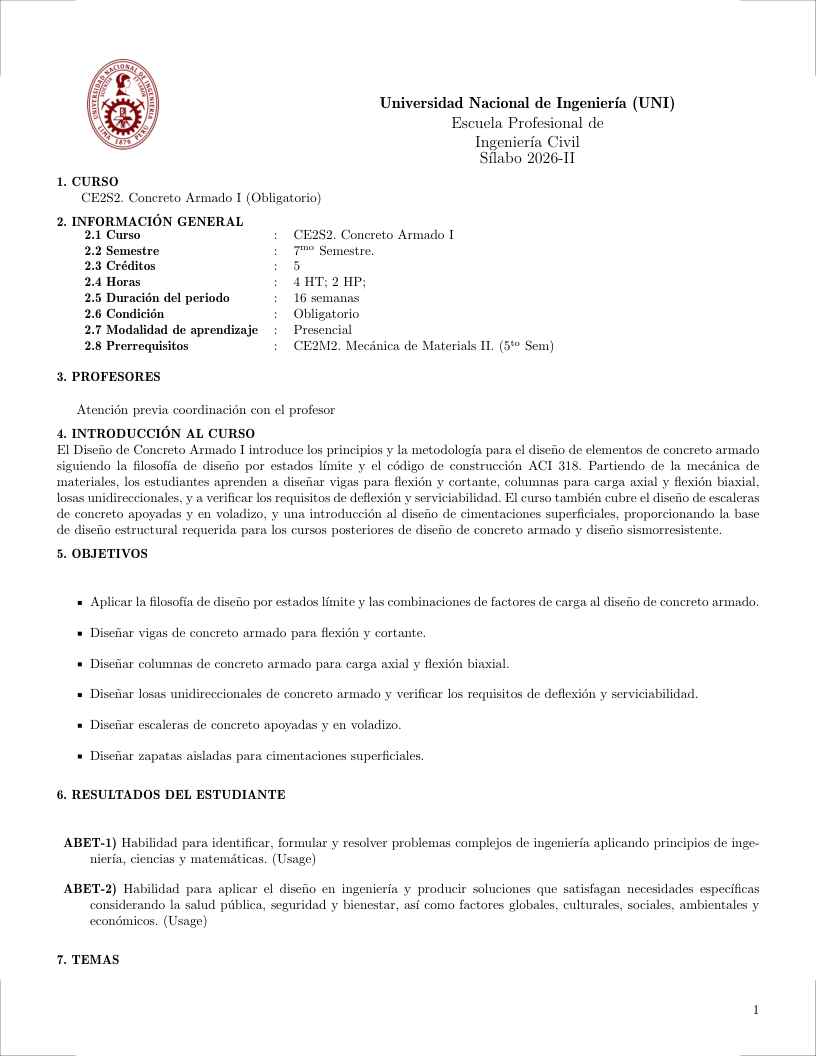
 Español (Latinoamérica)
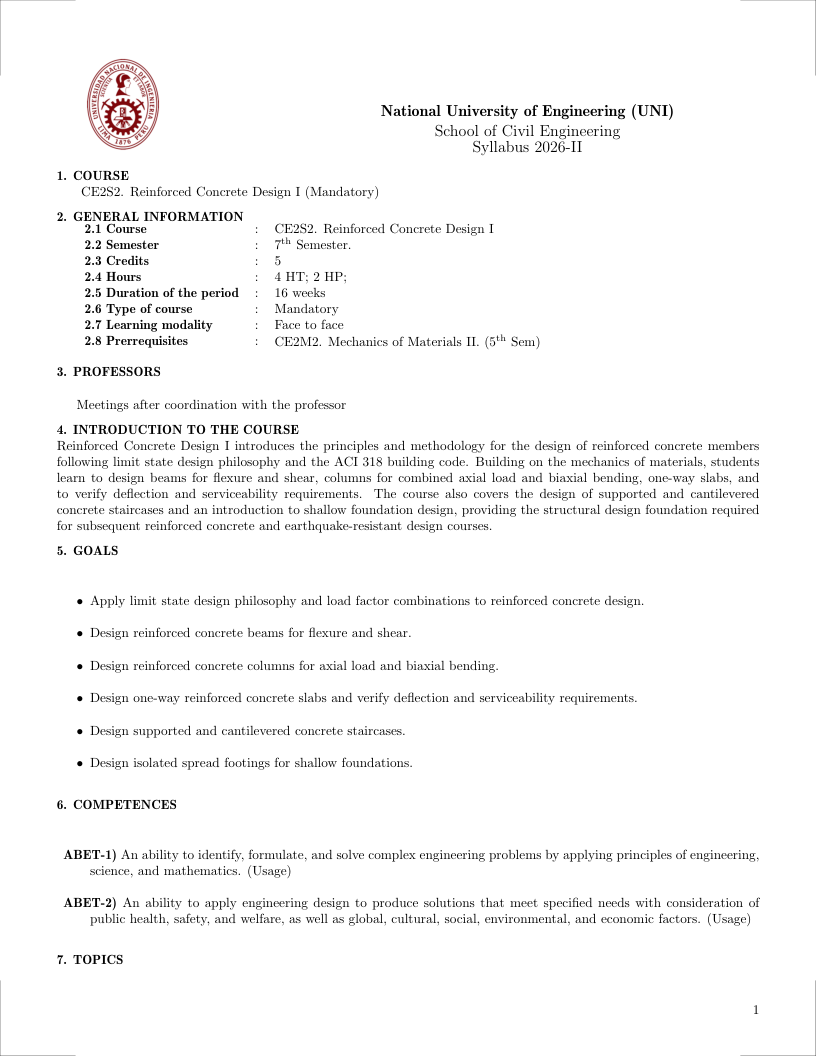 English
 - Prerrequisites:
- CE2M2 Mechanics of Materials II (5th Sem)
7.40.1. Justification ↑ Back to top
Reinforced Concrete Design I introduces the principles and methodology for the design of reinforced concrete members following limit state design philosophy and the ACI 318 building code. Building on the mechanics of materials, students learn to design beams for flexure and shear, columns for combined axial load and biaxial bending, one-way slabs, and to verify deflection and serviceability requirements. The course also covers the design of supported and cantilevered concrete staircases and an introduction to shallow foundation design, providing the structural design foundation required for subsequent reinforced concrete and earthquake-resistant design courses.
7.40.2. Generales Goals ↑ Back to top
- Apply limit state design philosophy and load factor combinations to reinforced concrete design.
- Design reinforced concrete beams for flexure and shear.
- Design reinforced concrete columns for axial load and biaxial bending.
- Design one-way reinforced concrete slabs and verify deflection and serviceability requirements.
- Design supported and cantilevered concrete staircases.
- Design isolated spread footings for shallow foundations.
7.40.3. Contribution to Outcomes ↑ Back to top
- ABET-1) An ability to identify, formulate, and solve complex engineering problems by applying principles of engineering, science, and mathematics. (Usage)
- ABET-2) An ability to apply engineering design to produce solutions that meet specified needs with consideration of public health, safety, and welfare, as well as global, cultural, social, environmental, and economic factors. (Usage)
7.40.4. Content ↑ Back to top
7.40.4.1. Reinforced Concrete Design (68 hours) [Skills ABET-1,ABET-2] ↑ Back to top
Bibliography: (Wight and MacGregor, 2016; ACI Committee 318, 2019; McCormac and Brown, 2021)
Topics
- Design philosophy and limit state methodology for concrete structures
- Flexural design of rectangular and T-beams
- Shear and torsion design of concrete members
- Compression members and column design
- Slab design including one-way and two-way systems
- Development length and splicing of reinforcement
- Deflection control and serviceability requirements for concrete beams and slabs
Learning Outcomes
- Explain limit state design philosophy and load factor combinations [Familiarity]
- Design reinforced concrete beams for flexure and check serviceability [Assessment]
- Calculate shear and torsional reinforcement requirements [Usage]
- Proportion columns for axial load and biaxial bending [Assessment]
- Design one-way and two-way slab systems with appropriate reinforcement [Usage]
- Determine development lengths and design lap splices for reinforcing bars [Assessment]
- Control deflections and verify serviceability requirements through adequate member sizing and reinforcement [Usage]
7.40.4.2. Design of Reinforced Concrete Stairs (6 hours) [Skills ABET-2] ↑ Back to top
Bibliography: (McCormac and Brown, 2021)
Topics
- Geometry of stair flights, landings, and waist slabs
- Load distribution and effective span for simply supported staircases
- Load distribution and effective span for cantilevered staircases
- Reinforcement detailing for stair flights, landings, and supports
Learning Outcomes
- Design a supported reinforced concrete staircase for gravity loads [Assessment]
- Design a cantilevered reinforced concrete staircase for gravity loads [Assessment]
- Detail reinforcement for stair flights, landings, and supports [Usage]
7.40.4.3. Bearing Capacity and Design (10 hours) [Skills ABET-2] ↑ Back to top
Bibliography: (Coduto, 2001)
Topics
- Bearing capacity theory and failure mechanisms
- Ultimate bearing capacity equations for various conditions
- Settlement analysis using elastic and consolidation methods
- Isolated spread footing design
- Combined footings and strap footings
- Allowable bearing pressure and factor of safety selection
- Mat foundation analysis and design
- Eccentric and inclined loading effects
- Soil-structure interaction effects
- Differential settlement and tolerable limits
- Continuous (strip) footing design for basement and foundation walls
Learning Outcomes
- Explain bearing capacity failure mechanisms in shallow foundations [Familiarity]
- Calculate ultimate bearing capacity using Terzaghi and Meyerhof equations [Assessment]
- Predict total and differential settlements for shallow foundations [Usage]
- Design isolated spread footings for gravity loads [Assessment]
- Proportion combined and strap footings for column arrangements [Usage]
- Determine allowable bearing pressures based on strength and settlement criteria [Assessment]
- Analyze mat foundations using conventional and finite element methods [Assessment]
- Evaluate bearing capacity under eccentric and inclined loading [Usage]
- Consider soil-structure interaction in foundation design [Familiarity]
- Assess differential settlement and apply tolerable settlement criteria [Assessment]
- Design continuous strip footings for basement and foundation walls [Usage]
7.40.5. Bibliography ↑ Back to top
Wight, J. K. and MacGregor, J. G. (2016). Reinforced Concrete: Mechanics and Design. Pearson, 7th edition.
ACI Committee 318 (2019). Building code requirements for structural concrete (aci 318-19) and commentary. Technical report, American Concrete Institute.
McCormac, J. C. and Brown, R. H. (2021). Design of Reinforced Concrete. Wiley, 10th edition.
Coduto, D. P. (2001). Foundation Design: Principles and Practices. Prentice Hall, 2nd edition.